
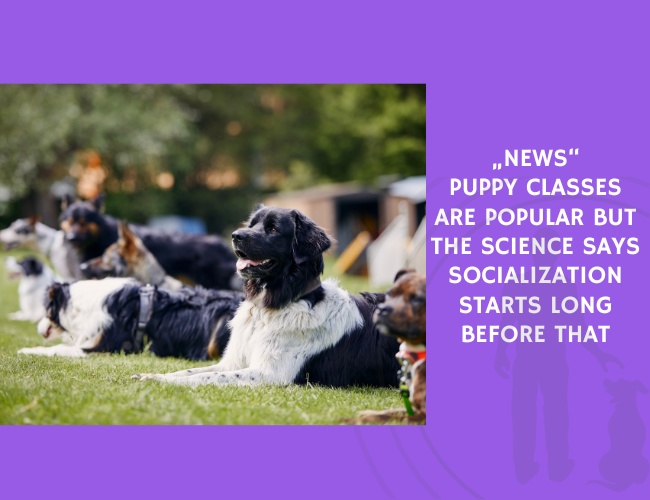
Howell, King & Bennett (2015) — Veterinary Medicine: Research and Reports
Puppy Parties and Beyond: The Role of Early Age Socialization Practices on Adult Dog Behavior
Published: July 11, 2026
Puppy classes have become a default recommendation for new dog owners almost everywhere. But a review of the actual research on early socialization reveals something most owners do not expect: the science behind puppy classes specifically is far less clear than the science behind socialization itself. The two are not the same thing, and conflating them may be leading owners to focus on the wrong window of time. 🐾
Researchers T. Howell, Tammie King, and P. Bennett reviewed the available evidence on age-appropriate socialization practices and their effect on adult dog behaviour. Their conclusions reposition socialization not as a single class or event but as an extended developmental process that begins almost immediately after birth and continues, in some meaningful form, throughout a dog’s entire life.
What Genuinely Effective Socialization Looks Like
The review establishes that age-appropriate socialization should begin within a few days of birth — well before most owners have even acquired their puppy. This places significant responsibility on breeders, who control the puppy’s environment during the earliest and arguably most developmentally critical weeks of life. Exposure during this period should be controlled and pleasant, introducing the puppy to a range of experiences, people, sounds, surfaces, and objects they are likely to encounter throughout their life, delivered in a way that builds positive association rather than overwhelming the developing nervous system.
The behavioural outcomes associated with appropriate early socialization are substantial and well documented. Dogs who receive it are less likely to develop aggression and fearfulness as adults. They are more likely to engage positively in social interaction with humans. They demonstrate a greater capacity to learn interactive play with humans compared to dogs whose early socialization was inadequate. These are not marginal effects — they represent some of the most consistently replicated findings in canine behavioural science.
Critically, the review is explicit that this process does not end at the conventional twelve to sixteen week socialization window that most puppy advice focuses on. Socialization should extend well into adulthood. The foundational period matters enormously, but ongoing exposure and positive experience throughout a dog’s life continues to shape and reinforce behavioural stability.
Why the Evidence on Puppy Classes Specifically Is Mixed ⚠️
This is where the review delivers its most counterintuitive finding. Puppy socialization classes — the structured group sessions widely recommended to new owners — show genuinely mixed evidence in the research literature. Some studies find a positive impact on adult behaviour. Others find no clear benefit at all.
This does not mean puppy classes are without value. It means the evidence does not currently support treating them as the primary or sufficient mechanism for socialization. A puppy who attends a six-week class but receives minimal varied exposure outside of it is not necessarily better prepared for adult life than a puppy whose owner provides consistent, varied, well-managed exposure across the full critical period without ever attending a formal class. The class is one tool among several. It is not, on current evidence, the determining factor.
The review also flags an important open question that the field has not yet resolved: what is the actual minimum amount of socialization a puppy needs, and is there a maximum beyond which additional exposure stops helping or potentially becomes counterproductive? This remains unanswered. Owners are often given an implicit message that more exposure is always better, without clear evidence establishing where that relationship plateaus or reverses.
Who Actually Carries This Responsibility 🐕
The review distributes responsibility for socialization across three parties working in sequence. Breeders are responsible for the earliest window, ensuring puppies in the litter are exposed to age-appropriate experiences before they ever leave for their new home. Owners are responsible for continuing varied, positive exposure throughout the dog’s life — not stopping once the puppy phase ends. And veterinarians play a structurally important role as the professional most owners actually see during the critical socialization window, given how frequently puppies attend vaccination appointments during exactly this period.
This creates a practical opportunity that is currently underused. Vaccination visits are a built-in touchpoint where veterinarians could systematically educate owners on socialization timing and method — yet this opportunity depends entirely on whether individual veterinary practices prioritise it.
At Zoeta Dogsoul, this research reinforces a principle central to NeuroBond: the relationship between dog and owner is not built in a single class or a single critical window. It is built through sustained, attentive, ongoing exposure to the world, delivered in a way that consistently signals safety. A puppy whose owner remains actively engaged in thoughtful, varied socialization well past the conventional puppy class period is a puppy whose nervous system continues receiving the kind of input that builds genuine behavioural stability into adulthood. 🐾
Source: Howell, T., King, T., & Bennett, P. (2015). Puppy parties and beyond: the role of early age socialization practices on adult dog behavior. Veterinary Medicine: Research and Reports. Published April 29, 2015.










