
Gnanadesikan, Bray et al. (2024) — Hormones and Behavior
Basal Plasma Oxytocin & Fecal Cortisol Concentrations Are Highly Heritable and Associated with Individual Differences in Behavior & Cognition in Dog Puppies
Published: June 29, 2026
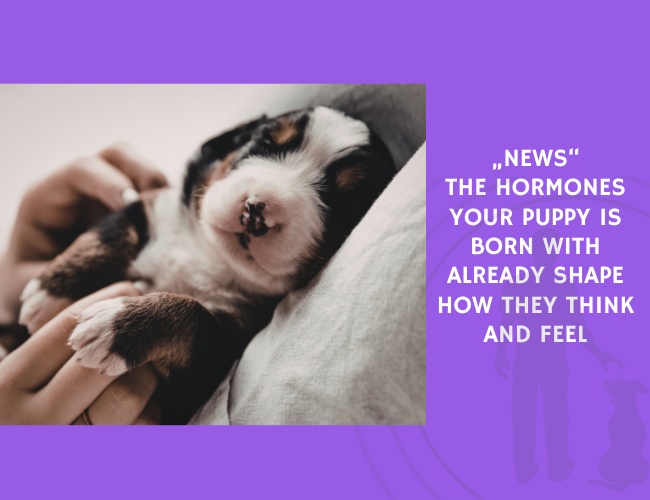
Before your puppy has learned a single command — before their first training session, their first socialisation class, their first experience of the world outside the litter — something is already shaping who they are. Two hormones. Largely inherited. Already at work. 🐾
The Study: Hormones, Genetics, and 247 Puppies
Researchers Gitanjali Gnanadesikan, Emily Bray, Evan MacLean, and their team measured basal oxytocin and cortisol levels in nearly 250 dog puppies from a pedigreed population — Canine Companions, a well-established assistance dog programme. These weren’t stress-response measurements. They were resting baseline levels, taken before any task or challenge.
Each puppy was then assessed across a broad range of cognitive and behavioural measures: social cognition, working memory, inhibitory control, perceptual discrimination, and temperament. The goal was to understand whether hormone levels at baseline predicted meaningful differences in how puppies think, feel, and behave.
The answer was clear — and the genetic findings behind it were striking.
Oxytocin: Almost Entirely Inherited 🔬
Oxytocin — often called the bonding hormone — showed heritability estimates between 0.90 and 0.99. That is an extraordinarily high figure. It means that the vast majority of variation in a puppy’s resting oxytocin level is determined by genetics, not environment.
Higher oxytocin concentrations were positively associated with better spatial working memory. The relationship with behavioural laterality — which side of the body a dog preferentially uses, a known marker of neurological organisation — followed a more complex curve, with moderate levels showing the strongest association.
Interestingly, oxytocin levels were not directly linked to social measures in this study. That challenges some popular assumptions about oxytocin being purely a “social bonding” signal and points toward a more nuanced role in broader cognitive architecture.
Cortisol: Inherited — and Linked to Impulse Control ⚠️
Cortisol — the primary stress hormone and an end-product of the HPA axis — showed moderate to high heritability, estimated at 0.43 to 0.47. Still substantially genetic. Still substantially set before training begins.
Higher baseline cortisol was negatively associated with inhibitory control performance. In plain terms: puppies with higher resting cortisol found it harder to pause, wait, and regulate impulse. They also showed a more complex relationship with bold reactions to novel objects — with very low and very high cortisol levels both associated with stronger reactions, and moderate levels producing the most measured responses.
This is not a verdict on any individual puppy. It is a biological context — one that shapes the starting conditions for everything that follows.
What This Means for How You Read Your Dog 🐕
A puppy who struggles with impulse control isn’t necessarily undertrained. A puppy who doesn’t naturally orient toward human social cues isn’t necessarily disconnected. They may simply be operating from a hormonal and genetic baseline that requires a different approach — more structure, more patience, more precision.
This is exactly where NeuroBond begins. Real attunement means reading the dog in front of you — not the dog you expected based on breed reputation or litter behaviour. A puppy with high baseline cortisol is already carrying a physiological load. The question isn’t how to override that. It’s how to build trust and structure that works with it.
And Soul Recall — the dog’s orientation back to you in moments of uncertainty — doesn’t emerge from repetition alone. It emerges from a nervous system that feels safe enough to return. Understanding your puppy’s hormonal baseline is part of creating that safety. You can’t build reliable connection on top of unaddressed physiological stress. 🐾
The Bigger Picture
Taken together with the growing body of canine genetics research, these findings point in one consistent direction: your dog arrives with a biological architecture already in place. Heritable hormones. Heritable cognitive tendencies. A nervous system shaped long before you met them.
That architecture is not a ceiling. But it is a starting point — and ignoring it doesn’t make it go away. The Invisible Leash between you and your dog is built most durably when it’s built on accurate understanding of who they are at the level of biology, not just behaviour.
Source: Gnanadesikan, G. E., Bray, E. E., MacLean, E. L., et al. (2024). Basal plasma oxytocin & fecal cortisol concentrations are highly heritable and associated with individual differences in behavior & cognition in dog puppies. Hormones and Behavior. Published August 7, 2024. https://www.semanticscholar.org/paper/e0a881c5f365bea0786906b655f79ff1f750c5fa










