
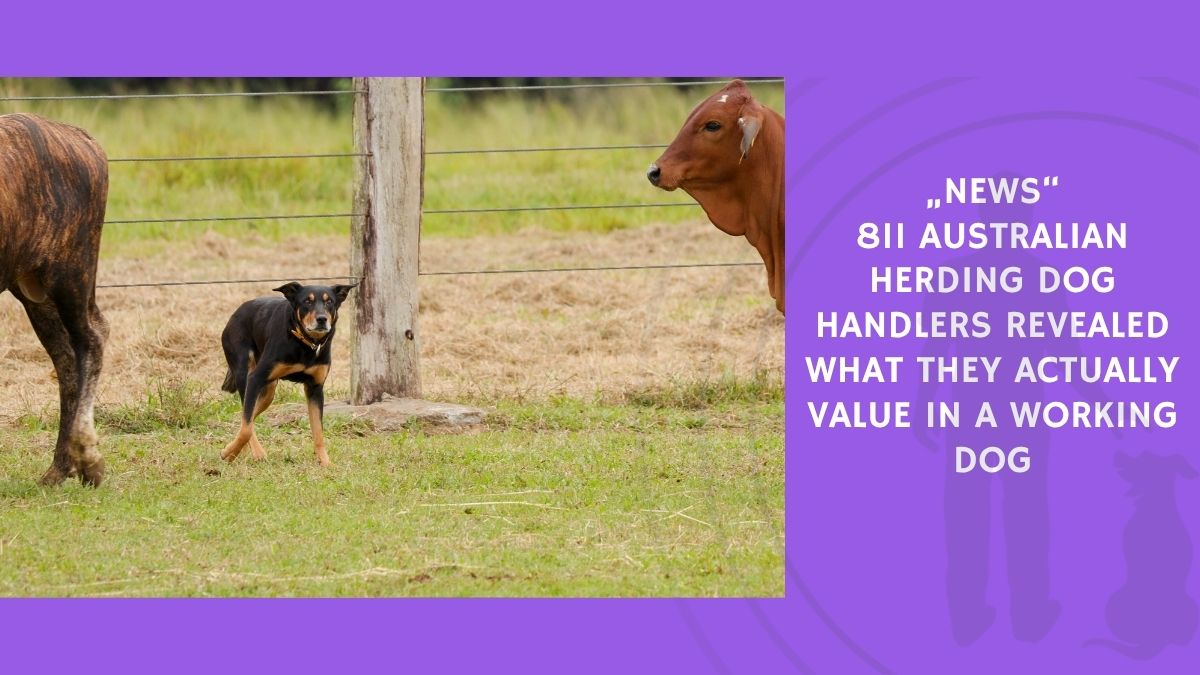
Early, Arnott et al. (2019) — Animals (MDPI)
The Perceived Value of Behavioural Traits in Australian Livestock Herding Dogs Varies with the Operational Context
Published: August 23, 2026
What does a livestock handler actually want from their working dog? That question sounds simple. The answer, it turns out, is highly context-dependent — and a survey of 811 Australian handlers and breeders has produced the most comprehensive dataset yet on how the value of specific behavioural traits shifts dramatically depending on where and how the dog is working. The findings have direct implications for how working dogs should be selected, bred, and matched to their handlers. 🐾
Researchers Jonathan Early, Elizabeth Arnott, B. Wilson, C. Wade, and P. McGreevy surveyed handlers and breeders through the Australian Farm Dog Survey, asking them to rate 16 working manoeuvres, 11 working attributes, and 5 general attributes across four distinct operational contexts: utility work (herding in both paddocks and yards), mustering (paddocks and livestock routes), yards work (sheds, sale-yards, and transport vehicles), and trial competition. The four-context design is what gives this study its distinctive value — it captures not just what traits handlers value in general but how those valuations shift across different working demands.
What Handlers Consistently Valued and What They Did Not
Several traits were valued highly across all four contexts. Among working manoeuvres, cast — the wide outrunning movement that positions the dog behind livestock — force, and gather were most valued across all working situations. Among working attributes, control and trainability were consistently rated at the top. Among general attributes, the combination of trainable, motivated, confident, and friendly emerged as the most universally desired profile regardless of operational context.
Traits consistently rated as less valuable included bite, bark, and backing — the physical livestock contact and pressure behaviours that have specific utility in certain contexts but are not universally desired. Notably, bite, bark, and backing were rated particularly low in the trial competition context — a finding that reflects the specific demands of structured competition where refined control is rewarded and physical pressure behaviours may attract penalties.
The general attribute finding is worth examining closely. Trainable and motivated are functional requirements — they determine whether the dog can be shaped to the specific demands of the working context and whether it will sustain working engagement across the demands of a full working day. Confident and friendly are welfare and relationship requirements — a dog who lacks confidence struggles under working pressure, and a dog who lacks friendliness toward its handler creates friction in the daily working relationship that experienced handlers consistently rated as costly to working effectiveness.
The Goldilocks Trait That Reveals Something Deeper ⚠️
The most conceptually interesting finding from the survey is the Goldilocks characterisation of excitability. Respondents preferred neither too much nor too little excitability in their working dog — they wanted a level that was just right for their specific working context. This is not simply a matter of taste. It reflects a genuine working principle: a dog with insufficient excitability lacks the arousal and engagement drive that demanding livestock work requires. A dog with excessive excitability creates the unpredictability and control problems that make it impossible to produce the precise, effective working behaviour that good livestock management demands.
The optimal excitability level is not fixed across contexts. The survey data reveals that what counts as the right amount shifts between mustering in open paddocks — where sustained energy and drive matter most — and yards work around livestock in confined spaces — where fine motor control and the ability to regulate arousal under pressure matter most. The same dog’s excitability level may be appropriately calibrated for one context and inappropriately calibrated for another.
This connects directly to the working dog genetics and assessment research covered in this series. The neurological gene GWAS identified arousal-related genetic variants underlying herding behaviour. The Kelpie personality assessment found that nervousness negatively predicted working ability. The herding dog field trial identified absence of prey drive expression as a key predictor of adequate phenotype. The Goldilocks excitability finding synthesises these from the handler perspective — confirming that working dog effectiveness requires arousal calibration to context rather than maximum or minimum arousal in any absolute sense.
Two Types of Handlers and Why Matching Matters 🐕
The analysis identified two distinct handler preference patterns. The first group preferred specialised dogs for utility work — animals with the specific combination of traits that make them exceptional at paddock and yard work simultaneously. The second group was focused on yard work and preferred dogs with a broad range of traits that make them easy to work with across the varied demands of enclosed livestock environments. These two groups are not looking for the same dog — and placing a highly specialised utility dog with a handler whose working context is primarily yards-focused, or a broadly capable but less specialised dog with a handler whose utility demands require specialist performance, mismatches working dog to working need in ways that undermine both dog welfare and working effectiveness.
The practical implication is that dog-handler matching should consider not just the dog’s trait profile but the handler’s operational context and working preferences. A breeding programme that produces excellent dogs without considering which handlers those dogs will work with best is optimising for the dog without optimising for the dyad — and the working effectiveness of herding dogs is always a dyad outcome, as the ethnographic herding research and the cooperation research covered in this series both confirm.
At Zoeta Dogsoul, NeuroBond is built on the accuracy of match between dog and human — understanding who the dog is, understanding what the handler actually needs, and building the relationship within that honest assessment of fit. The Invisible Leash holds most naturally when the dog and handler are well matched to begin with — not just in temperament but in the specific functional demands of the working context they will share. 🐾
Source: Early, J. B., Arnott, E., Wilson, B., Wade, C., & McGreevy, P. (2019). The perceived value of behavioural traits in Australian livestock herding dogs varies with the operational context. Animals. Published July 1, 2019.










