
Kydd & McGreevy (2017) — PLoS ONE
Sex Differences in the Herding Styles of Working Sheepdogs and Their Handlers
Published: August 23, 2026
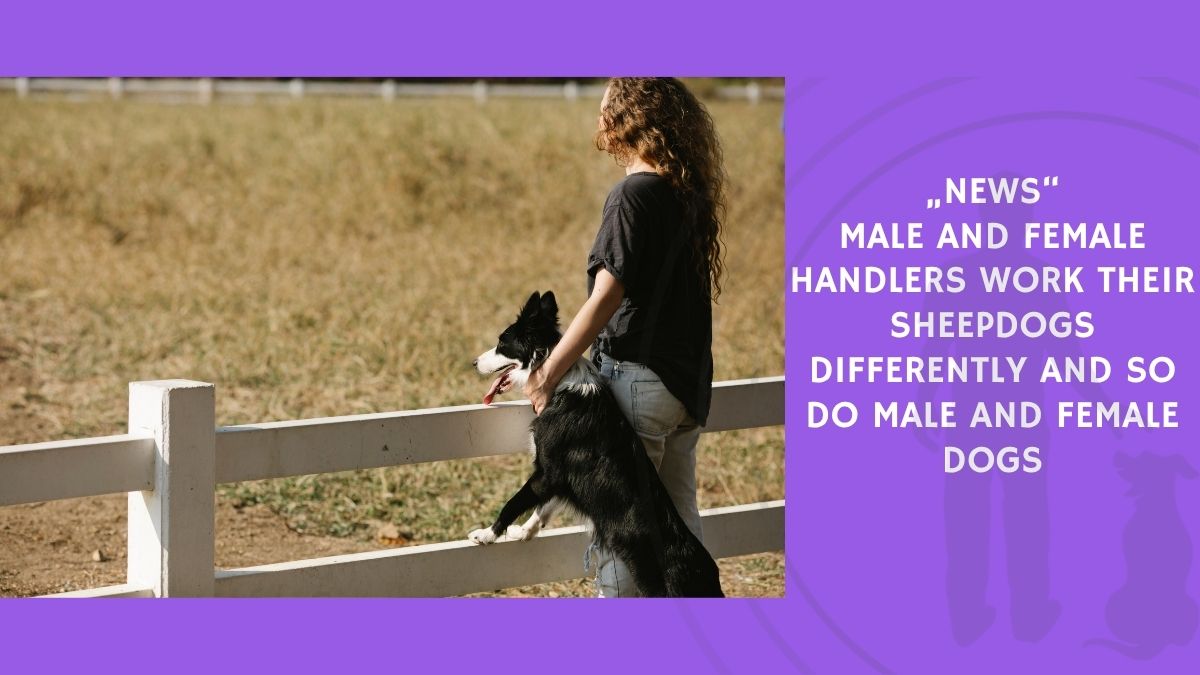
Sheepdog trials test both the dog and the handler simultaneously — the dog’s working skills and the handler’s ability to direct them effectively across the full range of elements that constitute a trial course. A study analysing video footage from 60 sheepdog trials has found measurable differences in how male and female handlers work their dogs, and how male and female dogs behave during competition — differences that are not simply noise but may reflect genuine complementary pairing opportunities for handler-dog matching. 🐾
Researchers Erin Kydd and P. McGreevy downloaded and analysed 60 trial videos from YouTube — 28 open-level trials and 32 not-open trials — comparing the stalking, crouching, chasing, and stationary behaviours of dogs by sex and competition level, alongside handler movement patterns, vocal cue use, and arm elevation signals by handler gender. The sample size is small and the video source has acknowledged limitations — the researchers are explicit about this — so the findings should be taken as preliminary and directional rather than definitive. They are sufficient, however, to identify patterns worth investigating further and to raise questions about sex-based pairing strategies in working dog selection.
What Male and Female Handlers Did Differently
Male handlers spent significantly more time in the fetch and drive elements of the trial than female handlers — but this difference was present only in not-open events, which feature less experienced dogs. In not-open competition, the mean time to complete the fetch element was 44 seconds for female handlers versus 124 seconds for male handlers. Drive showed a similar pattern: 95.8 seconds for female handlers versus 152.4 seconds for males. Open-level handlers — where both dogs and handlers are more experienced — did not show the same sex-based differences.
The interpretation the researchers offer is plausible and worth examining: female handlers of less experienced dogs may be more effective at the early training of fetch and drive elements — the working sequences that require the most precise early handler communication to develop. Whether this reflects differences in training approach, communication style, timing precision, or some combination of these factors is not established by the video analysis alone and would require further investigation to confirm. The finding is a pattern in the data, not a confirmed mechanism.
The disappearance of the handler sex difference at open competition level is itself informative. At the highest level of the sport, handler sex does not produce measurable differences in trial timing — suggesting that whatever sex-based differences appear during the training and development of less experienced dogs converge toward equivalent performance as dogs and handlers reach advanced working levels.
What Male and Female Dogs Did Differently ⚠️
Male dogs spent more time stationary than female dogs — but again, only in open competition. In not-open trials, dog sex did not produce significant differences in stationary behaviour. Open-level male dogs showing more stationary time than open-level female dogs may reflect differences in working style at the highest level of competition — male dogs potentially using more sustained eye contact and presence as a control mechanism, female dogs more continuous movement. Whether this reflects hormonal influences, the specific selection decisions that have produced the open-level competition population, or other factors requires research beyond what video analysis can establish.
The interaction between dog sex and competition level — and between handler sex and competition level — is where the most interesting questions sit. Differences that appear in less experienced handlers and dogs but not in experienced ones may reflect developmental patterns rather than fixed sex-based traits. Or they may reflect the selection pressures of reaching open-level competition differently selecting for male and female dogs. Or both.
What This Means for Handler-Dog Matching and Training 🐕
The researchers frame the study explicitly around its potential to identify pairings that complement each other — handler and dog combinations whose sex-based working styles align rather than conflict. This is a practical working dog management question that receives almost no scientific attention. The assumption in most working dog selection is that dogs should be matched to working context and working aptitude, with handler sex rarely considered as a pairing variable.
If female handlers are more effective at developing fetch and drive in less experienced dogs, then systematically pairing female handlers with young, inexperienced dogs during critical developmental periods might accelerate training outcomes. If male dogs at open level use more stationary control, understanding how handler sex interacts with that working style — whether female or male handlers elicit more of it — becomes a meaningful pairing consideration for competitive handlers and breeders.
The study is explicit that its sample size and data source limit generalisation. These are directions for investigation, not established conclusions. But the methodological approach — using publicly available competition video footage to generate preliminary data on real working dog behaviour — is itself worth noting as an accessible and low-cost research method that could be applied to much larger samples to produce more robust findings.
At Zoeta Dogsoul, the principle of accurate matching between dog and handler — accounting for all relevant variables rather than assuming universal working dog profiles — is part of how NeuroBond approaches the working partnership. If sex-based differences in handler working style and dog behavioural expression are real and systematic, they deserve to be understood and incorporated into how dogs are selected, trained, and paired — not assumed away by a model that treats all handlers and all dogs as equivalent inputs to a working outcome. 🐾
Source: Kydd, E., & McGreevy, P. (2017). Sex differences in the herding styles of working sheepdogs and their handlers. PLoS ONE. Published September 14, 2017.










