Csepregi & Gácsi (2023) — Animals (MDPI)
Factors Contributing to Successful Spontaneous Dog-Human Cooperation
Published: August 22, 2026
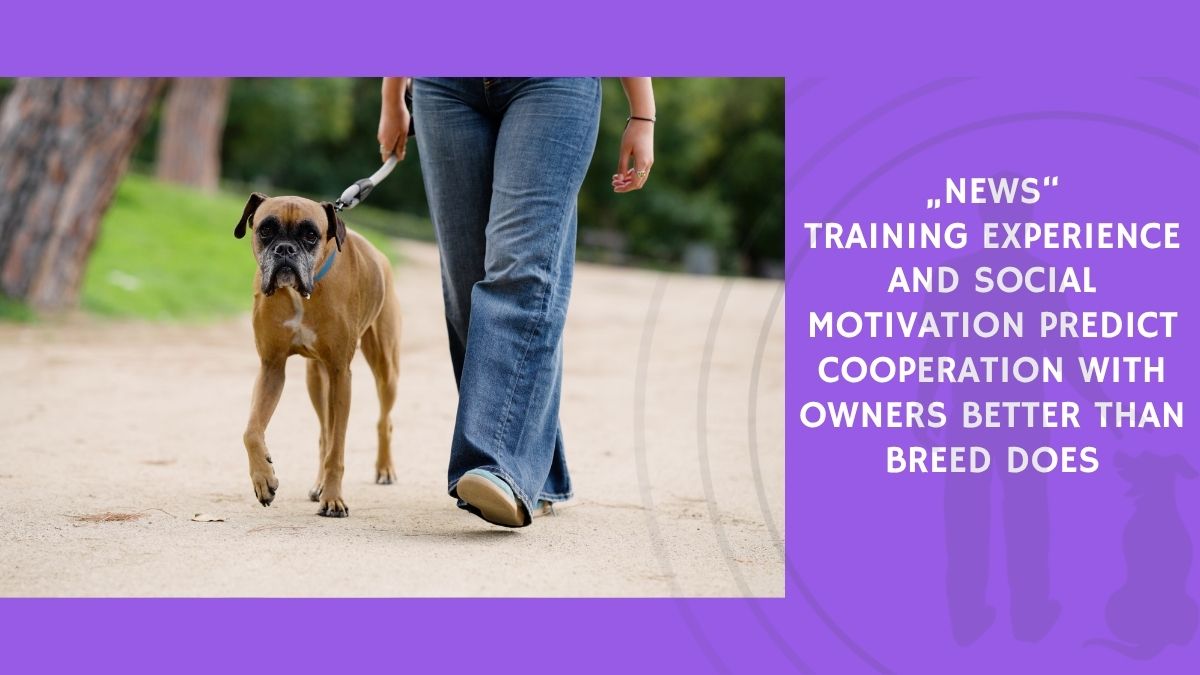
Dogs cooperate with humans. That much is established. What is less clear is which factors make a specific dog more likely to cooperate spontaneously — without being asked, without a specific trained cue, in response to a situation where the human needs help. A study testing 100 family dogs across breed groups in a cooperative task has produced a finding that challenges some widely held assumptions about what drives canine cooperation: breed function does not predict it. Training experience and social motivation do. 🐾
Researchers Melitta Csepregi and M. Gácsi designed an out-of-reach task in which owners were visibly unable to reach a desired object and never directly asked their dog for help — the spontaneous element of the design is what makes it methodologically distinctive. Three components of successful cooperation were measured: paying attention to the partner, understanding the problem situation, and willingness to help. Dogs from three breed groups — non-working breeds, cooperative working breeds, and independent working breeds — with varied training backgrounds participated, alongside owner-reported social motivation data for each dog.
The Breed Group Finding That Challenges Common Assumptions
Breed groups had no significant effect on any behavioural variable measured in this study. Dogs from cooperative working breeds — herding dogs, retrievers, dogs selected for human-directed collaboration — did not show higher spontaneous cooperation than non-working breeds or independent working breeds. The assumption that working breed function predicts cooperative tendency in family dog contexts is not supported by this data.
This finding sits in a precise relationship with the Morrill et al. Science research covered in this series — which established that breed explains only 9 percent of individual behavioural variation. Breed function may influence the genetic propensity for certain behavioural tendencies at the population level. But in a sample of family dogs tested on a spontaneous cooperation task, that population-level signal does not produce detectable differences at the individual level across breed groups. The individual variables — training experience and social motivation — were stronger predictors than the group-level variable of breed function.
This is not evidence that breed function is irrelevant to behaviour generally. It is evidence that spontaneous cooperative behaviour in family dog contexts is not primarily determined by breed function heritage — it is determined by variables that are individual, relational, and developmentally shaped rather than genetically categorised.
Why Training Experience and Social Motivation Predict Cooperation ⚠️
Dogs with high training levels showed more attention-related behaviours and were more likely to help their owner in the out-of-reach task. The mechanism is plausible: training builds the attentional habits, the handler orientation, and the problem-solving repertoire that make spontaneous cooperation possible. A dog who has learned through training that paying attention to the human partner is the reliable path to good outcomes will apply that attention in novel problem situations where no specific trained behaviour has been cued. A dog without that training history has less of the attentional infrastructure through which spontaneous cooperation can be expressed.
Critically, training level and social motivation were not correlated with each other. These are independent predictors — both mattered, and a dog could be high on one without being high on the other. A highly socially motivated dog without training experience showed a different cooperative profile than a highly trained dog with moderate social motivation. Both dimensions contributed independently to the cooperation outcome.
Social motivation — how strongly oriented toward human social engagement a dog is reported to be by their owner — predicted attentiveness and cooperative willingness independently of training. This makes biological sense. A dog whose motivation system is strongly oriented toward human social contact has more inherent drive to pay attention to the partner, to stay engaged with the shared situation, and to act in ways that maintain or enhance the social connection. That motivational substrate is what training then shapes into specific behavioural skills — but the motivation itself is not created by training. It is a foundational individual characteristic that training either works with or works against.
What This Means for Building a Cooperative Relationship 🐕
The practical implications of this research run in two directions simultaneously. For owners who believe that getting a herding breed or a retriever will automatically produce a more cooperative dog — the data does not support that expectation at the individual level. What produces a more cooperative family dog is a dog with high social motivation toward their specific owner and a training background that has built the attentional habits and problem-solving orientation within which spontaneous cooperation can emerge.
For training approaches, the finding that training level independently predicts spontaneous cooperation even when controlling for social motivation is an argument for consistent engagement across a dog’s life — not just task-specific training but the kind of regular, varied, attentive interaction that builds handler orientation as a default rather than a trained behaviour. A dog who has spent years learning that paying attention to their human partner produces good outcomes will apply that learned orientation to novel problems spontaneously. A dog who has had minimal structured engagement has less of that orientation available when the situation calls for it unprompted.
At Zoeta Dogsoul, NeuroBond describes the attunement between dog and owner as built through exactly the combination this research identifies: genuine social motivation on both sides of the relationship and the training history that has taught the dog that orienting toward the human partner is always the right instinct. A dog who spontaneously tries to help their owner in a novel problem situation is a dog who has internalised that instinct deeply enough to apply it without prompting. That level of cooperation is not a breed outcome. It is a relationship outcome. 🐾
Source: Csepregi, M., & Gácsi, M. (2023). Factors contributing to successful spontaneous dog-human cooperation. Animals. Published July 1, 2023.