Wilson, Arnott et al. (2022) — PLoS ONE
Valued Personality Traits in Livestock Herding Kelpies: Development and Application of a Livestock Herding Dog Assessment Form
Published: August 18, 2026
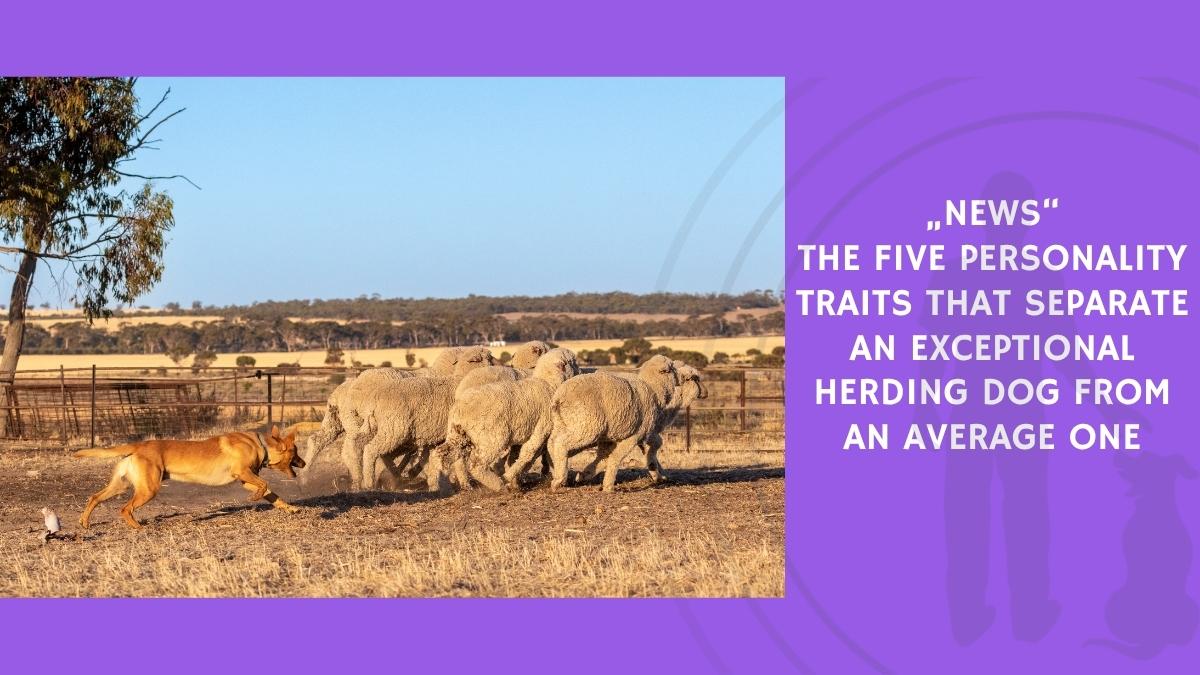
The Australian Kelpie is one of the most economically significant working dog breeds in the world — integral to the rural economy of Australia and increasingly valued internationally for livestock management. Yet the selection of individual dogs for herding work has historically lacked a methodical, evidence-based approach. A study developing and applying a validated personality assessment form to 228 working Kelpies has now identified the specific traits that most strongly predict herding ability — and the five that emerge from the data are worth examining closely for what they reveal about working dog cognition and character. 🐾
Researchers B. Wilson, Elizabeth Arnott, Jonathan Early, C. Wade, and P. McGreevy developed the Herding Dog Assessment Form — Personality (HDAF-P), a 17-trait behavioural descriptor questionnaire specifically designed for working dog contexts, and applied it through 95 owners assessing 228 of their working Kelpies. Overall ability ratings from the same owners allowed correlation analysis between individual trait scores and actual working performance across the sample. The study combined assessment tool development with immediate application — producing both a validated instrument and preliminary findings on which personality traits matter most in the field.
The Five Traits That Predicted Herding Ability
Kendall’s Tau correlation analysis identified five traits showing the strongest relationships with overall herding ability. Initiative correlated most strongly at T = 0.41 — the capacity to act independently, to make decisions without waiting for handler direction, to read a situation and respond without instruction. Confidence correlated at T = 0.36 — the absence of hesitation under pressure, the willingness to maintain working engagement with livestock without backing down from challenge. Persistence correlated at T = 0.36 — sustained task engagement through difficulty, repeated effort without giving up when a livestock animal resists or a task becomes complex.
Intelligence correlated at T = 0.32 — an owner-rated construct that in working dog contexts encompasses the capacity to solve novel problems, adapt to changing conditions, read livestock behaviour accurately, and apply learned experience to new situations. And nervousness correlated negatively at T = -0.30 — meaning higher nervousness was associated with lower overall ability, confirming that anxiety and stress reactivity undermine working performance in this demanding field context.
The negative nervousness correlation is as informative as the positive trait correlations. A nervous dog in a livestock working context is a dog whose arousal dysregulation makes sustained, effective herding difficult to execute — unpredictable responses to livestock pressure, inconsistent engagement, and the kind of stress-driven behavioural variability that disrupts the controlled, persistent working pattern that effective herding requires.
What the Principal Component Analysis Revealed ⚠️
Beyond the individual trait correlations, exploratory principal component analysis of the full 17-trait dataset revealed that 64.5 percent of the variance in personality scores across the 228 Kelpies could be explained by four components — a structure that shares similarities with the personality factor structures reported in previous dog personality research including the validated Finnish questionnaire covered earlier in this series. The fact that four broad personality dimensions emerge from working Kelpie assessment data, in patterns broadly consistent with pet dog personality research, suggests that the fundamental structure of dog personality is relatively consistent across working and companion contexts even when the specific behavioural expressions of those traits differ substantially.
This cross-context consistency has implications for how the broader field of dog personality research should integrate working and companion dog data. The validated assessment frameworks developed for companion dogs and the working dog assessment tools being developed through studies like this one are not necessarily measuring different things — they may be capturing the same underlying personality architecture expressed in different functional contexts.
What This Means Beyond the Working Dog World 🐕
The five traits that predicted herding ability in this sample — initiative, confidence, persistence, intelligence, and low nervousness — are not traits that matter only in agricultural working contexts. They are traits that shape every dog’s capacity for engagement, learning, relationship quality, and behavioural stability in any context. A companion dog high in initiative, confidence, and persistence with low nervousness is a dog whose owner experiences very different daily relationship dynamics than a dog scoring low on these dimensions.
Understanding where a specific dog sits across these dimensions — not just as a working assessment but as a personality characterisation — is part of what NeuroBond asks owners to see clearly. A dog with high initiative and high persistence requires an owner who can provide structure and engagement that channels those traits productively rather than leaving them to express in self-directed ways that the owner experiences as problematic. A dog with high nervousness is not simply a cautious dog — they are a dog whose working capacity, training responsiveness, and daily quality of life are all influenced by an anxiety baseline that requires specific management rather than generic training approaches.
The Invisible Leash holds most effectively when it is calibrated to the actual personality of the individual dog — their genuine initiative level, their confidence under pressure, their persistence when challenged. The Kelpie research makes those traits measurable and their importance explicit. The principle applies to every dog. 🐾
Source: Wilson, B., Arnott, E. R., Early, J. B., Wade, C., & McGreevy, P. (2022). Valued personality traits in livestock herding Kelpies: Development and application of a livestock herding dog assessment form. PLoS ONE. Published April 26, 2022.