
Wade, Nuttall & Liu (2023) — Canine Medicine and Genetics
Comprehensive Analysis of Geographic and Breed-Purpose Influences on Genetic Diversity and Inherited Disease Risk in the Doberman Dog Breed
Published: August 14, 2026
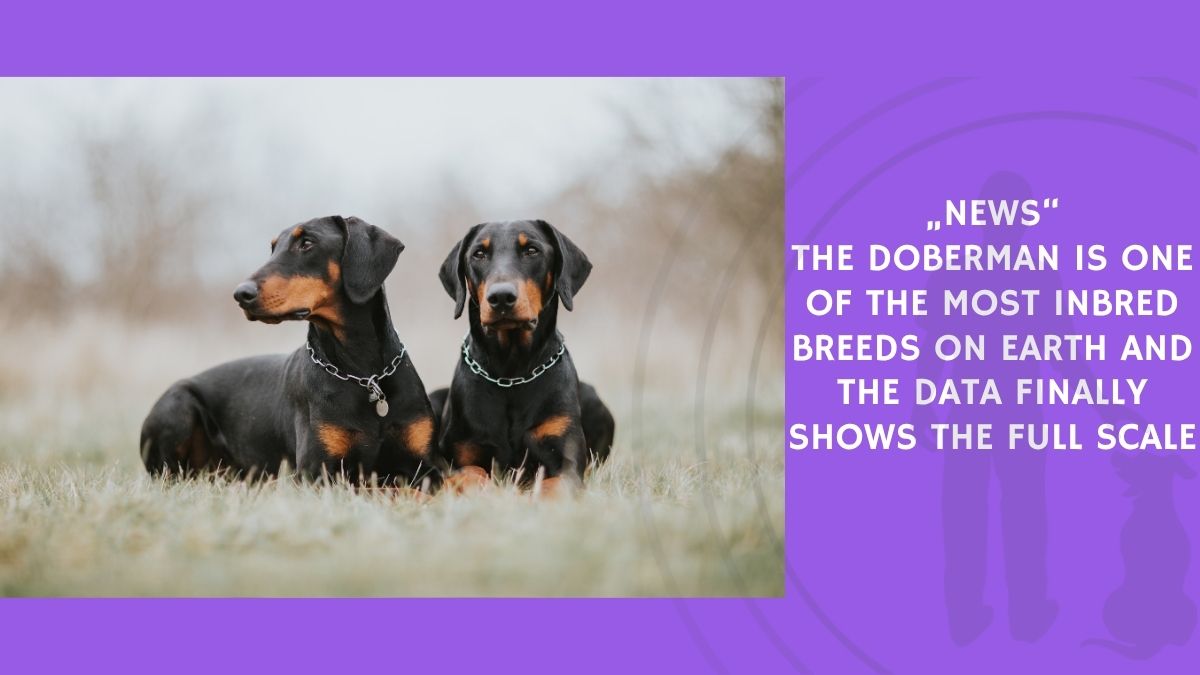
The Doberman Pinscher is a breed with a devoted following, a striking physical profile, and a health picture that the available data describes in stark terms. Life expectancy at birth of 9.1 years. Heart disease accounting for 28 percent of deaths. Cancers collectively accounting for 14 percent. Mean genomic inbreeding of 40 percent. A comprehensive genomic analysis drawing on data from over 3,000 dogs across citizen science health and diversity projects has now produced the most detailed picture yet of what the Doberman’s genetic architecture looks like — and what it means for the breed’s future. 🐾
Researchers C. Wade, R. Nuttall, and Sophie Liu analysed phenotypic health survey data alongside genotyping array data from the Doberman Health Surveys and the Doberman Diversity Project — two citizen science initiatives that have built unusually large and geographically diverse datasets for a single breed. The combined analysis allowed the researchers to examine relative homozygosity, genetic diversity, disorder risk, and the specific genomic regions most strongly fixed across the global Doberman population.
What 40 Percent Inbreeding Actually Means
A mean genomic inbreeding coefficient of 40 percent — calculated from the proportion of the assayed genome in runs of homozygosity — is a figure that deserves careful contextualisation. It means that approximately 40 percent of the Doberman genome is, on average, identical by descent in both copies across the dogs studied. The lowest inbreeding level observed in any Doberman in the dataset was 15 percent — in first-generation crosses between European and US-bred animals — establishing that even the most genetically diverse individual Dobermans currently available carry substantial inbreeding.
The practical consequences of this level of homozygosity are multiple. High inbreeding increases the proportion of the genome where recessive variants — including deleterious disease-associated variants — are present in both copies and can therefore be expressed. It reduces immune system diversity, narrowing the range of pathogens the immune system can effectively recognise. It reduces the effective population size available to respond to selection pressure, whether from disease, environmental change, or active breeding programme management.
The global Doberman population was found to exist as four major sub-populations: European exhibition-bred, Americas exhibition-bred, European working, and Americas pet and informal. Effective population sizes across these sub-populations ranged from approximately 70 to 236 — figures that indicate very small numbers of genetically unique breeding individuals contributing to each lineage, further concentrating the genomic homozygosity that population-level data documents.
Four genomic regions longer than 500 kilobases were found to be fixed — present in identical form in 90 percent or more of the 3,226 dogs studied — spanning chromosomes CFA3 and CFA31. Fixed genomic regions represent areas where essentially all variation has been eliminated by selection — and the 30 potentially functional variant calls identified within these regions as evolutionarily diverged from the wider dog population are the candidates for further investigation as potential drivers of the breed-specific disease risks that the phenotypic data documents.
Heart Disease Cancer and the Biological Consequences of Fixation ⚠️
The leading cause of death in the Doberman phenotypic dataset — heart disease at 28 percent of deaths — is not a surprise to anyone familiar with the breed. Dilated cardiomyopathy is a well-documented breed-associated condition in Dobermans, with documented genetic variants in the PDK4 and TTN genes among the candidates implicated in its pathogenesis. What this study adds is the genomic architectural context: the fixed regions on CFA3 and CFA31 contain plausible gene candidates for future analysis of the genetic basis of cardiac disease in the breed. The fixation of these regions across 90 percent of the global population means that every Doberman is carrying essentially the same genetic context in these critical chromosomal areas — and any deleterious variants fixed within them are present in essentially the entire breed.
Cancer at a collective 14 percent of deaths places neoplastic disease as the second leading mortality cause — consistent with the elevated cancer risk documented across multiple large breeds in the research covered in this series. The fixed genomic regions also contain candidates for cancer susceptibility analysis, though the researchers are precise that these are candidates for future investigation rather than confirmed causes.
The inter-crossing finding provides the most practically significant genetic conservation message in the study. First-generation crosses between European and Americas-bred Dobermans showed the lowest inbreeding levels observed — 15 percent — and array variant analysis confirmed that such inter-crossing has capacity to reintroduce variation at many loci that are currently strongly homozygous in geographically isolated sub-populations. Geographic isolation has accelerated genetic fixation within each sub-population even as the global Doberman population might theoretically retain more variation than any individual lineage currently expresses.
What This Means for Doberman Owners and Breeders Today 🐕
The study’s conclusion is direct and carries a note of caution alongside its conservation recommendation. Efforts to improve breed diversity should focus on the regions with the highest fixation levels — but managers must ensure that mutation loads are not worsened by increasing the frequencies of rarer haplotypes in those regions. This is not a simple intervention. Introducing genetic variation from a different lineage can reintroduce variation at beneficial loci but can also bring in deleterious variants that were at low frequency in the donor population and rise in frequency when the genetic context changes. Diversity management in a breed with the Doberman’s level of genomic compression requires genomic tools and specialist genetic expertise, not simply broader mate selection.
For owners, the health surveillance implications are the most immediately actionable message. A breed with 40 percent mean genomic inbreeding, a 9.1-year life expectancy at birth, and heart disease as the dominant mortality cause is a breed where cardiac screening is not an optional extra — it is the single most important health monitoring commitment an owner can make. Echocardiographic screening programmes for Dobermans exist precisely because the genetic and epidemiological evidence has long pointed toward this breed’s cardiac vulnerability. The genomic data in this study provides the mechanistic context for why that vulnerability exists at population scale.
At Zoeta Dogsoul, physical foundation is always part of the full picture that NeuroBond asks owners to see. A Doberman is a dog whose genetic architecture carries specific risks encoded across decades of intensive breeding. Seeing that clearly — not as a reason for despair but as the accurate starting point for the most attentive, proactive care the relationship can provide — is what genuine attunement to the whole animal looks like in a breed with this health profile. 🐾
Source: Wade, C., Nuttall, R., & Liu, S. (2023). Comprehensive analysis of geographic and breed-purpose influences on genetic diversity and inherited disease risk in the Doberman dog breed. Canine Medicine and Genetics. Published June 5, 2023.










