Powell, Stefanovski et al. (2025) — Preventive Veterinary Medicine
The Impacts of Household Factors and Proxies of Human Social Determinants of Health on Dog Behavior
Published: August 14, 2026
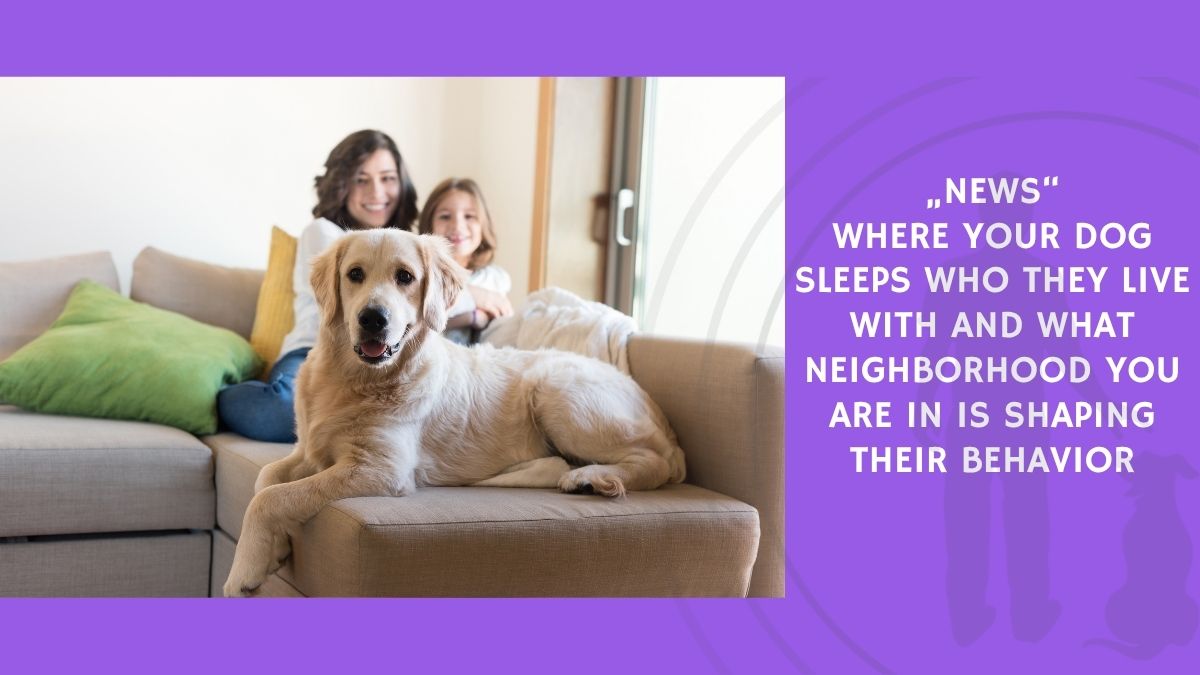
Social determinants of health — the neighbourhood you live in, the socioeconomic conditions of your household, the density of the community around you — have enormous documented effects on human health and behaviour. Whether they influence dog behaviour in comparable ways has received almost no systematic scientific attention. A longitudinal study tracking over 3,000 Golden Retrievers for up to eight years has now applied that framework to canine behaviour — and the results show that household environment and neighbourhood characteristics shape dog behaviour in ways that accumulate and change across the lifespan. 🐾
Researchers Lauren Powell, D. Stefanovski, N. Dreschel, and James Serpell used an existing dataset of C-BARQ behavioural assessments from 3,044 Golden Retrievers collected between 2012 and 2023 — up to eight years of longitudinal data per dog — alongside household characteristic data and zip-code-level proxies for human social determinants of health. Linear mixed effect models and generalised estimating equations were used to identify associations and longitudinal patterns. The result is one of the largest and longest behavioural datasets ever analysed for domestic dogs, and the first study to formally examine social determinants of health as predictors of canine behaviour.
What the Household Data Found
Dogs from single-dog households showed increased odds of dog-directed fear compared to dogs living with other dogs — an odds ratio of 1.44, meaning single-dog household dogs were 44 percent more likely to show fear toward other dogs. They also showed poorer trainability, particularly during early adulthood. The conspecific social environment — whether the dog has regular contact with other dogs within the home — appears to be a meaningful shaper of both fear responses to dogs and the capacity for training engagement during the developmental period when training foundations are typically established.
Sleeping in the owner’s bed produced two significant associations. Dogs who slept in the owner’s bed showed increased aggression toward strangers and a greater reduction in trainability with age — the decline in trainability across the lifespan was steeper in dogs who slept with their owners than in those who did not. Energy levels also declined more steeply with age in bed-sharing dogs. These are longitudinal effects — patterns that diverge and compound across years rather than appearing as single cross-sectional snapshots.
The bed-sharing finding is the one most likely to generate debate, and it warrants careful interpretation. Correlation in an observational study does not establish causation — dogs who sleep in owners’ beds may differ in multiple ways from dogs who do not, and the association with stranger aggression could reflect pre-existing temperament differences that also influence where the dog sleeps rather than the sleeping arrangement itself producing aggression. The longitudinal trainability decline finding is more specific and harder to explain away — the pattern of steeper decline over years is suggestive of something that accumulates rather than something that was simply present from the beginning.
The Neighbourhood Effect — A First in Canine Behaviour Research ⚠️
The neighbourhood density finding is the most novel contribution in the study. Dogs living in the most densely populated neighbourhoods showed greater odds of displaying aggression toward strangers compared to dogs in sparsely or moderately populated areas. Sparsely populated neighbourhood dogs were 22 percent less likely to show stranger aggression (OR 0.78). Moderately populated neighbourhood dogs were 27 percent less likely (OR 0.73).
This is the first time neighbourhood-level social determinants have been formally associated with canine behaviour outcomes. The mechanism is not established by this study but several plausible pathways exist. Dense urban environments provide more frequent, more unpredictable, and often more stressful social encounters — with unfamiliar humans, dogs, noise, and spatial crowding — that may cumulatively shift the baseline arousal and threat-detection calibration of dogs living within them. A dog who encounters dozens of strangers daily in a dense urban context is accumulating a very different social exposure history than a dog who rarely encounters unfamiliar people.
The finding also raises the question of whether the neighbourhood effects documented here reflect genuine environmental influences on behaviour — similar to the environmental effects on human health documented in social determinants of health research — or whether they reflect owner characteristics that correlate with neighbourhood density and also independently influence dog behaviour through training practices, activity levels, and relationship quality.
What Eight Years of Longitudinal Data Adds to the Picture 🐕
The most significant methodological contribution of this study is the longitudinal scope — up to eight years of repeated C-BARQ assessment per dog across a sample of 3,044 animals. Most canine behaviour research is cross-sectional, capturing a single point in time and comparing across individuals. This dataset captures how individual dogs change across their lifespans — and how household factors and neighbourhood characteristics influence the trajectory of that change rather than simply its level at any given moment.
The finding that household characteristics have differential impacts on behaviour across the lifespan — that the steeper trainability decline in bed-sharing dogs is a pattern that emerges and compounds over years — is a finding that cross-sectional research could not have produced. It points toward the household environment as a dynamic influence on the developmental arc of canine behaviour rather than a fixed background characteristic. The dog you live with at age two is being shaped toward the dog they will be at age eight by the conditions of their daily environment — including the neighbourhood they walk through, the conspecifics they do or do not live with, and the sleeping arrangements that structure their proximity to you across thousands of nights.
At Zoeta Dogsoul, this research sits directly within the territory of NeuroBond. The environment the dog inhabits is not a neutral container for the relationship — it is an active shaper of the nervous system, the behaviour patterns, and the trainability that the relationship must work with. A dog in a dense urban environment accumulating daily stranger encounters is a dog whose arousal baseline and threat calibration are being influenced in ways that require active, attentive management rather than the assumption that the dog will habituate without support.
The Invisible Leash holds best when the owner understands not just the dog in front of them today but the environmental conditions that are shaping who that dog is becoming across years. This study, for the first time, puts longitudinal data behind that principle. 🐾
Source: Powell, L., Stefanovski, D., Dreschel, N., & Serpell, J. A. (2025). The impacts of household factors and proxies of human social determinants of health on dog behavior. Preventive Veterinary Medicine. Published March 28, 2025.