
Pereira, Valério-Bolas et al. (2019) — Veterinary Sciences
Development of Dog Immune System: From in Uterus to Elderly
Published: August 13, 2026
The immune system is not a fixed capability that a dog is born with and maintains until they die. It is a dynamic, lifelong adaptive process — present before birth, radically different in a newborn puppy than in a healthy adult, and declining again in complex ways as the dog ages. A comprehensive review mapping immune development from in utero through to old age produces a picture that has direct implications for vaccination timing, disease susceptibility, and how immune function shapes a dog’s health across every stage of their life. 🐾
Researchers M. Pereira, A. Valério-Bolas, Cátia Saraiva-Marques, G. Alexandre-Pires, I. Pereira da Fonseca, and G. Santos-Gomes reviewed the full developmental arc of the canine immune system — covering the immunological challenges of pregnancy, the immune status of newborn puppies, the maturation of immune function through puppyhood and adulthood, and the specific changes that accompany immune ageing in elderly dogs. The review identifies priority research goals alongside current knowledge, making it a map of both what is understood and where critical gaps remain.
Pregnancy and the Newborn Immune Paradox
The immune challenges of canine pregnancy begin with a fundamental biological paradox. The embryos and fetuses developing in the uterus are semi-allograft tissue — genetically distinct from the mother and theoretically recognisable as foreign by her immune system. A normal immune response to foreign tissue would be rejection. Pregnancy requires the maternal immune system to simultaneously maintain vigilance against genuine pathogens while suppressing the rejection response that would otherwise eliminate the developing puppies. The hormonal and immunological mechanisms that achieve this balance alter normal homeostasis in ways that make the pregnant female more susceptible to certain infections even as her body is protecting the developing litter.
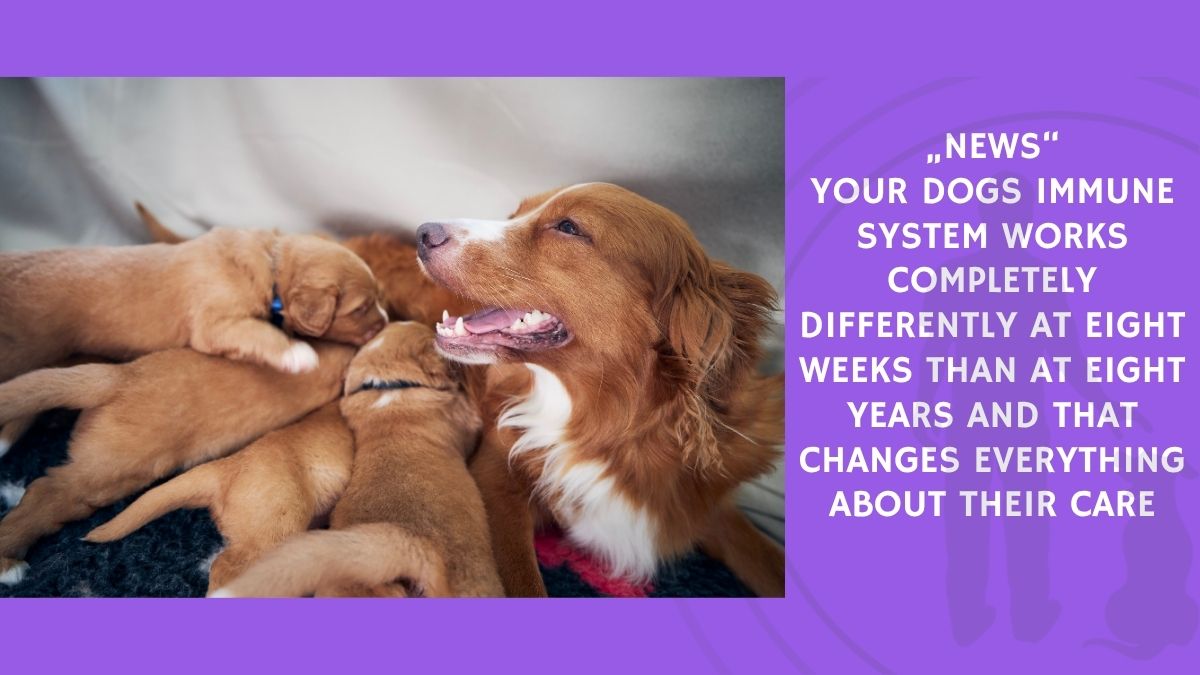
At birth, puppies arrive with an immune system that is architecturally present but functionally immature and without immune memory. They have never encountered pathogens before. They have no antibody repertoire built from prior exposure. Their innate immune responses are present but not fully calibrated. The risk of infectious disease in the first weeks of life is therefore substantial — and this is where colostrum becomes critical.
Passive immunity transferred through colostrum — the mother’s first milk — provides the antibodies the puppy cannot yet produce themselves. These maternal antibodies cross the intestinal wall in the first hours of life, entering the puppy’s bloodstream and providing temporary protection against the pathogens the mother has encountered and developed immunity to. This passive transfer is not simply helpful. For most puppies, it is survival-critical. A puppy who does not receive adequate colostrum in the first hours of life loses the maternal antibody protection window and faces the neonatal disease risk without the immune resources to manage it.
The Vaccination Window That Every Owner Needs to Understand ⚠️
The same maternal antibodies that protect the newborn puppy create a complication that every owner of a young puppy encounters in the form of vaccination schedules: passive maternal immunity interferes with the puppy’s ability to mount an active immune response to vaccines. A vaccine administered while maternal antibodies are still circulating at protective levels will be neutralised before it can stimulate the puppy’s own immune system to produce memory cells. The vaccine appears to have been given but no durable active immunity is established.
This is why puppy vaccination series begin at a specific age window and are repeated multiple times. The timing of primary vaccination is calibrated to the predicted decline of maternal antibody levels — which varies between individual puppies depending on how much colostrum they received and how high the mother’s antibody titres were. A single vaccination at eight weeks may miss its window in a puppy with high residual maternal antibody levels. The series protocol covering the typical range of maternal antibody decline is designed to ensure that at least one vaccination lands in the window where maternal antibodies have declined enough to allow active immune response without having left the puppy entirely unprotected.
The practical implication for owners is that the vaccination schedule recommended by a veterinarian is not arbitrary. It reflects the immunological reality of maternal antibody kinetics in puppies. Delaying or spacing vaccinations differently from professional guidance because the puppy appears healthy and active leaves real immunity gaps that the maternal antibody protection window cannot indefinitely fill.
Immune Decline in Elderly Dogs and What It Means for Health 🐕
At the other end of the lifespan, the review documents what happens as the canine immune system ages — a process called immunosenescence that mirrors age-related immune decline in humans and contributes to the increased susceptibility to infection, reduced vaccine responsiveness, and elevated cancer risk that characterise old age across species.
The structural and functional competence of the immune system declines in elderly dogs in ways that reduce their capacity to mount effective responses to novel antigenic challenges — new infections they have not encountered before, and vaccines administered in old age. An elderly dog is not simply an adult dog who is older. They are an animal whose immune surveillance capacity has shifted in ways that make early detection of immune-relevant problems more important and potentially less effective simultaneously.
This immunological dimension of canine ageing connects directly to the comorbidity picture documented in the companion dog ageing model research covered in this series. Cancer risk rises with age partly because the immune surveillance mechanisms that detect and eliminate abnormal cells are less robust in elderly animals. Infection risk rises because response capacity to novel pathogens is reduced. And vaccine effectiveness in elderly dogs may be lower than in young adults — a consideration that affects how booster vaccination timing is interpreted in this age group.
At Zoeta Dogsoul, understanding the immune landscape of the dog across their lifespan is part of what seeing the whole animal means in practice. NeuroBond is built on attunement to the real animal — and the real animal’s immune system is doing fundamentally different work at eight weeks than at eight years and fundamentally different work again at twelve years. Calibrating care decisions to that biological reality — vaccination timing, disease monitoring, environmental exposure management, and the recognition of early signs of immune challenge — is part of what genuine attentiveness to the whole dog looks like across a lifetime. 🐾
Source: Pereira, M., Valério-Bolas, A., Saraiva-Marques, C., Alexandre-Pires, G., Pereira da Fonseca, I., & Santos-Gomes, G. (2019). Development of Dog Immune System: From in Uterus to Elderly. Veterinary Sciences. Published October 21, 2019.










