Abugomaa, Elbadawy et al. (2023) — Frontiers in Pharmacology
Anti-Cancer Activity of Chaga Mushroom (Inonotus obliquus) Against Dog Bladder Cancer Organoids
Published: July 4, 2026
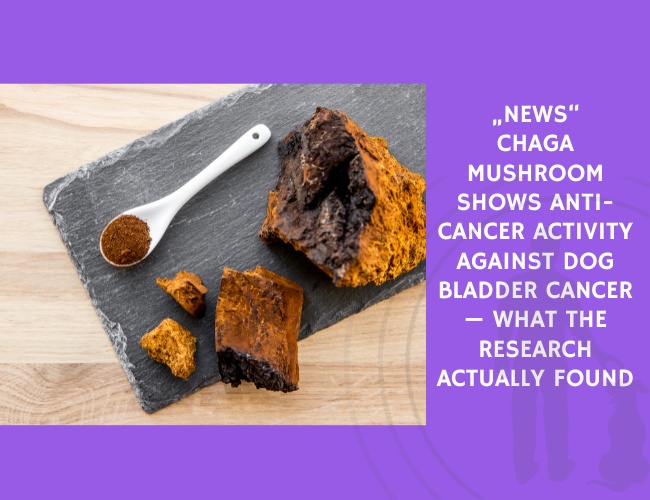
Chaga mushroom has circulated in the natural supplement world for years — promoted for immune support, anti-inflammatory properties, and general health promotion. Now, for the first time in a canine cancer context, laboratory research has tested it directly against dog bladder cancer tissue. The findings are more specific — and more significant — than the general supplement conversation usually gets. 🐾
Researchers Amira Abugomaa, Mohamed Elbadawy, and their team at Frontiers in Pharmacology used a novel experimental model — dog bladder cancer organoids — to examine exactly what Chaga mushroom extract does to cancer cells at a biological level. Organoids are three-dimensional tissue cultures grown from actual tumour tissue that replicate the genetic, molecular, and structural complexity of the original cancer far more accurately than flat cell line cultures. What happens to an organoid gives a much more reliable picture of what might happen in the body.
What the Research Found
Four strains of dog bladder cancer organoids were treated with Chaga extract across a range of concentrations. The results across multiple mechanisms were consistent and meaningful.
Chaga inhibited cell viability in a concentration-dependent manner — meaning the more Chaga applied, the more cancer cell death occurred. It arrested the cell cycle, preventing cancer cells from replicating. It induced apoptosis — programmed cell death — in the treated organoids. And critically, it suppressed the expression of bladder cancer stem cell markers including CD44, C-MYC, SOX2, and YAP1.
Cancer stem cells are one of the primary reasons bladder cancer is difficult to treat. They drive drug resistance and are responsible for distant metastasis — the spread of cancer beyond the original site. A compound that targets cancer stem cell markers specifically is addressing the mechanism behind treatment failure, not just the visible tumour mass. Chaga also inhibited ERK phosphorylation and the downstream signals that drive cancer cell proliferation, including multiple Cyclin proteins and CDK4.
In vivo testing in mice confirmed the organoid findings: Chaga administration reduced tumour growth and weight, with induction of necrotic lesions in the tumour tissue. And when Chaga was combined with established chemotherapy drugs — vinblastine, mitoxantrone, and carboplatin — potentiating activity was observed. The combination outperformed chemotherapy alone.
What This Means — and What It Doesn’t ⚠️
This is laboratory and animal model research. It is not a clinical trial. It does not establish that giving a dog Chaga supplements will treat or prevent bladder cancer. The pathway from promising organoid results to validated clinical protocol is long, and many compounds that show anti-cancer activity in laboratory models do not translate directly into clinical outcomes.
What this research does establish is a specific, mechanistically grounded biological rationale for Chaga’s anti-cancer potential in canine bladder cancer. That is meaningfully different from the general health promotion claims that circulate in the supplement market. This is not “Chaga is good for your dog.” This is “Chaga extract demonstrated specific inhibitory effects on four strains of dog bladder cancer organoids through identifiable molecular pathways.”
For owners whose dogs have been diagnosed with bladder cancer, or who are navigating chemotherapy decisions, this research is worth bringing to a veterinary oncologist as part of an informed conversation about adjuvant support options. Chaga is not a replacement for conventional treatment. The study’s own conclusion frames it as a potential potentiator of chemotherapy — something that may enhance efficacy and reduce adverse effects when used alongside, not instead of, established protocols.
The Bigger Picture for Natural Supplementation 🐕
We covered recently how owners of dogs with cancer are significantly more likely to turn to mushroom extracts and natural supplements — often through social media and blogs rather than veterinary guidance. This study is an example of why the conversation around natural supplements deserves more scientific rigour on both sides: neither blanket dismissal nor uncritical enthusiasm serves the animal.
Chaga now has peer-reviewed, mechanistically specific laboratory evidence behind it in a canine cancer context. That evidence has limits and requires professional interpretation. But it exists — and that matters for owners trying to make informed decisions in a space that is too often driven by anecdote rather than data.
At Zoeta Dogsoul, physical foundation is always part of the whole picture. A dog navigating cancer is a dog under maximum physiological and neurological load — and that load is present in every interaction, every signal, every moment of connection. The NeuroBond between owner and dog doesn’t pause during illness. If anything, it becomes the most important thing in the room. Staying informed, staying present, and staying in close contact with a veterinary team is how that bond translates into the best possible support. 🐾
Source: Abugomaa, A., Elbadawy, M., et al. (2023). Anti-cancer activity of Chaga mushroom (Inonotus obliquus) against dog bladder cancer organoids. Frontiers in Pharmacology. Published April 19, 2023.