
Calancea, Daina & Macri (2024) — Frontiers in Animal Science
The Science of Snacks: A Review of Dog Treats
Published: July 01, 2026
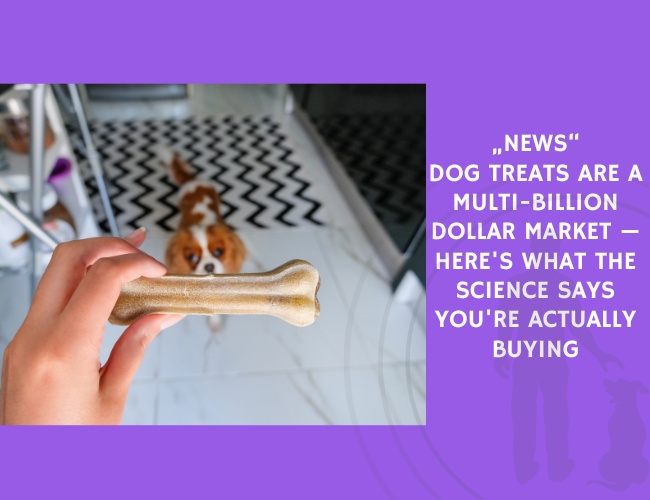
You give your dog treats. So does almost every dog owner on the planet. But what’s actually in those treats, what’s driving purchasing decisions, and what are the real risks hiding behind the emotional act of handing your dog something they love? A comprehensive new review has mapped the entire landscape — and the picture is more complicated than the packaging suggests. 🐾
Researchers Bogdan-Alexandru Calancea, Sorana Daina, and A. Macri published a full-scope review in Frontiers in Animal Science covering the global dog treat market, its nutritional realities, its labelling problems, and its genuine benefits — alongside the risks most owners don’t think about until something goes wrong.
Why the Market Is Booming — and Why That Matters
The global canine population is growing, and the treat sector is growing faster than the broader pet food market. The review identifies a clear emotional driver: the bond between owner and dog is directly expressed through feeding practices. Treats aren’t just nutrition. They’re relational currency. Owners reach for them in training, in comfort, in celebration, and in moments of guilt. The industry knows this and has built itself around it.
Six distinct treat categories exist within the market. Meat-based treats dominate — driven by owner perceptions of naturalness, quality, and nutritional alignment. The preference for raw and locally sourced alternatives is growing, reflecting a broader shift toward ingredient transparency in human food that is now migrating into pet food purchasing decisions.
But here’s where the review gets uncomfortable: labelling discrepancies and a lack of clear nutritional information are widespread. Owners who are actively trying to make quality choices often cannot do so, because the information on the label doesn’t give them what they need to assess what they’re actually buying. Nutritional values vary significantly across treat categories. Sensory qualities — texture, palatability, smell — drive purchasing far more reliably than nutritional content. The gap between what owners think they’re buying and what they’re actually feeding is real and measurable.
The Genuine Benefits — and the Real Risks ⚠️
The review is balanced on this. Treats are not inherently problematic. Positive reinforcement is one of the most evidence-backed mechanisms in canine training, and treats are a primary tool for delivering it effectively. Certain treat types support dental health. Nutritionally tailored treats can provide meaningful support for senior dogs with specific dietary needs. These are real, documented benefits.
The risks, however, deserve equal attention. Obesity is the most significant. Treats add caloric load that owners routinely underestimate — especially when treats are used frequently across a day, given by multiple household members, or chosen for palatability rather than nutritional density. The review identifies excessive calorie consumption from treats as a direct contributor to the canine obesity epidemic.
Beyond calories: microbiological contamination risk exists in certain treat categories, particularly raw and minimally processed products. Choking and administration-related accidents are documented, especially with certain shapes and textures given to unsupervised dogs. And the environmental footprint of treat production — often overlooked entirely — is flagged as a growing concern at scale.
What Informed Treat Use Actually Looks Like 🐕
The review’s conclusion is clear: effective communication between veterinarians and owners is essential, and treat recommendations need to be individualised. A treat regime that works for a lean, active 4-year-old dog is not the same regime that works for an overweight, sedentary 9-year-old with joint issues. One-size advice doesn’t serve the animal.
At Zoeta Dogsoul, this connects directly to how we think about the physical dimension of NeuroBond. The act of giving a treat carries relational weight — it is one of the most consistent and frequent points of interaction between dog and owner. That makes it a structural moment, not a throwaway one. What you give, how you give it, and under what conditions shapes more than nutrition. It shapes the dynamic between you.
A treat given in the right moment, for the right reason, with the right ingredient profile, is a precision tool. A treat given reflexively, out of guilt or habit, without awareness of cumulative load — that’s a different thing entirely. The Invisible Leash is built through consistent, intentional interaction. Treats are part of that system. They deserve to be chosen and used like it. 🐾
Source: Calancea, B.-A., Daina, S., & Macri, A. (2024). The science of snacks: a review of dog treats. Frontiers in Animal Science. Published July 15, 2024.










