Marchi, Miranda et al. (2025) — Journal of Animal Physiology and Animal Nutrition
Allergic Reaction to Beta-Glucans in an Obese Dog: A Case Report of Confirmed and Suspected Sources
Published: June 30, 2026
Beta-glucans are one of the more talked-about nutraceuticals in dog nutrition right now — promoted for immune support, gut health, and obesity management. What almost nobody talks about is what happens when a dog reacts badly to them. A newly published case report documents exactly that. 🐾
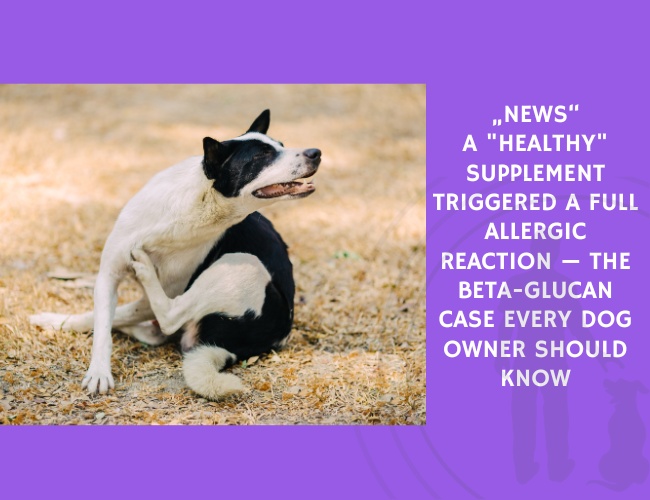
A 6-year-old obese mixed-breed dog, enrolled in a clinical trial testing two types of beta-glucans, developed intense itching, hair loss, and skin inflammation after consuming a diet containing purified beta-1,3/1,6-glucans from Saccharomyces cerevisiae. The reaction was confirmed through elimination and rechallenge — the gold standard for identifying food-related allergic responses. When beta-glucans were removed, symptoms resolved within a week. When reintroduced, they returned within two weeks. Twice.
How the Case Unfolded
The trial used three nutritionally matched extruded dry diets: a control diet containing no beta-glucans, Beta-Glucan A containing 0.1% beta-1,3/1,6-glucans from Saccharomyces cerevisiae, and Beta-Glucan B containing 0.1% beta-1,3-glucans from Euglena gracilis.
After a 30-day adaptation period on the control diet — with all clinical parameters normal — the dog was moved to Beta-Glucan A. Within 30 days, the owner reported pruritus, alopecia, and erythema across multiple body areas. No prior exposure to beta-glucans had ever occurred. The dog was returned to the control diet; symptoms cleared in seven days.
A second challenge with Beta-Glucan A produced the same result — dermatological signs reappearing within 14 days, resolving again on removal. A subsequent trial with Beta-Glucan B from Euglena gracilis produced clinical signs after 15 days. The owner declined a final confirmatory rechallenge with the Euglena source, so that reaction remains highly probable but technically unconfirmed.
The conclusion: confirmed allergy to beta-1,3/1,6-glucans from Saccharomyces cerevisiae. Suspected but unconfirmed allergy to beta-1,3-glucans from Euglena gracilis.
What This Means for Supplement Decisions 🧪
Beta-glucans have a genuinely strong evidence base for immune modulation and digestive health support in dogs. This case report does not change that. What it does is add a necessary caveat that the supplement community rarely discusses: nutraceuticals are bioactive compounds, and bioactive compounds carry allergy risk — even in ingredients with no prior history of causing reactions.
Food allergy in dogs is defined as an abnormal immune response to an ingredient or additive. It is not dose-dependent in the way toxicity is. It is immune-mediated — meaning the body identifies a compound as a threat and mounts a response. With beta-glucans, this mechanism is particularly counterintuitive because the same immunomodulatory properties that make them appealing as a supplement are precisely what can trigger an immune response in a sensitive individual.
The practical checklist if your dog is starting beta-glucan supplementation:
- Introduce as a single dietary change — no other new ingredients simultaneously
- Monitor skin, coat, and digestive signs actively for the first 30–45 days
- Know the source — Saccharomyces cerevisiae and Euglena gracilis are structurally different beta-glucan types and may not cross-react identically
- If signs appear, remove the supplement before assuming another cause
Reading the Signals Your Dog Is Already Sending 🐕
Pruritus, alopecia, erythema — itching, hair loss, redness. These are not subtle signals. But they are easy to misattribute. In this case, the owner noticed and reported changes promptly. That matters more than it might seem.
At Zoeta Dogsoul, we talk consistently about physical attunement as part of NeuroBond. A dog who is scratching more, whose coat is changing, who seems restless in their skin — that dog is communicating. The signal is there. Whether it gets read in time is a function of how closely you are actually paying attention to the animal in front of you, not just the supplement label in your hand.
Structural integrity in nutrition means more than picking evidence-backed ingredients. It means monitoring individual response — because no ingredient is universally safe for every dog. 🐾
Source: Marchi, P. H., Miranda, M. D. S., et al. (2025). Allergic Reaction to Beta-Glucans in an Obese Dog: A Case Report of Confirmed and Suspected Sources. Journal of Animal Physiology and Animal Nutrition. Published March 13, 2025.