
Peterca, Gobbo & Zupan Šemrov (2024) — Animals (MDPI)
Dog–Owner Relationship and Its Association with Social Cognition in French Bulldogs
Published: June 29, 2026
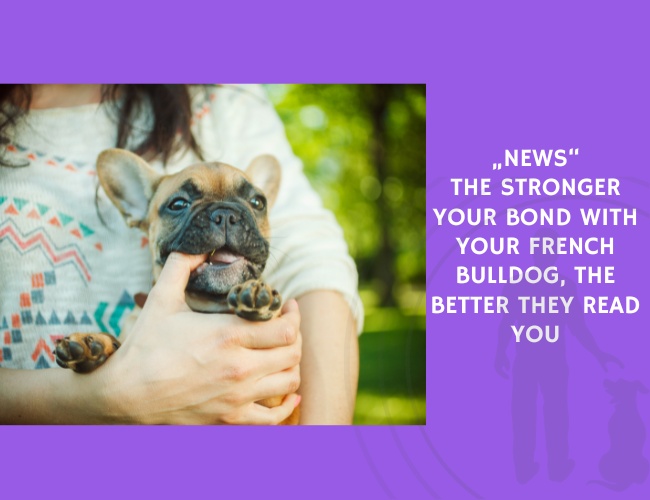
Can your dog read your gestures — and does the strength of your relationship determine how well they do it? A new study on French Bulldogs says yes. The bond you build with your dog isn’t just emotional. It actively shapes their social intelligence. 🐾
Researchers Lara Peterca, Elena Gobbo, and Manja Zupan Šemrov worked with 26 French Bulldogs and their owners, testing a straightforward but revealing setup: could the dogs follow a pointing gesture to locate a hidden treat? The task measures something fundamental — whether a dog is reading human communicative intent, not just environmental cues.
How the Bond Was Measured
The owner–dog relationship was assessed through a validated questionnaire alongside salivary oxytocin levels — the hormone most commonly associated with positive social bonding. Together, these two measures gave the researchers a picture of both the subjective quality of the relationship and its physiological signature.
Several individual variables also turned out to matter: the dog’s age, gender, neuter status, and prior training experience all influenced performance on the pointing task. These findings are a useful reminder that cognition is never one-dimensional — it’s always the product of biology, history, and relationship combined.
What the Results Actually Show 🧠
Dogs with stronger owner bonds performed better at following the pointing gesture. The relationship quality — how connected and attuned the owner-dog pair was — predicted social cognitive performance in a meaningful way.
The oxytocin finding, however, was more nuanced. Salivary oxytocin levels didn’t directly influence which bowl the dogs chose. This mirrors findings from other recent research suggesting that oxytocin’s role in bonding is more complex than a simple more-is-better equation — it operates within a broader system, not as a standalone switch.
What held firm across the data was this: the quality of the relationship predicted the quality of communication. A dog who is more deeply bonded to their owner doesn’t just feel more comfortable around them — they understand them better. That’s not a small finding. That’s a direct link between emotional connection and cognitive function.
The Bond Is the Infrastructure 🐕
This is what NeuroBond points to at its core. The relationship between dog and owner isn’t a backdrop to training — it’s the operating system that makes communication possible in the first place. A dog who trusts you doesn’t just behave better. They read you better. They follow you better. They’re more available to the signals you’re sending.
The Invisible Leash described in this study isn’t about obedience. It’s about attunement — the quiet, accumulated alignment that makes a pointing finger mean something, that makes a glance carry weight. You don’t teach that in a single session. You build it over time, through presence, consistency, and genuine connection.
And when that foundation is in place, communication doesn’t have to be forced. It flows. 🐾
Source: Peterca, L., Gobbo, E., & Zupan Šemrov, M. (2024). Dog–Owner Relationship and Its Association with Social Cognition in French Bulldogs. Animals, published December 25, 2024.










