
Chiang Mai, Thailand, June 27, 2026 Junttila et al. (2024/2025) — smartDOG Cognitive Test Battery
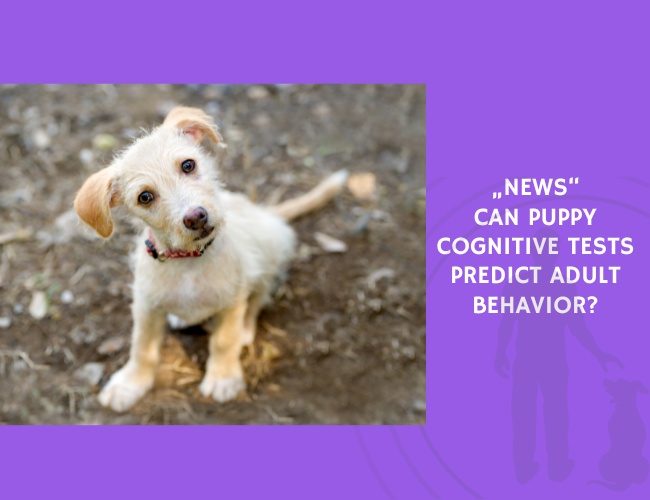
Can Puppy Cognitive Performance Predict Adult Behaviour Problems?
What if you could know — early — whether your puppy is likely to struggle with fearfulness, impulsivity, or reactivity as an adult? New research suggests that cognitive testing in puppies may get us closer to exactly that. 🐾
A growing body of research is examining whether the way a puppy thinks — how they solve problems, how they respond to signals, how they manage impulses — can tell us something meaningful about who they’ll become. The answer, increasingly, appears to be yes.
The Problem With Problem Behaviour
Problem behaviour in dogs is far more common than most people realise. Research puts the prevalence somewhere between 34% and 99% — a wide range, but even at the low end, that’s a striking number. Aggression, excessive barking, fearfulness, hyperactivity, inappropriate elimination — these aren’t rare edge cases. They’re the everyday reality for a significant portion of dog owners.
And the consequences go both ways. Problem behaviour affects the welfare of the dog. It affects the owner. At its worst, it leads to relinquishment, early death, or euthanasia. These aren’t abstract statistics — they represent real dogs, real bonds broken under pressure that could, potentially, have been anticipated earlier.
What Cognitive Tests Can Tell Us 🧩
The researchers behind this work had already found, in a previous study focusing on adult dogs, that cognitive test performance was associated with key behavioural traits — including impulsivity, trainability, fearfulness, and what they call management problems. These traits don’t just affect day-to-day life. They shape the entire quality of the dog-owner relationship.
The question this new research asks is whether those same patterns can be detected earlier — in puppies — and whether they hold across time.
For working dogs, the evidence already exists. Detection dog success has been predicted from memory and reversal learning tasks at just 2–3 months. Guide dog success from a motor inhibition task at puppy age. Cognition, it turns out, leaves early fingerprints.
Not All Puppy Tests Are Equal ⚠️
This is where it gets important for anyone who has ever attended a puppy temperament test or had a breeder assess their litter.
Testing puppies under eight weeks of age is common — but the reliability of those results is genuinely questionable. At that stage, traits simply haven’t fully stabilised yet. Across species, personality becomes more consistent with age. A puppy’s results before eight weeks can even be influenced by something as basic as whether they’re in a light or deep phase of their sleep-wake cycle at the time of testing.
The picture becomes more reliable, the research suggests, once puppies are past three months. By that point, cognitive and behavioural traits are starting to show the kind of consistency that makes prediction meaningful.
What This Means for You and Your Dog 🐕
If early cognitive testing can flag the behaviours a puppy is more likely to develop — fearfulness, impulsivity, difficulty with inhibitory control — then owners have something genuinely valuable: a window. Not a verdict. A window.
Early awareness creates the possibility of early action. Targeted training, environmental adjustments, the right kind of socialisation at the right time. Problems that might have escalated quietly over months or years become visible early enough to shape differently.
This is what we mean at Zoeta Dogsoul when we talk about NeuroBond — building the kind of attunement that doesn’t wait for problems to arrive. It pays attention upstream. A dog who trusts you isn’t a dog who happened to turn out fine. It’s a dog whose signals were read early, consistently, and accurately.
The Invisible Leash runs both ways. The clearer your read of your puppy’s cognitive and emotional wiring from the beginning, the stronger — and calmer — that connection becomes over time.
The Bottom Line
Cognitive testing in puppies is not yet a crystal ball. Longitudinal research is still limited, sample sizes in some key studies have been small, and the science is actively developing. But the direction is clear: how a young dog processes, responds, and regulates is not random noise. It’s signal.
Pay attention early. The dog your puppy is becoming is already showing you who they are. 🐾
Source: Junttila, S., et al. The influence of puppy cognitive performance on adult behavioural traits — smartDOG cognitive test battery research series. Referenced in conjunction with Junttila et al. (2024), and related longitudinal research including Bray et al. (2021), Lazarowski et al. (2020), and Foraita et al. (2024).










