
Molinaro & Wynne (2025) — PeerJ
Paw-spective Shift: How Our Mood Alters the Way We Read Dog Emotions
Published: July 13, 2026
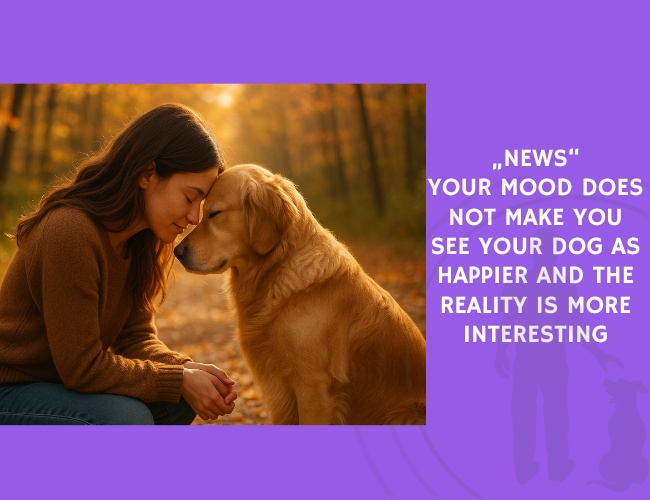
The same researchers who recently demonstrated that background context distorts how owners read dog emotions have now turned to a different question: does the owner’s own mood systematically bias how they interpret what their dog is feeling? The answer is more counterintuitive than almost anyone would predict — and it challenges one of the most common assumptions about human emotional perception. 🐾
Researchers H.G. Molinaro and Clive Wynne ran two experiments using validated mood priming — a well established psychological method of reliably inducing positive, neutral, or negative emotional states — before asking participants to evaluate video clips of dogs displaying positive, neutral, or negative emotional states. The design was precise, the mood induction was confirmed to have worked, and the results came out in a direction the existing literature on mood congruence effects would not have predicted.
Two Experiments and One Unexpected Result
In the first experiment, participants were primed into different moods using visual stimuli unrelated to animals, then asked to rate the valence and arousal of dogs in video clips. Mood priming worked — participants self-reported emotional states consistent with the intended prime. But when it came to rating the dogs, mood made no measurable difference. A person primed into a positive mood did not rate the dogs as more positive. A person primed into a negative mood did not rate the dogs as more negative. The mood effect, clear in the participants themselves, simply did not transfer to how they read the dogs on screen.
The second experiment introduced dog-specific primes — visual stimuli related to dogs rather than unrelated images. Here the mood priming did produce a significant effect on how participants interpreted dog emotions. But the direction was the opposite of what mood congruence theory would predict. Participants primed into a positive mood rated the dogs as sadder. Participants primed into a negative mood rated the dogs as happier. The mood effect was real. It was just running in reverse.
This contrasting effect is not yet fully explained. The researchers are explicit on this point — the mechanisms behind this finding require further investigation. One plausible interpretation is a form of contrast effect: a person in a positive emotional state may use their own high baseline as a reference point and judge the dog as relatively lower by comparison. A person in a negative state may judge the dog as relatively more positive against their own lowered baseline. But this remains a hypothesis rather than a confirmed mechanism, and the researchers are careful not to overstate the explanation.
Why This Matters for How You Read Your Dog ⚠️
Taken together with their earlier study on contextual bias, this research produces a picture of human emotion perception that is significantly more complex and less reliable than most owners assume. Background context distorts reading. Mood distorts reading. And the direction of mood distortion may run counter to what intuition suggests.
The owner who is having a bad day and looks at their dog and sees a dog who seems fine may not be accurately reading the dog at all. They may be reading a contrast effect produced by their own emotional state. Equally, an owner in a positive mood who perceives their dog as subdued or sad may not be detecting genuine canine distress — they may be experiencing the same contrast mechanism from the other direction.
Neither of these patterns is under conscious control. They are not errors in attentiveness that can simply be corrected by trying harder. They are features of how emotional perception operates at a cognitive level, and they apply to even careful, engaged, experienced owners. The dog owner who believes their emotional state has no effect on how they read their dog has now been directly contradicted by controlled experimental data.
What Genuine Attunement Actually Requires 🐕
This is where NeuroBond becomes more than a relational ideal — it becomes a practical discipline. Real attunement requires actively accounting for the noise your own emotional state introduces into the signal you are trying to read. Not eliminating it, because this research suggests that may not be fully possible, but recognising it as a variable. Asking not only what does my dog seem to be feeling but also what am I bringing to this reading that might be shaping it.
The Invisible Leash runs in both directions — and this research shows that what travels along it from owner to dog is not limited to training signals or physical cues. Your mood alters your perception of your dog. Your altered perception shapes how you respond to them. And your response shapes their subsequent behaviour and state. The loop is continuous, and the quality of the read you are making is one of the most important variables within it. 🐾
Source: Molinaro, H. G., & Wynne, C. D. L. (2025). Paw-spective shift: how our mood alters the way we read dog emotions. PeerJ. Published December 5, 2025.










