
Kogan, Currin-McCulloch et al. (2025) — Human-Animal Interactions
Dog Training-Related Guilt: Prevalence and Associations with Owner Demographics and Self-Compassion
Published: July 20, 2026
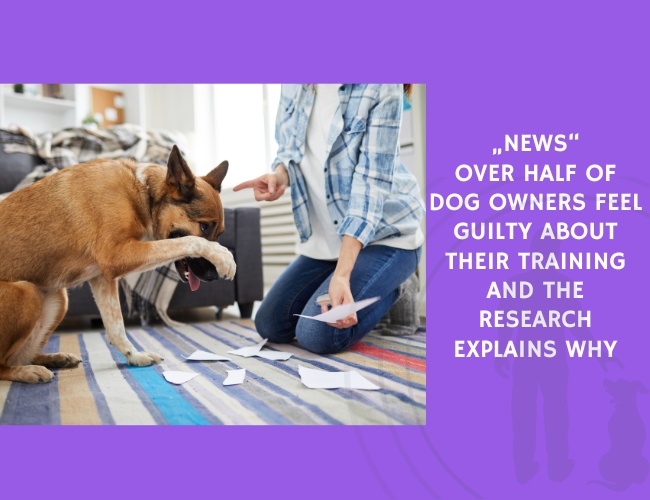
Dog training guilt is real, it is widespread, and it is now being studied systematically for the first time. A survey of 361 dog owners across the United States, Canada, and the United Kingdom has found that the majority of owners regularly experience guilt related to their training practices — and the specific triggers, the demographic patterns, and the psychological variable that predicts it most strongly all carry practical implications for every owner who has ever raised their voice at their dog and felt bad about it afterward. 🐾
Researchers Lori Kogan, Jennifer Currin-McCulloch, W. Packman, and Cori Bussolari examined the prevalence of training-related guilt among dog owners, what predicts it, and what buffers against it. The study used validated measures for guilt frequency and self-compassion alongside demographic data, and ran regression analyses to identify which variables most strongly predicted guilt levels. The picture that emerged is one that the dog training industry has largely avoided naming directly — and naming it matters.
How Common Training Guilt Actually Is
The prevalence figures alone are striking. Approximately 40 to 45 percent of owners reported often feeling guilty for not spending adequate time training, for raising their voice at their dog, or for being inconsistent with rules. Over 50 percent felt guilty when they reacted negatively to their dog’s behaviour or when they felt pressure to always use positive reinforcement. Regarding specific behaviours, over half of owners felt guilty about their dog jumping on guests (53.8%), lunging at cars or bikes (57.5%), or chewing inappropriate items (51.6%).
That last category is particularly telling. Guilt about the dog’s behaviour — not the owner’s training method, but the outcome — suggests that many owners have internalised a standard against which their dog’s every action is being measured and found wanting. The dog that lunges at a cyclist is not just a training challenge. It is a source of shame. That is a significant psychological burden, and it is one that the training industry’s emphasis on positive reinforcement as the only acceptable method has almost certainly amplified rather than reduced.
The parallel the researchers draw to parental guilt is precise. Parents experience guilt when their discipline practices deviate from what professional guidance advocates. Dog owners experience the same mechanism when their training practices deviate from professional recommendations — regardless of whether those deviations were chosen or simply happened in a moment of frustration. The emotion is the same. The trigger structure is the same. And the consequences for the person experiencing it are similarly corrosive when they accumulate.
Who Feels It Most and What Predicts It ⚠️
Regression analysis identified three demographic and psychological predictors of higher training-related guilt. Younger women owners reported higher guilt levels than older owners or male owners. Owners who had attended professional training sessions with a trainer or behaviourist reported higher guilt than those who had not. And lower self-compassion — specifically the dimensions of self-judgment, isolation, and over-identification with negative experience — was the strongest individual predictor of training-related guilt across the sample.
The professional training finding is counterintuitive and important. Owners who sought help, who invested in understanding how to train their dog better, reported more guilt than those who had not attended training at all. This is not evidence that professional training causes guilt. It is evidence that exposure to professional standards, without the psychological scaffolding to apply them imperfectly and recover, increases the gap between what an owner believes they should be doing and what they are actually doing — and guilt lives precisely in that gap.
Self-compassion as the strongest predictor is the most actionable finding in the study. Self-compassion in psychological research refers to the capacity to treat oneself with the same understanding one would extend to a friend facing the same difficulty — to acknowledge imperfection without self-punishment, to recognise that struggle is part of shared human experience rather than personal failure, and to hold difficult emotions without being overwhelmed by them. Owners with lower self-compassion are not worse dog owners. They are owners whose psychological relationship with their own imperfection makes the training process significantly harder than it needs to be.
What This Means for How Owners Approach Training 🐕
The researchers are explicit in their conclusion: dog trainers and veterinary behaviourists should actively normalise training challenges and incorporate self-compassion interventions into their work with owners. This is not a soft recommendation. It is a recognition that the psychological state of the owner is a training variable — one that shapes consistency, emotional tone, and the quality of the relationship within which all training occurs.
An owner who trains from a state of accumulated guilt is not an owner who is fully present with their dog. They are an owner managing their own emotional reaction to their perceived failures alongside the actual task of communicating with the animal in front of them. That split attention is not neutral. It produces exactly the inconsistency that the research identifies as a major guilt trigger — creating a loop where guilt produces inconsistency and inconsistency produces more guilt.
At Zoeta Dogsoul, this research confirms something central to NeuroBond. The quality of presence an owner brings to their dog is inseparable from the quality of their relationship with themselves. A training session conducted from guilt, self-judgment, and the need to perform perfect positive reinforcement is a training session in which the owner is not fully available to the dog. The dog receives a distorted version of the interaction — one filtered through the owner’s internal noise.
Imperfect training, done consistently and with genuine presence, builds more than perfect technique delivered through a fog of self-criticism. The Invisible Leash is held most steadily by an owner who can make a mistake, acknowledge it, and return to the dog without carrying it forward as a weight. That is not a lowering of standards. That is what sustainable, effective training actually looks like in practice. 🐾
Source: Kogan, L. R., Currin-McCulloch, J., Packman, W., & Bussolari, C. (2025). Dog training-related guilt: Prevalence and associations with owner demographics and self-compassion. Human-Animal Interactions. Published September 25, 2025.










