Zilocchi, Tagliavini et al. (2016) — Applied Animal Behaviour Science
Effects of Physical Activity on Dog Behavior
Published: Augsut 24, 2026
Whether the amount of physical activity a dog gets influences their behavioural profile — specifically whether it reduces the expression of undesirable behaviours — is a question with obvious practical relevance for every dog owner. A questionnaire study comparing 94 sports-active dogs to 140 sedentary dogs has produced preliminary data suggesting the answer is yes, with some specific caveats about which behaviours change and in which direction. 🐾
Researchers Marcella Zilocchi, Zalea Tagliavini, Elisa Cianni, and A. Gazzano collected and analysed 234 owner-completed questionnaires, separating respondents into an active dog group — dogs performing a sport — and a sedentary dog group. Behavioural differences between the groups were assessed across a range of specific behaviours, and the agility subgroup within the active category was examined separately for its particularly distinctive results.
What Physical Activity Changed and What It Did Not
Active dogs showed significantly fewer instances of turning on itself and mounting compared to sedentary dogs. Both of these behaviours can be indicators of stress arising from frustration — repetitive or displacement behaviours that emerge when a dog’s motivational system is chronically underactivated relative to its drive levels. The interpretation the researchers offer is direct: physical activity, particularly sport, requires the animal to develop frustration tolerance and self-control capacity. A dog who is regularly challenged to maintain composure under the arousal demands of sport training may have a more resilient frustration regulation system than a sedentary dog whose arousal builds without adequate outlet.
Active dogs also showed more chasing of vehicles and persons, and more object staring — behaviours associated with predatory motor sequences and sustained attentional focus. The researchers note that this may partly reflect the high proportion of Border Collies in the active group — a breed in which both sustained visual fixation and chase drive are strongly expressed and may be intensified rather than reduced by sport training that rewards focus and drive. This is an important caveat that prevents over-generalising the chasing and staring findings across all active dogs — the sport-active group in this sample is not a representative cross-section of the dog population.
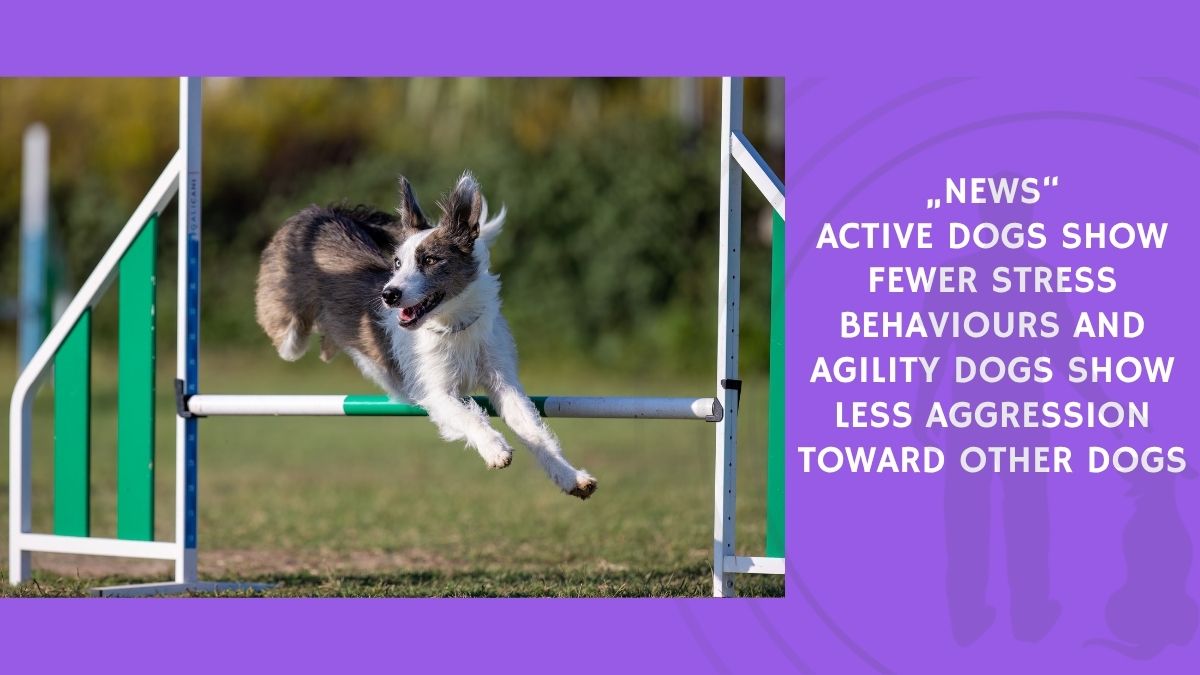
The agility subgroup produced the most specific and practically significant finding: agility dogs showed significantly lower aggression toward other dogs compared to other subjects in the sample. The proposed mechanism is socialisation — dogs who compete in agility are regularly exposed to large numbers of unfamiliar dogs in the structured, positive context of sporting events. This repeated positive contact in an organised environment may produce better intraspecific social calibration than either no exposure or unstructured high-arousal exposure. The positive reinforcement training methods characteristic of agility may add a further contribution — a dog trained through positive reinforcement to engage with a task has a different relationship to novel stimuli than a dog trained through aversive methods.
What Frustration Tolerance Actually Is and Why It Matters ⚠️
Frustration in dogs — the motivational state produced when goal-directed behaviour is blocked — is one of the most common drivers of the undesirable behaviours that owners find most difficult to manage. Mounting, repetitive movement, compulsive focus on objects, displacement activities, and some forms of aggression all have frustration contributions in their aetiology. A dog with higher frustration tolerance — who can sustain directed behaviour without tipping into stress-driven alternatives when the immediate goal is not achieved — is a dog who is less likely to express these behaviours in challenging daily life contexts.
Sport training builds frustration tolerance because it systematically requires exactly that: sustained effort toward a goal across many trials, with delay and partial reinforcement woven into the training structure. A dog who has learned through agility training that sustained attentional focus on the task will eventually produce the outcome is a dog whose frustration regulation system has been trained alongside its physical and cognitive skills. The behavioural benefit is not simply the calming effect of physical exercise — it is the frustration regulation capacity that sport-structured training specifically develops.
This is distinct from simply tiring a dog out through exercise. A dog who runs for an hour and then returns to an unstimulating environment may have lower energy for a period but has not developed frustration tolerance through that run. The structured, goal-directed, skill-building quality of sport training — not just its physical demands — appears to be what produces the behavioural benefits this study identifies.
What This Means for How Owners Think About Activity 🐕
The distinction between physical exercise and structured sport is the most practically important message from this research. A dog who walks twice daily and occasionally runs in a park is getting exercise. A dog who attends agility, nose work, obedience sport, or any other structured dog sport is getting exercise plus the frustration tolerance development, focused handler engagement, and intraspecific socialisation that produce the behavioural benefits this study identifies.
At Zoeta Dogsoul, structured engagement is always part of how NeuroBond approaches the relationship between dog and owner. A dog whose motivation system is adequately challenged through structured, positive, goal-directed activity with their handler is a dog whose frustration regulation, social calibration, and behavioural stability are being actively maintained rather than left to deteriorate through under-engagement. The Invisible Leash is strongest in a dog who has learned through structured engagement that orienting toward their handler and sustaining effort toward shared goals produces consistently good outcomes. That is not incidental to the physical activity. It is the core of what the activity is building. 🐾
Source: Zilocchi, M., Tagliavini, Z., Cianni, E., & Gazzano, A. (2016). Effects of physical activity on dog behavior. Applied Animal Behaviour Science. Published August 1, 2016.