Shan, Xu & Brenig (2021) — Frontiers in Veterinary Science
Genome-Wide Association Studies Reveal Neurological Genes for Dog Herding, Predation, Temperament, and Trainability Traits
Published: Augsust 19, 2026
Why does a Border Collie herd and a Greyhound chase? Why does one breed train in minutes what takes another breed weeks? These differences in working behaviour between breeds have been attributed to selective breeding for centuries — but the specific genes driving them have remained largely unknown. A genome-wide association study using whole-genome sequences from 268 dogs across 130 modern breeds has now identified neurological candidate genes underlying herding, predation, temperament, and trainability. 🐾
Researchers Shuwen Shan, Fangzheng Xu, and B. Brenig used breed standard descriptions and American Kennel Club breed groupings as phenotypic measurements — an approach that trades individual-level precision for the large sample sizes needed to detect genome-wide significant signals in complex behavioural traits. Behavioural phenotypes mapped from breed standards are imprecise instruments, but at scale they capture the aggregate genetic signal that centuries of directional selection have built into breed-level behavioural differences. The candidate genes that emerge from this approach point toward specific neurological pathways.
The Herding and Predation Genetics
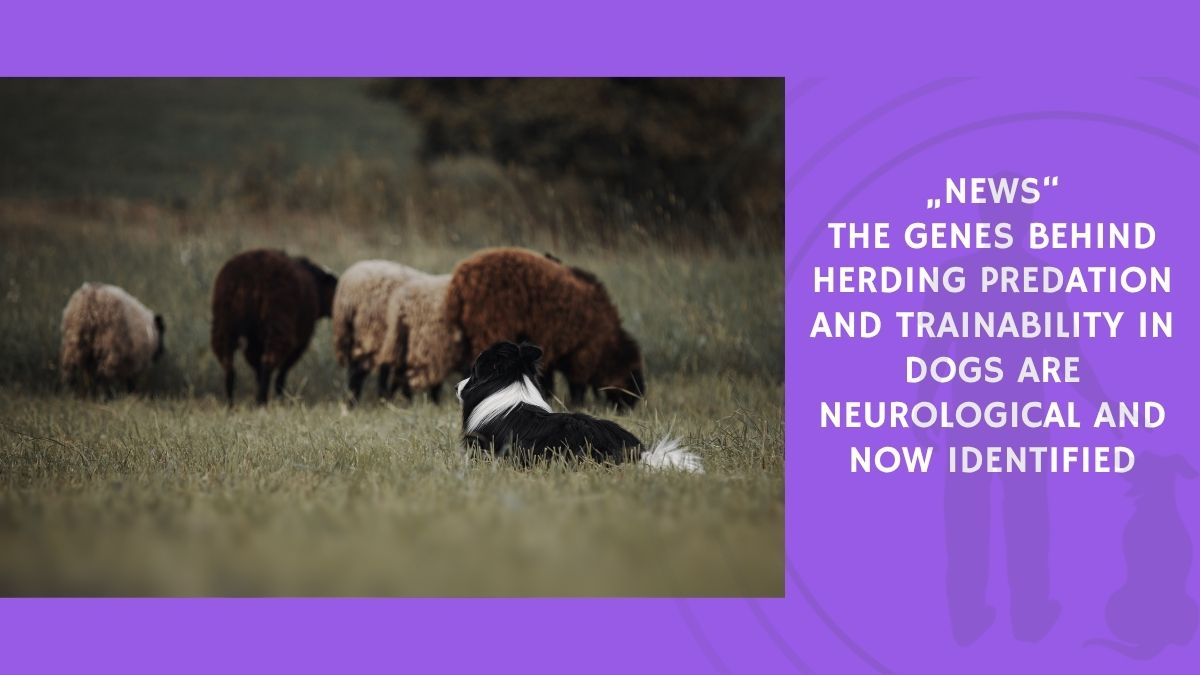
The GWAS for herding behaviour identified 44 significantly associated sites across five chromosomes. The most biologically interesting are those on chromosomes CFA7, 9, 10, and 20 — located in or near genes including THOC1, ASIC2, MSRB3, LLPH, RFX8, and CHL1. Two of these — MSRB3 and CHL1 — have previously been reported in association with dog fear. That herding behaviour shares genetic territory with fear-related gene variants is not coincidental. Herding is, as the researchers precisely frame it, a restricted form of hunting behaviour — predatory motor sequence with the killing instinct removed. The neural circuits that produce herding may be a modified version of the neural circuits that produce predation, with the modification encoded in part through the same genetic regions that modulate fear and threat response.
The predation analysis compared 36 hounds and 55 herding dogs directly, identifying three neuronal-related candidate genes: JAK2, MEIS1, and LRRTM4. JAK2 is involved in cytokine signalling with known roles in brain development. MEIS1 is a transcription factor associated with neural development and has been implicated in restless legs syndrome in humans — a condition involving dopaminergic pathway dysfunction. LRRTM4 is involved in synapse formation and function. The neural architecture of predatory behaviour is beginning to resolve at a molecular level through findings like these.
Temperament GWAS identified a significant variant within the ACSS3 gene — involved in acetyl-CoA metabolism and with roles in nervous system function. Trainability showed the highest association on chromosome CFA22, though no variant reached the Bonferroni significance threshold — a reminder that trainability is likely a highly polygenic trait whose genetic architecture requires larger sample sizes to fully resolve than the current dataset provides.
What Neurological and Psychiatric Gene Overlap Tells Us ⚠️
The finding that consistently runs through this GWAS is that the candidate genes for dog herding, predation, and temperament are not morphological genes, not metabolic genes, not structural genes. They are neurological genes — genes involved in nervous system development, synaptic function, and neural circuit architecture. In humans, the same genes are associated with nervous system development and, in some cases, with psychiatric disorders.
This parallel is not a coincidence and it is not alarming. It reflects a fundamental biological reality: the same gene systems that build and regulate complex behaviour in any mammal — the wiring of attention, arousal, impulse control, social motivation, threat sensitivity — are going to be implicated in both adaptive behavioural variation and maladaptive psychiatric conditions when they are disrupted. A gene that contributes to the precise attentional focus of a herding Border Collie may, in a different allelic variant or a different genetic background, contribute to anxiety or compulsive behaviour. The gene is not the disorder. The genetic context determines which direction variation in that gene pushes behaviour.
This is consistent with the research covered earlier in this series showing that dogs are a translational model for human psychiatric conditions — the overlapping genetic architecture between canine behavioural traits and human neurological and psychiatric conditions is one of the most compelling arguments for studying both within the same scientific framework.
What This Means for Understanding the Dog in Front of You 🐕
The breed-level phenotype approach used here captures the genetic signal of centuries of directional selection — the aggregate difference between herding breeds and hound breeds encoded across thousands of individual breeding decisions. But as the Morrill et al. Science study covered in this series established, breed explains only 9 percent of individual behavioural variation. The neurological genes identified here shape the starting distribution of behavioural tendencies in breed populations — they do not determine the individual dog.
What they do provide is a molecular foundation for the kind of individual attunement that NeuroBond describes. A Border Collie carrying the herding-associated variants in MSRB3 and CHL1 — genes linked to both herding behaviour and fear responses — is a dog whose neural architecture may place herding drive and fear sensitivity in closer proximity than in breeds where these signals are more separated. Understanding that proximity changes how the handler approaches the dog, how training is structured, and what environmental conditions support or undermine the dog’s working capacity.
The Invisible Leash between working dog and handler is held by a nervous system whose architecture is now beginning to be read at the level of specific genes. That knowledge does not replace attunement — it deepens it. 🐾
Source: Shan, S., Xu, F., & Brenig, B. (2021). Genome-Wide Association Studies Reveal Neurological Genes for Dog Herding, Predation, Temperament, and Trainability Traits. Frontiers in Veterinary Science. Published July 21, 2021.