
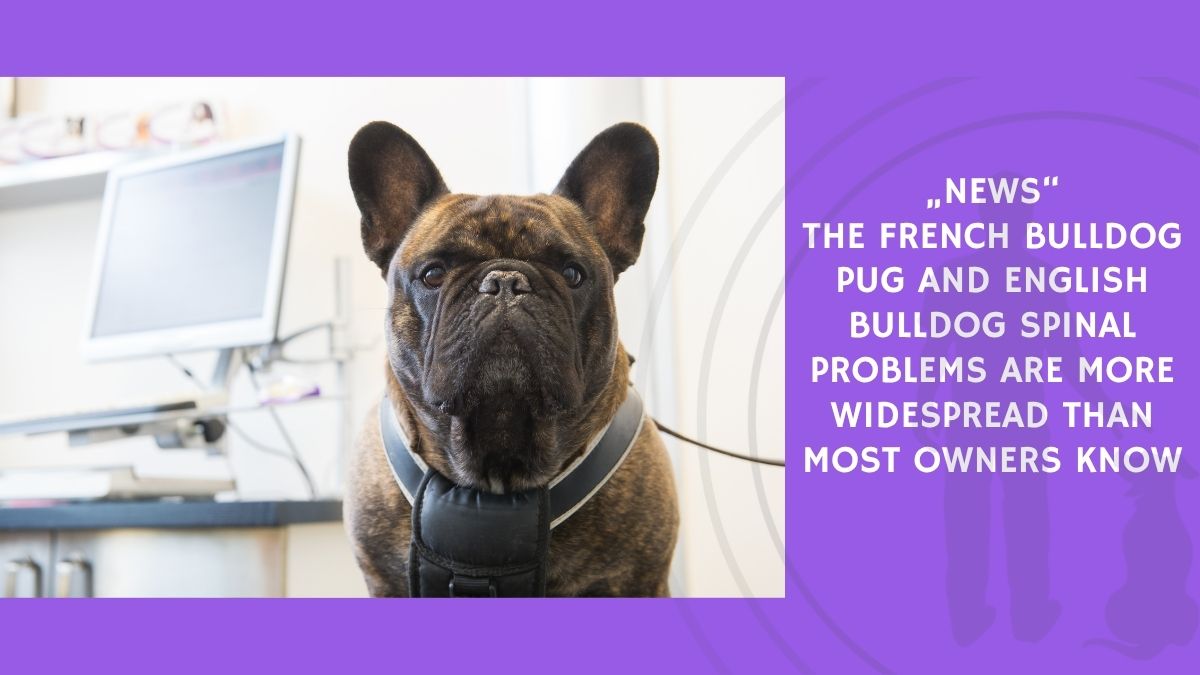
de Decker, Rohdin & Gutiérrez-Quintana (2024) — The Veterinary Journal
Vertebral and Spinal Malformations in Small Brachycephalic Dog Breeds: Current Knowledge and Remaining Questions
Published: August 27, 2026
The brachycephalic health conversation has been dominated by airways. Stenotic nares, elongated soft palate, obstructive airway syndrome — these are the conditions that have received the most public attention and the most legislative scrutiny. A comprehensive review published in The Veterinary Journal makes the case that the spinal picture in these breeds deserves equal attention — and that what is currently known about vertebral and spinal malformations in French Bulldogs, English Bulldogs, and Pugs raises questions that clinical practice has not yet fully resolved. 🐾
Researchers S. de Decker, C. Rohdin, and R. Gutiérrez-Quintana reviewed the current understanding of vertebral and spinal malformations in small brachycephalic breeds — covering prevalence, anatomical characteristics, pathophysiology, and treatment across six distinct conditions: hemivertebra, caudal articular process dysplasia, transitional vertebra, cranial thoracic vertebral canal stenosis, spinal arachnoid diverticulum, and meningeal fibrosis. The review is explicit that recent research has produced new insights but has also surfaced new controversies — and that many questions remain unanswered.
What These Breeds Are Predisposed To and How Common It Is
Hemivertebra — wedge-shaped or incompletely formed vertebrae that produce spinal curvature — is the most widely recognised vertebral malformation in these breeds. The same selective breeding that produced the screw tail characteristic of Bulldogs and Pugs selected for wedge-shaped caudal vertebrae as an aesthetic feature, and that same developmental tendency produces hemivertebra throughout the thoracic spine as a regular anatomical finding in these breeds rather than an exceptional one.
Caudal articular process dysplasia — malformation of the joints between adjacent vertebrae — and transitional vertebra — vertebrae with anatomical features intermediate between two spinal regions — also occur commonly in neurologically normal dogs from these breeds. Cranial thoracic vertebral canal stenosis — narrowing of the bony channel through which the spinal cord passes — is similarly documented at significant prevalence.
The review identifies a clinically important controversy around these findings: their presence in neurologically normal dogs has led some to question their clinical relevance. A French Bulldog with hemivertebra on imaging who shows no neurological signs presents a genuinely difficult interpretive challenge — is the hemivertebra clinically incidental, or is the dog compensating in ways that may eventually fail? The review addresses this directly: severe kyphosis and hemivertebra in Pugs have been specifically associated with increased likelihood of neurological signs, providing at least partial clinical guidance even where the general question remains open.
Spinal arachnoid diverticulum — fluid-filled pouches within the spinal canal that can compress the spinal cord — and meningeal fibrosis — dense intradural fibrotic adhesions that constrict the spinal cord — represent the more severe end of the malformation spectrum. Meningeal fibrosis is heavily associated with the Pug breed specifically, and in Pugs it commonly occurs alongside multiple concurrent spinal disorders — a presentation the review designates as pug dog thoracolumbar myelopathy, characterised by chronic progressive pelvic limb gait abnormalities. Potential genetic risk factors for this specific presentation have recently been identified, opening a pathway toward genetic screening that does not yet fully exist.
What Owners of These Breeds Need to Monitor ⚠️
The clinical manifestations of spinal malformation in these breeds range from entirely subclinical — found incidentally on imaging performed for other reasons — through subtle gait abnormalities that owners may initially attribute to other causes, to progressive neurological deterioration that eventually requires surgical intervention or produces permanent disability. The subclinical-to-clinical progression is not predictable at the individual level with current knowledge.
For Pug owners specifically, the association between this breed and meningeal fibrosis alongside thoracolumbar myelopathy means that any gait abnormality — wobbling, crossing of the hindlimbs, difficulty rising, reduced hindlimb strength — warrants prompt neurological evaluation rather than observation. Pug dog thoracolumbar myelopathy can present as gradually worsening hindlimb weakness that owners sometimes attribute to ageing or to the breed’s general physical style. The review’s documentation of a specific, named clinical syndrome with identified genetic risk factors means this is no longer a vague category — it is a distinct condition with a distinct presentation that vets and owners can actively look for.
For French Bulldog and English Bulldog owners, the prevalence of vertebral malformations in neurologically normal dogs means that imaging findings should be interpreted carefully in clinical context rather than automatically treated as the explanation for any sign of pain or neurological dysfunction. A dog with hemivertebra on imaging who is showing cervical pain may have unrelated cervical disc disease. A dog with vertebral canal stenosis who is showing hindlimb weakness may be experiencing stenosis-related cord compression or may have concurrent intervertebral disc disease. Teasing apart these overlapping conditions requires specialist neurological assessment.
What the Research Still Cannot Answer 🐕
The review is honest that significant questions remain unanswered — and naming those gaps is as important as summarising what is known. The natural history of hemivertebra in neurologically normal dogs is not fully characterised: what proportion will develop neurological signs, over what timeframe, and which anatomical features most reliably predict progression? The optimal treatment for spinal arachnoid diverticulum and meningeal fibrosis when they are identified — surgical intervention versus medical management versus surveillance — is not definitively established across the range of presentations these conditions can take. And the genetic architecture of pug dog thoracolumbar myelopathy, while partially identified, is not yet fully characterised enough to support reliable predictive genetic testing.
At Zoeta Dogsoul, seeing the whole animal accurately means seeing the spinal reality of brachycephalic breeds alongside their airway reality. NeuroBond is built on genuine attunement to the physical experience of the dog — and a dog carrying spinal malformations that affect their movement, their comfort, and potentially their neurological function is a dog whose physical experience is fundamentally different from what their behaviour may visibly suggest. Recognising that difference, monitoring for it actively, and responding to early signs promptly is part of what responsible ownership of these breeds looks like with the current evidence in hand. 🐾
Source: de Decker, S., Rohdin, C., & Gutiérrez-Quintana, R. (2024). Vertebral and spinal malformations in small brachycephalic dog breeds: current knowledge and remaining questions. The Veterinary Journal. Published March 6, 2024.










