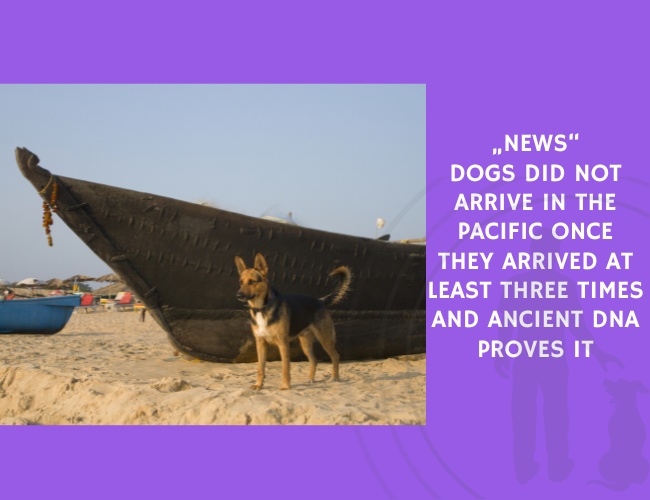
Greig, Gosling et al. (2018) — Scientific Reports
Complex History of Dog (Canis familiaris) Origins and Translocations in the Pacific Revealed by Ancient Mitogenomes
Published: July 24, 2026
The story of how dogs reached the Pacific islands is also the story of how humans crossed the largest ocean on earth — and for thousands of years, dogs made that crossing alongside them. A study analysing ancient DNA from archaeological dog specimens across Southeast Asia and the Pacific has revealed that this shared history was not a single event but a series of distinct dispersal waves, each leaving its own genetic signature in dog populations that persist to this day. 🐾
Researchers K. Greig, A. Gosling, E. Matisoo-Smith, and their team sequenced seven new complete ancient mitogenomes and five partial mitochondrial DNA sequences from archaeological dog specimens recovered from sites across Mainland and Island Southeast Asia and the Pacific. Mitogenomes — the complete genetic sequence of mitochondrial DNA, which is inherited maternally and preserved well in ancient samples — allow researchers to trace lineages backward through time and identify when and where populations diverged. What the data revealed was considerably more complex than previous archaeological models had assumed.
Three Separate Dispersal Events and What They Mean
The analysis identified at least three distinct dog dispersal events into the Pacific region, in addition to the introduction of dingoes to Australia — which represents a fourth independent translocation event in the broader picture. The three Pacific dispersal events left different genetic signatures in different geographic areas, and critically, they did not simply layer on top of each other. Some earlier lineages did not persist into later island populations, suggesting that dog populations were replaced or substantially changed rather than continuously accumulated as human migration pushed further east.
The earliest dispersal introduced dogs to Island Southeast Asia — but the genetic signatures of these early dogs do not appear in the later dog populations of Oceania. Whatever dogs arrived first in Island Southeast Asia either did not make the onward crossing or were replaced by later introductions before the Oceanic expansion began.
A shared haplogroup identified between Iron Age Taiwanese dogs and dogs from terminal and post-Lapita sites links at least one dog lineage directly to the Austronesian-speaking populations associated with the Lapita Cultural Complex — the archaeological culture credited with the human settlement of Near Oceania approximately 3,300 years ago. These dogs appear to have reached Near Oceania but the genetic evidence does not show them successfully transported beyond New Guinea into the broader Pacific.
The third event produced the most geographically widespread dog clade in the dataset — a lineage found across the Pacific including the islands of Polynesia, whose genetic signature points toward a post-Lapita introduction from southern Island Southeast Asia rather than a direct continuation of the Lapita dog lineage. This means that even the dogs who eventually reached the most remote islands of Polynesia by the fourteenth century AD were not simply the same dogs that crossed with the first Lapita settlers. They came later, from a different source population, in a dispersal event that has left its mark on Pacific dog genetics to this day.
Why Dogs Travelled With Humans at All ⚠️
The deeper question the research raises is not just how dogs reached the Pacific but why they were brought at all. Oceanic voyaging in outrigger canoes across hundreds or thousands of kilometres of open ocean was an extreme logistical challenge. Every item carried had weight, volume, and resource cost. Dogs were transported deliberately, across multiple independent dispersal events, by multiple human populations, into environments where they had to be maintained alive through the voyage and established in new island ecosystems on arrival.
The most likely explanations involve dogs serving practical functions — as hunting companions, as a food source in protein-scarce island environments, and potentially as culturally significant animals in the ritual and social life of Pacific communities. But the consistency with which dogs appear in the archaeological record of Pacific human expansion across multiple independent waves of migration suggests something more than purely instrumental utility. Dogs were considered worth the cost of transport across some of the most challenging maritime environments humans have ever navigated.
This is consistent with what the broader research on human-dog co-evolution shows: from the earliest wolf domestication through the global spread of human populations, dogs and humans have been moving together. The Pacific evidence extends that pattern into one of the last major phases of human global expansion and shows it operating through multiple independent decisions by multiple distinct human groups across thousands of years.
What Ancient Dog History Tells Us About the Bond Today 🐕
The relationship between dogs and humans is not a modern phenomenon and not a Western one. It is a global, ancient, repeatedly chosen connection that appears independently across human cultures in every environment humans have occupied. The Pacific dispersal evidence adds another chapter to a story that began tens of thousands of years ago and has not stopped since.
At Zoeta Dogsoul, this historical depth is part of what gives NeuroBond its full context. The attunement between dog and human did not begin with modern training methodology or contemporary pet culture. It was built across millennia of shared survival, shared migration, and shared adaptation — in Island Southeast Asia, in the canoes of Lapita voyagers, on the beaches of islands no human had seen before. The oxytocin loop, the physiological co-modulation, the capacity for mutual gaze bonding — all of it was shaped by a history long enough to cross an ocean. 🐾
Source: Greig, K., Gosling, A., et al. (2018). Complex history of dog (Canis familiaris) origins and translocations in the Pacific revealed by ancient mitogenomes. Scientific Reports. Published June 14, 2018.