Niazy, Bawish & Matoock (2024) — Assiut Veterinary Medical Journal
Assessment of Dog Temperaments of Different Breeds by Using the ATT Test in Dog Farms
Published: August 21, 2026
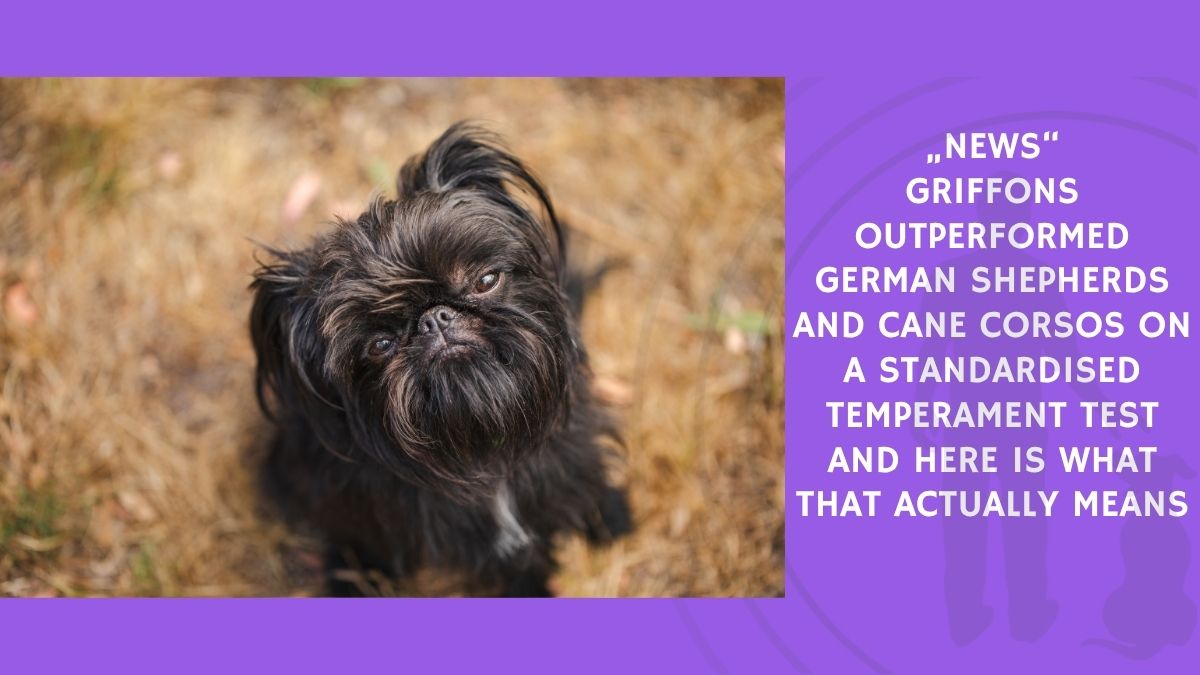
The American Temperament Test is a standardised behavioural assessment that evaluates dogs for shyness, fear, and unprovoked aggression across a structured series of neutral, threatening, and discriminatory scenarios. When toy breed Griffons pass it at significantly higher rates than German Shepherds and Cane Corsos, most people’s first reaction is surprise. Understanding why that result is not as counterintuitive as it appears — and what it reveals about how temperament tests actually work — is the more useful outcome of this study. 🐾
Researchers Azhar Niazy, Basma Bawish, and M. Matoock applied the ATT to 62 dogs across three breed groups — 16 Cane Corsos from the working group, 14 German Shepherds from the herding group, and 32 Griffons from the toy group — and analysed the results using descriptive statistics, Cronbach’s alpha for internal reliability, and dimension reduction analyses. The statistical rigour applied here adds methodological value beyond the straightforward breed comparison, and the findings invite interpretation at several levels.
What the ATT Actually Measures
The American Temperament Test was designed not as a breed evaluation tool but as an individual dog assessment — specifically to identify shyness and fear responses that may be addressable through training, and to flag unprovoked aggression that represents a safety concern. The test presents the dog with a series of social, auditory, visual, and tactile stimuli across neutral, friendly, and threatening contexts, evaluating whether the dog reacts with appropriate confidence, with fear and avoidance, or with unprovoked aggressive responses.
A dog passes the ATT by maintaining stable, appropriately responsive behaviour throughout — neither shutting down and showing persistent fear nor displaying unprovoked aggression. What the test is not designed to do is rank dogs by working ability, protective suitability, or the presence of traits that are valuable in specific functional contexts but would register as test failures in the ATT format.
This is the key to interpreting the Griffon result. A breed selected for alertness, curiosity, social responsiveness, and the kind of owner-directed engagement that makes toy breeds companionable is a breed that will naturally perform well in a test rewarding stable, curious, appropriately responsive behaviour across varied stimuli. The Griffon is not a braver or more temperamentally sound dog than a German Shepherd in any general sense — it is a dog whose specific temperament profile aligns more naturally with what the ATT is designed to identify as passing behaviour.
What Breed Group Differences in ATT Results Actually Tell Us ⚠️
The German Shepherd’s characteristic temperament profile — fearless, confident, aloof with strangers, quietly standing ground — contains elements that the ATT may score differently than the Griffon profile. A dog who stands its ground under neutral stimulus conditions may score differently from a dog who immediately orients toward the evaluator with curiosity and social engagement. A dog who is appropriately aloof with strangers may appear more reserved in a test administered by a stranger than a breed selected for broader human social responsiveness.
The Cane Corso profile — protective, affectionate with family, docile and easily trained in context — reflects a breed whose optimal behaviour is highly context-dependent. A dog bred to protect its family and property from genuine threat will apply a different behavioural assessment to neutral strangers in a testing environment than a dog whose entire social architecture is oriented toward positive engagement with unfamiliar people. That context-dependence is a feature of the breed’s working purpose — and the ATT may not fully distinguish between appropriate breed-typical caution and the kind of shyness or fear-based reactivity it was designed to identify as problematic.
This does not mean the ATT results are meaningless. They document real and measurable differences in how these breed groups respond to the test protocol. What requires care is the interpretation — the Griffon’s higher passing rate is not evidence of superior temperament in any global sense. It is evidence of closer alignment between the Griffon’s selected behavioural profile and the behavioural profile that the ATT defines as passing.
What Temperament Testing Can and Cannot Tell Us About Individual Dogs 🐕
Temperament testing across breeds is genuinely useful when the test’s design and the interpretation of results are calibrated to what is actually being measured. The ATT as an individual assessment tool — identifying fear and shyness that training might address — is a different instrument than a breed comparison tool. Using it to compare breed groups requires understanding that breed-typical behaviour that is adaptive and appropriate for the breed’s function may register differently on a test designed around a generalised behavioural standard.
The validated Finnish personality questionnaire covered earlier in this series identified seven distinct personality factors across companion dogs. The Kelpie working dog assessment identified five traits predicting herding ability. The ATT identifies a different set of parameters — fear, shyness, unprovoked aggression — that matter for public safety and trainability assessment rather than for working performance or relationship quality. Each instrument measures something real. None measures everything.
At Zoeta Dogsoul, accurate understanding of any individual dog begins with accurate understanding of what any given assessment is actually measuring. NeuroBond is built on seeing the real dog — which requires knowing the difference between a test result and a complete characterisation of who that dog is. A German Shepherd whose ATT score reflects breed-typical stranger aloofness is not the same dog as one whose score reflects fear-based reactivity — and managing them well requires that distinction to be read correctly from the result. 🐾
Source: Niazy, A. F., Bawish, B. M., & Matoock, M. (2024). Assessment of dog temperaments of different breeds by using the ATT test in dog farms. Assiut Veterinary Medical Journal. Published July 1, 2024.