
Lasserre, Ducreux et al. (2024) — Journal of Animal Science
Testing and Characterization of Herding Dogs’ Behaviours
Published: August 21, 2026
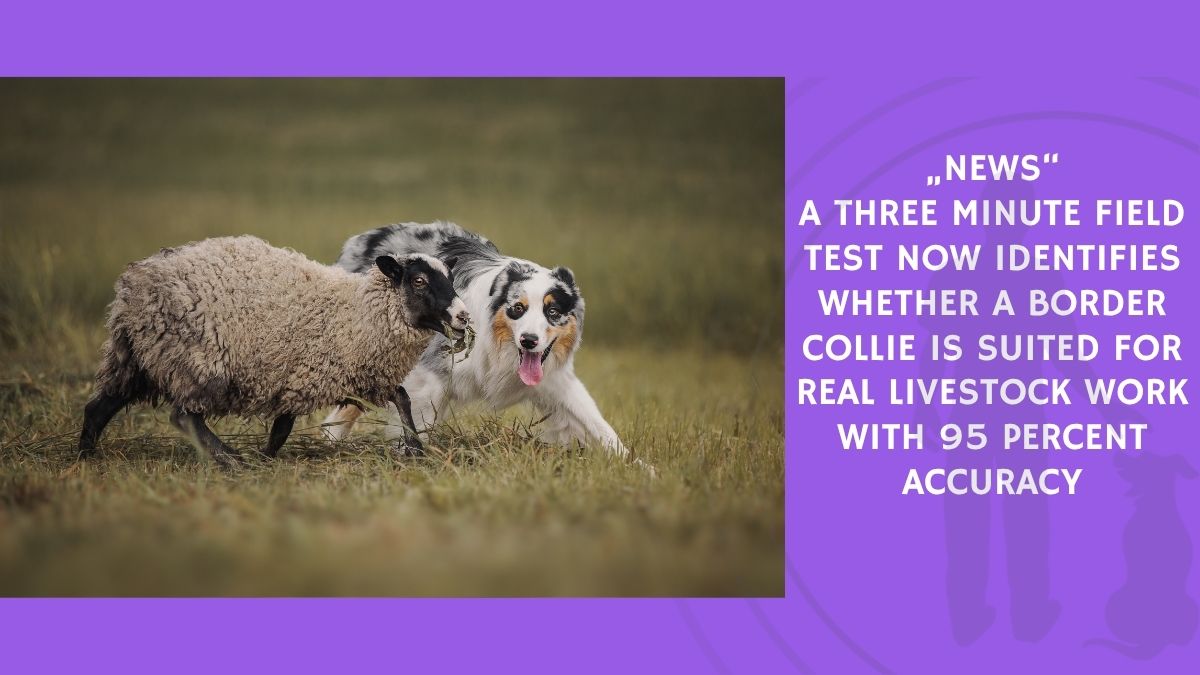
National field trial competitions have long been the primary basis for breeding selection in herding dogs. The problem is that competition performance is a poor predictor of whether a dog will actually be useful in real livestock farming conditions — where the demands of daily agricultural work differ significantly from the structured, scored environment of a competition arena. A new field trial protocol developed and validated on 460 French Border Collies has produced a short, standardised, reproducible test that identifies herding dogs suited for real-world agricultural work with 95.7 percent accuracy. 🐾
Researchers B. Lasserre, B. Ducreux, Caroline Gilbert, and their team designed a 28-item scoring system structured as a Pre-Test and Test phase — average total duration 3 minutes and 16 seconds — and applied it across 460 Border Collies aged 8 to 24 months. Expert assessment provided the gold standard against which the scoring system’s performance was evaluated. The result is a validated phenotyping tool with both the precision and the practical brevity needed for real breeding programme implementation.
What Adequate Phenotype Actually Means
The researchers defined an Adequate Phenotype herding dog with precision that goes beyond competition scoring. An AP dog is able to control the direction of a flock, keep it grouped close to the handler when needed, confront the livestock it is working with in a respectful manner, and create movement without excessive disturbance — specifically without threatening, attacking, uncontrolled chasing, or uncontrolled biting. This definition prioritises functional livestock management capacity over stylistic performance qualities that competition judging may reward.
The distinction matters because livestock farming places different demands on a dog than a competition field. Precision of outrun and fetch may be evaluated and scored in competition. The capacity to work cattle or difficult sheep calmly and effectively across an entire working day, in varied terrain, without creating the kind of disturbance that injures animals or disrupts production, is what actually determines a herding dog’s agricultural value. The AP definition is built around the latter set of demands rather than the former.
The sensitivity of the scoring system — its ability to correctly identify dogs that expert assessment rated as AP — was 93.3 percent. Specificity — correctly identifying non-adequate dogs — was 96.1 percent. Overall accuracy was 95.7 percent. These are strong performance figures for a behavioural phenotyping tool, particularly one brief enough to be practically implemented across large numbers of dogs in field conditions.
What Predicted Adequate Phenotype in the Data ⚠️
Recursive Feature Elimination identified 25 of 118 scored features as significant predictors of AP versus Non-Adequate Phenotype. The statistical definition of an AP herding dog that emerged from this analysis combined four elements: completing both the Pre-Test and Test phases, showing keenness — sustained motivated engagement with the task — correct positional relationship to the handler throughout, and absence of prey drive expression. That last element — absence of prey drive — is the most counterintuitive and most important. A herding dog who expresses overt prey drive during work is a dog whose predatory impulse is not being channelled into controlled herding but is breaking through the surface of the working behaviour. The AP dog is not a dog without predatory motivation — it is a dog whose predatory motivation is fully integrated into the controlled working pattern rather than expressing as uncontrolled chasing or attack.
Four environmental factors significantly influenced AP versus NAP outcomes in ways that have direct practical implications for breeders and farmers. The field trial session — which session the dog was tested in — had significant effects, likely reflecting evaluator calibration and environmental consistency. The owner’s experience with herding dogs significantly influenced outcomes, confirming that handler skill is not separable from dog performance even in phenotyping conditions. The conditions of the dog’s first contact with livestock mattered significantly — suggesting that early exposure quality shapes working phenotype in ways that persist into assessment. And the type of livestock the dog was accustomed to working with mattered — dogs habituated to one livestock species may not transfer performance equivalently to a different species.
The handler experience finding is the one with the broadest implications. It confirms what every experienced trainer knows and what the ethnographic herding dog research covered in this series documented from a different angle: the dog’s working performance cannot be evaluated in isolation from the handler. A dog assessed by an experienced herding dog owner is not showing the same performance profile as the same dog assessed by a novice — and a breeding programme that does not control for this variable is introducing systematic noise into its phenotypic data.
What This Means for Breeding and for Working Dog Selection 🐕
The researchers are explicit that the field trial and scoring system could provide the basis for a breeding programme based on phenotype — pending additional testing and the genetic analyses needed to connect phenotypic assessment to heritable variants. The working dog genetics research covered in this series, including the neurological gene GWAS and the Kelpie personality assessment work, provides the emerging genetic framework within which validated phenotypic assessments like this one could be integrated.
For farmers selecting working dogs, the validation of a short, implementable, reproducible assessment tool with this level of accuracy represents a genuine practical advance. The capacity to assess a dog in three minutes and identify with 95 percent accuracy whether it will be useful in real farming conditions is a selection tool that most herding dog selection processes currently lack. The fact that it identifies only 16.5 percent of tested dogs as adequate phenotype in this sample is itself a significant finding — it suggests that the current working dog population, even among purpose-bred Border Collies, contains a large proportion of individuals who will not perform adequately under real farming demands. Breeding selection that prioritises competition performance rather than functional phenotype is not efficiently producing the dogs that agricultural work actually requires.
At Zoeta Dogsoul, this research reinforces a principle that runs through the working dog science covered in this series: NeuroBond and the capacity for genuine working partnership are built on accurate assessment of who the dog actually is — not who the competition results suggest they might be, not who the breed stereotype implies they should be, but who this specific dog is in the specific functional context that matters. A validated tool that can reliably answer that question in three minutes and sixteen seconds is a tool worth knowing about. 🐾
Source: Lasserre, B., Ducreux, B., et al. (2024). Testing and characterization of herding dogs’ behaviours. Journal of Animal Science. Published June 21, 2024.










