
Jadhav, Pasqua et al. (2024) — Communications Biology
Collective Responses of Flocking Sheep to a Herding Dog (Border Collie)
Published: Augsut 17, 2026
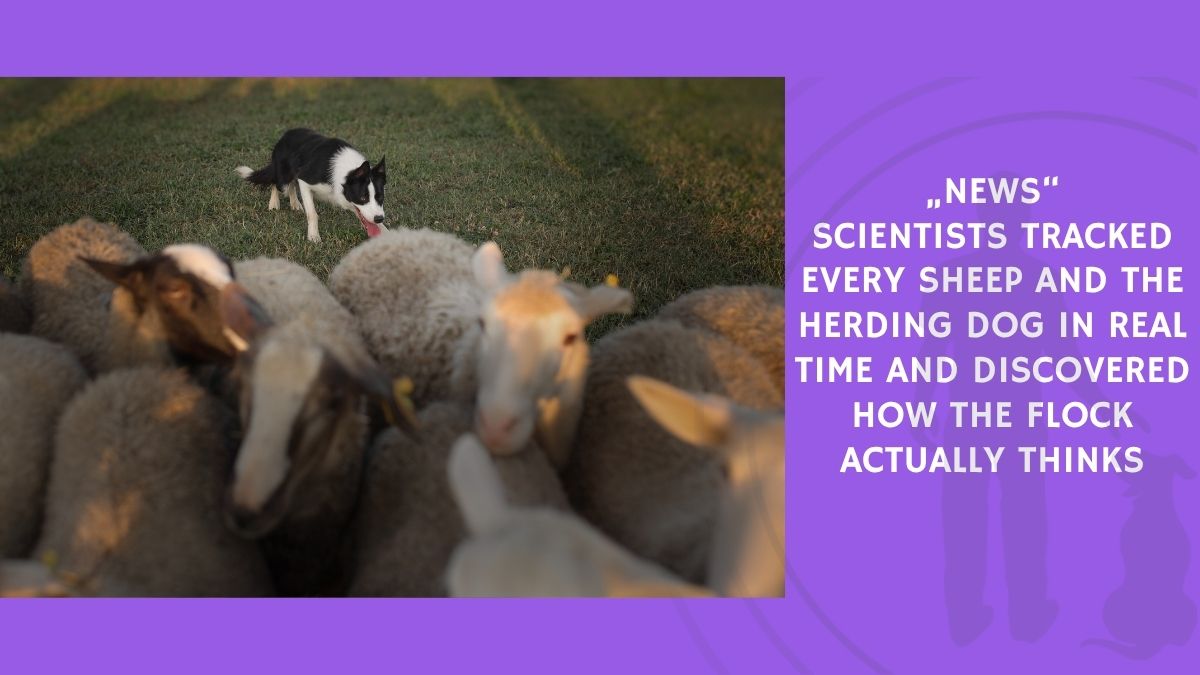
When a Border Collie moves behind a flock of sheep, something remarkable happens — 14 individual animals begin behaving as a single coordinated system, information flowing through the group in milliseconds, positional hierarchies emerging spontaneously, and the dog adjusting its own movement in real time in response to the flock’s dynamics. A study using ultra-wideband tracking tags on every sheep and the dog simultaneously has produced the highest-resolution picture yet of how this works — and what it reveals about collective intelligence and the Border Collie’s working cognition is striking. 🐾
Researchers Vivek Jadhav, Roberto Pasqua, Guy Theraulaz, and their team attached ultra-wideband tracking tags to 14 sheep and one Border Collie during herding tasks between two defined target points — collecting high-resolution spatiotemporal data on the position, velocity, and movement of every individual simultaneously. The data density this approach produces — tracking every animal in the group continuously rather than sampling positions at intervals — allowed analyses of collective movement and information flow that were previously impossible to conduct at this resolution. An agent-based computational model was then developed to capture the key patterns observed in the data.
How Information Flows Through the Flock
The first major finding concerns where in the flock directional information originates and how it propagates. The spatial position of individual sheep along the front-to-back axis of the group’s velocity direction strongly correlated with their influence on collective movement — sheep at the front of the moving group had greater impact on where the group went. This is consistent with what theory predicts: in a moving group, individuals at the leading edge are the first to detect and respond to changes in environment or threat, making their decisions propagate through the group faster than decisions made by individuals at the rear.
What the analysis revealed about the direction of information flow under chasing conditions adds a counter-intuitive layer. Even though the Border Collie was chasing the flock from behind, directional information on shorter time scales propagated from the front of the group toward the rear during chasing — not from back to front as might be expected from a rear-approaching threat. The sheep at the back of the flock were not the ones determining group direction despite being closest to the dog. The front-of-flock individuals remained the directional leaders even under active herding pressure.
This front-to-back information propagation pattern emerged specifically during chasing and disappeared in the absence of chasing — when the dog was not actively driving the flock, spatial positions shifted more frequently and the directional information flow pattern changed. The chasing context produced a more rigid spatial structure within the flock and a clearer directional information hierarchy than resting or undirected movement.
What the Dog Was Actually Doing ⚠️
The Border Collie was not simply applying pressure from behind and watching the flock go. The data confirmed that the dog was continuously adjusting its own movement in response to the flock’s dynamics — responding to where individual sheep were moving, how the group shape was changing, and where the collective was heading relative to the target. This bidirectional responsiveness — flock responding to dog, dog responding to flock — is what makes herding work as a cooperative task rather than a simple chase.
The agent-based model that captured these dynamics provided a computational description of the rules governing both individual sheep behaviour and dog behaviour within the herding system. For the model to reproduce the observed collective patterns, the dog’s movement rules had to include responsiveness to flock dynamics rather than simply a fixed chasing algorithm. The dog that successfully moves a flock is a dog that reads the flock in real time and adjusts continuously — a cognitively demanding process that the high-resolution tracking data makes visible for the first time at this level of precision.
This connects directly to what the detection dog behavioral profile research covered in this series established about working dog cognition: the behavioral profiles that predict working success in different roles are not generic. The Border Collie’s working herding capacity involves a specific combination of sustained attention to group dynamics, real-time movement adjustment, and the self-regulation required to maintain productive pressure without triggering panic-driven dispersal that defeats the herding goal entirely.
What This Research Reveals About Collective and Working Intelligence 🐕
The study’s contribution extends beyond herding science into the broader understanding of collective behaviour in animal groups — how groups make decisions, how information propagates through a collective, and how external agents (including working dogs) interact with those collective dynamics. The specific finding that front-of-group individuals drive directional information flow even when pressure comes from behind has implications for understanding escape responses in any group-living species.
For Border Collie owners and working dog handlers, the data provides a precision picture of what the dog is actually doing during herding work. Every movement adjustment, every positional response to flock dynamics, every moment of sustained attention to 14 simultaneously moving animals — this is the cognitive and behavioural landscape the working Border Collie navigates. Understanding herding at this level of resolution changes how training, handler support, and the working relationship between dog and handler should be conceptualised.
At Zoeta Dogsoul, NeuroBond describes attunement as the capacity to read and respond to the other in real time. What this study documents in the Border Collie during herding is exactly that — a dog continuously reading 14 moving animals and adjusting its own behaviour moment by moment in response to the collective dynamics it perceives. The Invisible Leash between herding dog and flock is not metaphor. It is a documented real-time information exchange system running at the speed of collective movement. 🐾
Source: Jadhav, V., Pasqua, R., et al. (2024). Collective responses of flocking sheep (Ovis aries) to a herding dog (border collie). Communications Biology. Published November 20, 2024.










