
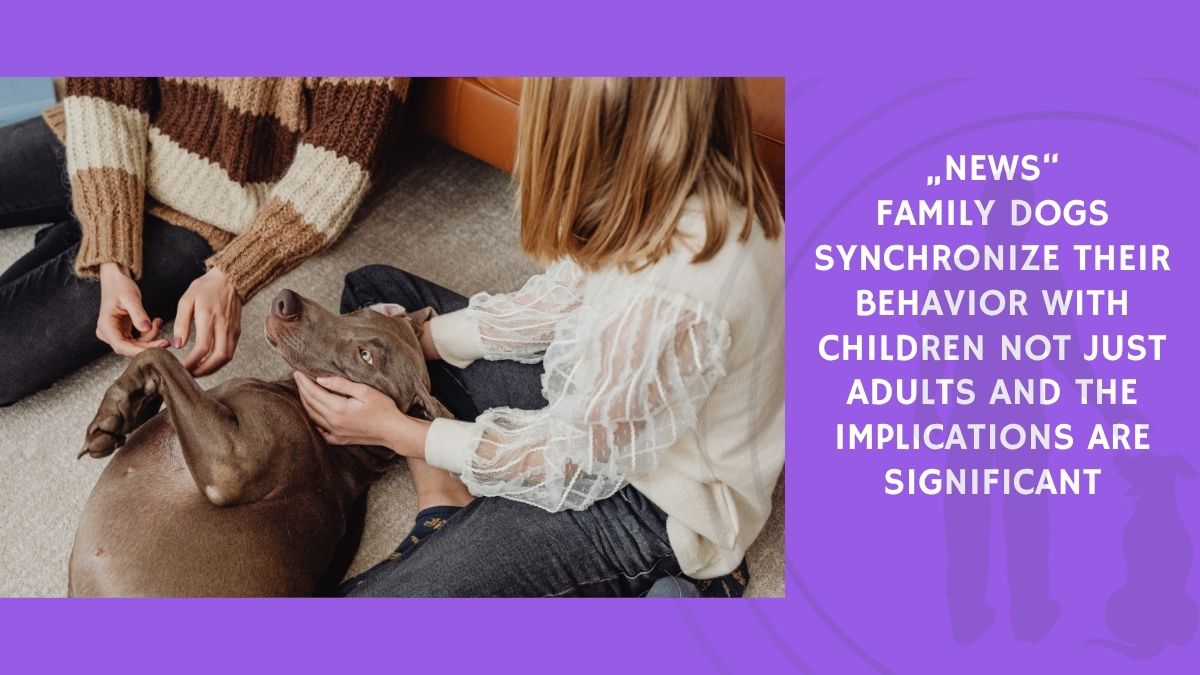
Wanser, MacDonald & Udell (2021) — Animal Cognition
Dog-Human Behavioral Synchronization: Family Dogs Synchronize Their Behavior With Child Family Members
Published: August 14, 2026
Behavioral synchrony between dogs and their adult owners — the spontaneous coordination of activity, proximity, and orientation that reflects social attunement — has been documented across multiple studies. What had not been tested was whether that same synchrony extends to the children in the household. A study measuring three components of behavioral synchrony between family dogs and child family members has found that it does — and the finding changes how we should understand what dogs perceive and respond to in the humans they live with. 🐾
Researchers S. Wanser, Megan MacDonald, and M. Udell tested whether family dogs would exhibit behavioral synchrony with child family members using the same framework applied in adult-dog synchrony research — measuring activity synchrony, proximity, and orientation as three distinct but related components of the broader synchrony construct. All three components were measured against what would be expected by chance, allowing the researchers to confirm that the synchrony observed was not simply coincidental movement in shared spaces but genuine behavioural coordination.
What Behavioral Synchrony Actually Is and Why It Matters
Behavioral synchrony is the spontaneous matching and coordination of behaviour between individuals across time — moving when the other moves, orienting toward them when they orient toward you, adjusting proximity in response to their movement. In human social science, synchrony is associated with increased affiliation, social bonding, and the kind of attunement that characterises close relationships. It has been documented in mother-infant pairs, in close friendships, and between romantic partners. The finding that dogs exhibit synchrony with adult owners placed the human-dog bond within the same attunement framework that governs close human-human relationships.
The current study extended that framework to the child-dog relationship — a relationship that is both extremely common and remarkably understudied from a cognitive perspective. The vast majority of dog social cognition research has focused on adult humans. Children represent a meaningfully different social partner — smaller in physical size, different in movement patterns, voice characteristics, and predictability of behaviour, and often less experienced in dog communication norms than adults. Whether dogs perceive familiar children as social partners deserving of the same attunement that adults receive was not established before this study.
What the Three Components of Synchrony Showed ⚠️
Activity synchrony — the matching of activity level between dog and child — was significant at p less than 0.0001, indicating extremely strong evidence that dogs were coordinating their activity with their child partner at levels well above chance. Proximity — the degree to which dog and child maintained closeness across the observation period — was similarly significant at p less than 0.0001. Orientation — the dog’s attentional direction toward the child — was also significant at p equal to 0.0026.
All three components were present and significant. The family dog was not simply sharing a space with the child and occasionally making contact. They were actively coordinating their behaviour across three distinct dimensions in ways that reflect genuine social attunement rather than incidental proximity.
The researchers note, however, that some differences between dog-child synchrony outcomes and the dog-adult human literature were also observed — the synchrony with children was not identical in pattern or magnitude to what has been documented with adult owners. This is scientifically important. It suggests that dogs are not simply applying a uniform social responsiveness template to all human household members. They are responding differently to children and adults in ways that likely reflect the genuine perceptual and cognitive differences between these two types of social partners — differences in size, movement, voice, and the specific history of interaction the dog has built with each person.
What This Means for Families With Both Dogs and Children 🐕
The prevalence of households containing both children and dogs makes this research practically significant beyond its scientific contribution. A dog who is exhibiting genuine behavioral synchrony with a child — who is orienting toward them, matching their activity level, and maintaining proximity in coordinated ways — is a dog who is treating that child as a genuine social partner. The implications for safety, for relationship quality, and for the developmental benefits covered in the earlier PLAYCE research in this series are all shaped by this basic cognitive fact.
A dog who is socially attuned to the children in the household is a dog whose arousal state and behaviour will be influenced by what the children are doing. A child who moves excitedly and unpredictably will influence a synchronised dog’s activity level. A child who is calm will contribute to a calmer dog. This bidirectional influence runs through the same synchrony mechanism — and understanding it as a genuine attunement process rather than incidental proximity helps parents appreciate both the opportunity and the responsibility that it represents.
For child-focused animal-assisted interventions — therapy dog programmes, school-based dog presence programmes, and similar initiatives — the finding that dogs genuinely synchronise with children has direct implications for how those programmes are structured and how dog behaviour during child interaction is interpreted and managed.
At Zoeta Dogsoul, NeuroBond has always described the attunement between dog and human as running in both directions. This research extends that description to include the children in the household — who are not simply small adults from the dog’s perspective but genuine and distinct social partners whose behaviour the dog is actively tracking, matching, and orienting toward. The Invisible Leash between dog and child is real and measurable — and helping children understand that the dog is as attuned to them as they are to the dog is one of the most important things any family with both can teach. 🐾
Source: Wanser, S., MacDonald, M., & Udell, M. (2021). Dog-human behavioral synchronization: family dogs synchronize their behavior with child family members. Animal Cognition. Published January 12, 2021.










