
Boccardo, Marelli et al. (2020) — Animals (MDPI)
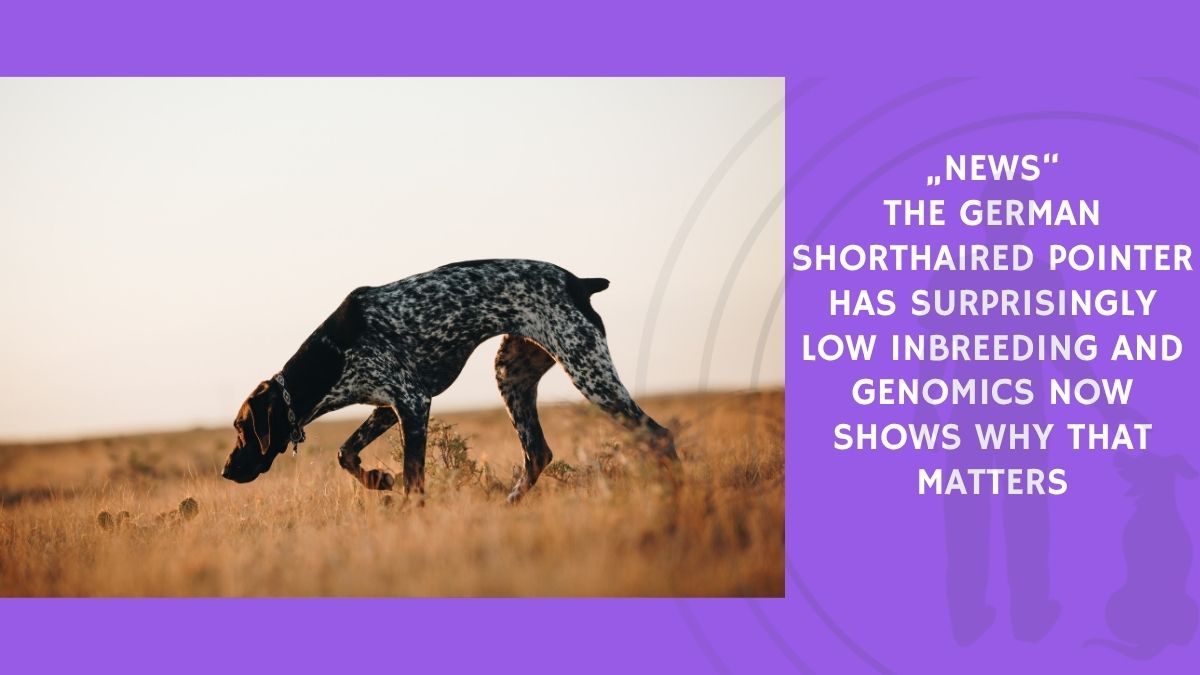
The German Shorthaired Pointer Dog Breed: Genomic Inbreeding and Variability
Published: August 10, 2026
Inbreeding in purebred dogs is a growing concern across the veterinary and conservation genetics communities — and for good reason. Reduced genetic diversity within breeds increases the prevalence of recessive disease variants, narrows immune system capacity, and can compromise reproductive health and lifespan. Against that backdrop, a genomic characterisation of the German Shorthaired Pointer has produced a finding worth noting: this breed shows relatively low inbreeding and reasonably good levels of genetic variability compared to what is commonly seen in more intensively selected breeds. 🐾
Researchers A. Boccardo, Stefano Marelli, D. Pravettoni, A. Bagnato, and M. Strillacci genotyped 24 Italian German Shorthaired Pointers and combined that dataset with published genotype data from 10 US dogs — producing a 34-dog sample analysed for genomic architecture, runs of homozygosity, and inbreeding coefficients from both genomic and pedigree perspectives. The German Shorthaired Pointer is globally recognised for hunting versatility across tracking, field trailing, pointing, and retrieval — a functional breadth that has historically required a working dog capable of sustained performance across diverse tasks and environments, a demand that may have exerted selection pressure quite different from breeds developed primarily for aesthetic conformation.
What Runs of Homozygosity Reveal About a Breed
Runs of homozygosity — ROH — are continuous stretches of the genome in which both copies of the DNA (one inherited from each parent) are identical. They arise when an individual inherits the same genomic region from both parents because those parents share a common ancestor. The longer and more numerous the ROH in a genome, the more homozygous the animal is — and the greater the proportion of their genome where recessive variants, including deleterious ones, are present in both copies and can be expressed.
Across all 34 German Shorthaired Pointers, 3,183 runs of homozygosity were identified spanning all chromosomes. The mean number of ROH per dog was 93.6. The genomic inbreeding coefficient based on ROH was 0.17 — a value indicating that approximately 17 percent of the genome is in runs of homozygosity. The mean inbreeding coefficient based on pedigree information was substantially lower at 0.023, a discrepancy that reflects a well-documented pattern in breed genetics: pedigree-based inbreeding consistently underestimates genomic inbreeding because pedigrees only capture recorded lineage rather than actual DNA identity.
The proportion of observed homozygotes across the total SNP set was 0.70. Together these metrics describe a breed population with what the researchers characterise as low inbreeding and good genetic variability — a more favourable genomic health picture than is seen in breeds where intensive selection for specific conformation or working traits has rapidly reduced effective population size.
What the ROH Island Regions Point Toward ⚠️
Within the 3,183 identified ROH, 11 regions of particularly high ROH density were identified — termed ROH islands — defined by 854 SNPs that appeared in homozygous runs across a large proportion of the sampled dogs. ROH islands represent genomic regions where selection has been most active — where the breed has been consistently selected for specific traits in ways that have swept surrounding genetic variation out of the population, leaving a signature of shared homozygosity.
In the ROH island regions of the German Shorthaired Pointer, the researchers identified genes already associated with behavioural and morphological canine traits. The presence of behaviour-associated genes in the most selection-swept regions of the genome is consistent with the breed’s working history — a dog selected for versatile hunting performance across multiple tasks is a dog whose behaviour-associated genomic regions would be expected to show the signatures of selection, while morphological regions in a breed not intensively selected for conformation show comparatively less selection pressure.
This is an important distinction when comparing breeds. The German Shorthaired Pointer’s ROH island pattern reflects selection primarily for function — the behavioural and physical capacities required for versatile hunting work — rather than the conformation-focused selection that produces high ROH density in morphological trait regions and the associated health consequences seen in breeds where body shape has been the primary selection target.
What This Means for Breed Health and Breeding Practice 🐕
A breed with relatively low genomic inbreeding and good genetic variability is a breed with more evolutionary resilience — more capacity to respond to disease challenges, more immune diversity, and less exposure of deleterious recessive variants. This does not mean the German Shorthaired Pointer is without breed-associated health risks. All breeds carry specific vulnerabilities. But the genomic foundation on which those risks sit is more diverse than in breeds where the effective population size has been severely constrained by intensive selection or small founder populations.
For breeders working with this breed, the message from genomic data is that the current genetic diversity should be actively maintained rather than assumed to be permanent. Breeding decisions that consistently select from a small subset of high-performing or award-winning lines can erode genomic diversity faster than it appears on pedigree coefficients — precisely because pedigrees underestimate true genomic inbreeding, as this study confirms. Genomic tools that directly measure ROH provide a more accurate picture of where the breed’s diversity stands and which mating combinations would maintain rather than compress it further.
At Zoeta Dogsoul, understanding the genetic foundation of the dog you are working with or selecting is part of seeing the whole animal accurately. NeuroBond begins with genuine knowledge of who the dog actually is — and in an era where genomic tools can reveal that knowledge at a molecular level, integrating that information into breeding and ownership decisions is part of what responsible engagement with dogs looks like. A breed that has maintained its genetic diversity through functional rather than aesthetic selection has something worth protecting. 🐾
Source: Boccardo, A., Marelli, S. P., Pravettoni, D., Bagnato, A., Busca, G. A., & Strillacci, M. (2020). The German Shorthaired Pointer Dog Breed (Canis lupus familiaris): Genomic Inbreeding and Variability. Animals. Published March 1, 2020.










