
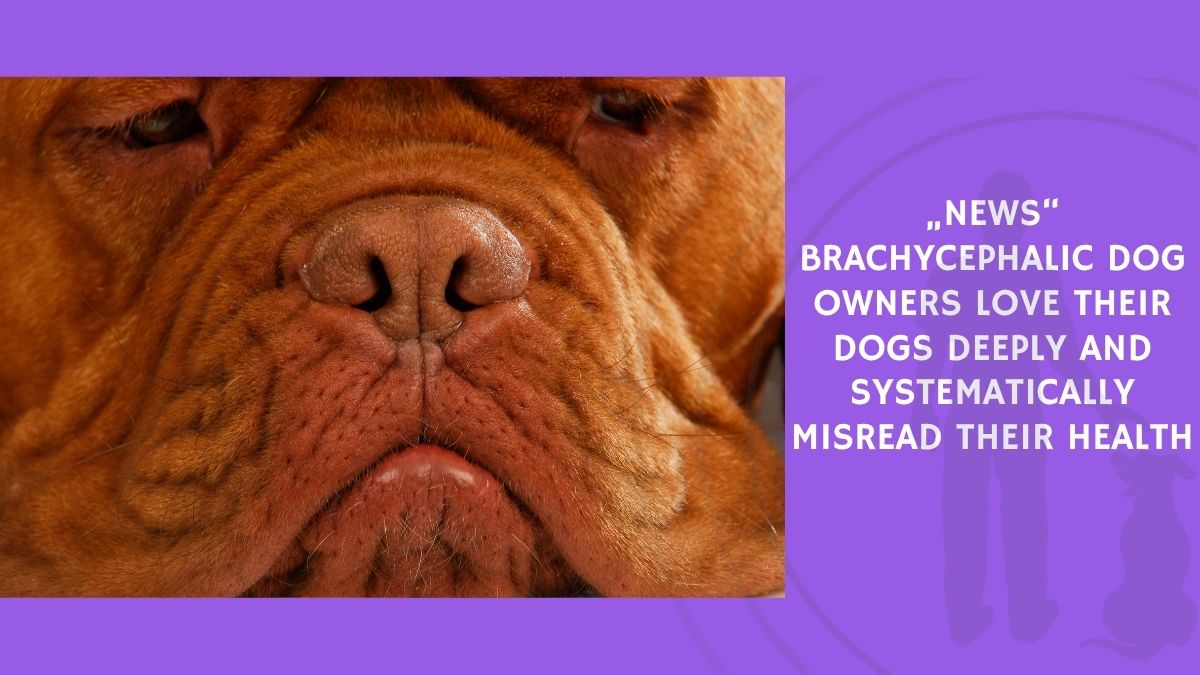
Packer, O’Neill et al. (2019) — PLoS ONE
Great Expectations, Inconvenient Truths, and the Paradoxes of the Dog-Owner Relationship for Owners of Brachycephalic Dogs
Published: August 10, 2026
Pugs, French Bulldogs, and Bulldogs are among the most popular companion dog breeds in the world. They are also among the most medically compromised — their flat-faced conformation producing documented, predictable health problems that affect the majority of individuals within these breeds. A large-scale survey of 2,168 owners has produced data on the psychological paradox at the heart of this situation: these owners report extremely strong emotional bonds with their dogs and simultaneously hold health perceptions that are significantly more positive than the clinical reality their dogs are living. 🐾
Researchers R. Packer, D. O’Neill, F. Fletcher, and M. Farnworth surveyed owners of 789 Pugs, 741 French Bulldogs, and 638 Bulldogs — all relatively young dogs, with median ages between 2.0 and 2.5 years — on their dogs’ health status, their awareness of breed-associated health issues, their perceptions of their own dog’s health relative to the breed, and the quality of their dog-owner relationship. The combination of health reporting, health perception, and relationship quality data in a single large dataset allows a portrait of brachycephalic ownership that no smaller or single-focus study could produce.
What the Health Data Actually Showed
The health picture across the three breeds was consistent with the clinical literature on brachycephalic morbidity. The most commonly owner-reported disorders were allergies, corneal ulcers, skin fold infections, and Brachycephalic Obstructive Airway Syndrome. One in five owners — 19.9 percent — reported that their dog had undergone at least one conformation-related surgery. Over a third of dogs — 36.5 percent — were reported with problems regulating body temperature in heat. And 17.9 percent of dogs were reported with breathing problems.
These are not rare or extreme cases. Problems with heat regulation in over a third of dogs in a sample with median ages around two years — at the beginning of these animals’ expected lifespans — is a prevalence figure that reflects the baseline health burden these breeds carry as a consequence of their physical structure rather than incidental individual variation.
The surgical figure deserves particular attention. One in five dogs having undergone at least one conformation-related surgery before the age of 2.5 years means a significant proportion of owners are already managing active medical consequences of their dog’s anatomy in the early years of the relationship — and doing so with dogs young enough that additional surgeries and additional health complications are statistically likely across the dogs’ remaining lifespan.
The Perception Gap That Drives the Paradox ⚠️
Against this clinical backdrop, the health perception data produces the most striking finding in the study. Despite awareness of their dog’s health issues — and many owners were demonstrably aware, given the surgical and disorder reporting rates — 70.9 percent of owners considered their dog to be in very good health or the best health possible. Only 6.8 percent considered their dog to be less healthy than average for their breed.
This is not a gap between informed and uninformed owners. It is a perceptual pattern that appears to operate independently of specific health knowledge. Owners who have observed breathing difficulties, heat regulation problems, and skin infections in their dogs — and who have funded conformation-related surgeries — simultaneously rate those dogs as being in very good or best possible health. The researchers identify cognitive dissonance as a likely mechanism: holding two contradictory beliefs simultaneously and resolving the discomfort by adjusting the health perception upward rather than acknowledging the full weight of what the clinical picture represents.
The comparison within breed is particularly revealing. Only 6.8 percent of owners rated their dog as less healthy than average for their breed — a figure that is statistically impossible to reconcile with the disorder and surgery prevalence data unless owners are systematically setting their baseline for breed-average health far below what would constitute health in a non-brachycephalic dog. The frame of reference has shifted to what is normal for these breeds rather than what is healthy for a dog. Within that adjusted frame, a dog with controlled breathing difficulties and managed skin fold infections can genuinely be perceived as doing well — because the comparator is other brachycephalic dogs with similar or worse presentations.
The Bond Dimension and Why It Matters 🐕
Dog-owner relationships across all three breeds were reported as extremely strong. Emotional closeness was highest for Pug owners, female owners, and owners without children in the household. The strength of the bond was not in question — these are not owners who are indifferent to their dogs. They are owners who are deeply emotionally invested in animals who are also carrying significant health burdens.
This combination — extremely strong bond plus significantly distorted health perception — is what the researchers identify as the central paradox of brachycephalic ownership. The bond may be part of what maintains the perceptual distortion. An owner who is deeply attached to a dog and emotionally invested in their dog’s wellbeing has more psychological motivation to perceive that dog as healthy than an owner with a more distant relationship. The love is not the problem. The perceptual consequence of that love, operating through cognitive dissonance, is the problem — because it reduces the likelihood of seeking veterinary evaluation for signs that, in a different attentional framework, would be recognised as warranting attention.
This is the exact territory that earlier research in this series on human perception of dog emotional states also touches. Owners systematically read dog states through filters — contextual, emotional, relational — that distort accuracy in consistent directions. In brachycephalic ownership, the relevant filter is the emotional investment in the animal combined with a breed-normalised reference point for health, producing perceptions that are genuinely held and genuinely inaccurate simultaneously.
At Zoeta Dogsoul, NeuroBond is built on seeing the whole animal accurately — not through the filter of what we want to see or what we have normalised through breed exposure, but through honest, calibrated observation of the animal’s actual physical and behavioural state. For owners of brachycephalic dogs, that accuracy requires an active effort to reset the health baseline to what unobstructed respiration, unimpeded thermoregulation, and absence of chronic skin irritation actually look and sound like — not what is typical for the breed. The love these owners carry for their dogs is evident and real. Directing it toward more accurate health perception is what gives it the most power to actually help. 🐾
Source: Packer, R., O’Neill, D., Fletcher, F., & Farnworth, M. (2019). Great expectations, inconvenient truths, and the paradoxes of the dog-owner relationship for owners of brachycephalic dogs. PLoS ONE. Published July 19, 2019.










