Bosch, Hagen-Plantinga & Hendriks (2014) — British Journal of Nutrition
Dietary Nutrient Profiles of Wild Wolves: Insights for Optimal Dog Nutrition?
Published: July 21, 2026
Raw feeding advocates cite wolf ancestry as justification for their approach. Commercial dog food manufacturers cite dogs’ omnivorous classification to justify grain-inclusive formulas. A study that actually calculated the nutrient profiles of fifty wolf diets drawn from the scientific literature offers something more useful than either position: data. And the data complicates both narratives in ways that every owner invested in their dog’s nutrition should understand. 🐾
Researchers G. Bosch, E. Hagen-Plantinga, and W. Hendriks reviewed the foraging ecology of wild wolves and calculated nutrient profiles across fifty reported wolf diets from the literature. Their goal was to determine what wolves actually eat in terms of macronutrient and nutrient composition, compare that to the nutrient profiles of modern commercial dog food, and draw evidence-based conclusions about what the divergence between the two might mean for dog physiology and metabolism.
What Wolf Diets Actually Look Like
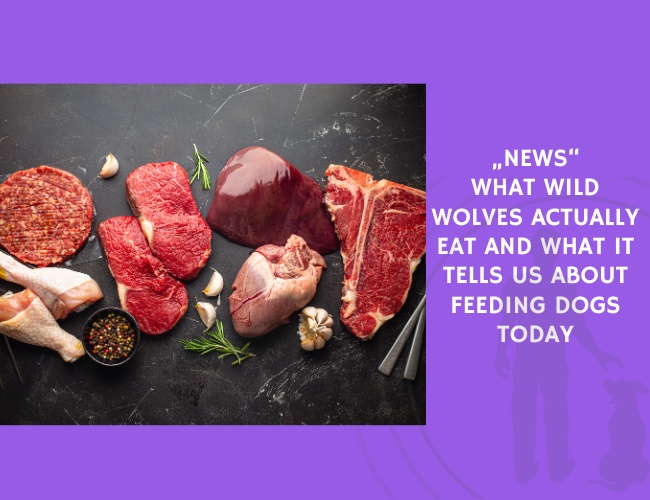
The foraging ecology data is unambiguous on one point: wolves are true carnivores. Vegetal matter in wild wolf diets is negligible. The vast majority of nutritional intake comes from prey animals — primarily ungulates — consumed including organs, bone, stomach contents, and soft tissue. The nutrient profile that results from this feeding pattern is high in protein and fat, with carbohydrate content close to zero in most analysed diets.
The feast and famine dimension of wolf ecology is equally important and consistently underweighted in nutritional discussions. Wolves do not eat daily. They experience extended periods of food scarcity during low prey availability, followed by periods of excessive intake after successful hunts. The metabolic adaptability required to manage this variability — to store, mobilise, and process nutrients efficiently across a highly irregular intake pattern — is a defining feature of wolf physiology. And the researchers note that this metabolic flexibility is still functionally present in modern domestic dogs.
This is a more nuanced point than the raw feeding debate usually captures. The argument is not simply that dogs should eat like wolves because wolves eat meat. It is that dogs retain a metabolism shaped by a feast and famine lifestyle that commercial feeding practices — delivering consistent, measured, carbohydrate-inclusive meals twice daily — may not be optimally aligned with at a physiological level.
Where Commercial Dog Food Diverges From Wolf Nutrient Profiles ⚠️
The comparison between wolf dietary nutrient profiles and commercial dog food nutrient profiles reveals differences in several dimensions. Commercial foods tend to be higher in carbohydrate content, lower in protein as a percentage of metabolisable energy, and more consistent in macronutrient delivery than the highly variable wolf diet from which domestic dogs diverged 13,000 to 17,000 years ago.
The researchers are careful not to overstate the clinical implications. Dogs have diverged from wolves in multiple digestive and metabolic traits during domestication — including increased amylase production for starch digestion and differences in gut microbiota composition — that have moved them toward a more omnivorous functional profile. The classification of dogs as omnivores is not simply marketing language. It reflects genuine adaptive changes that occurred during the period when dogs transitioned from hunting prey to scavenging human food waste.
But the researchers are equally careful not to use this omnivorous classification to dismiss the relevance of wolf dietary data entirely. The omnivorous traits dogs have developed explain their capacity to utilise plant-based nutrition. They do not necessarily mean that a diet structured around plant-based carbohydrates as its primary energy source represents the physiologically optimal condition for a species whose ancestral metabolic architecture was built around a very different nutrient profile.
The gap between what the wolf diet delivers and what most commercial dog foods deliver — particularly in terms of protein density, fat composition, and carbohydrate load — represents a genuine area of ongoing nutritional research rather than a settled question.
What This Means for How You Think About Feeding Your Dog 🐕
This research does not make the case for raw feeding specifically, nor does it condemn commercial food categorically. What it does is provide a biologically grounded reference point for evaluating dog food from the outside in — starting from what the species’ closest free-living ancestor actually consumes and working toward what that implies for optimal domestic feeding, rather than starting from what is convenient or economical to manufacture and working backward to justify it.
Protein density, fat quality, carbohydrate load, and feeding frequency are all variables that this research suggests are worth examining against the ancestral context rather than accepting at commercial default. A dog food that meets current regulatory minimum standards may nonetheless deliver a nutrient profile that sits at a significant distance from the one that shaped the metabolism now receiving it.
At Zoeta Dogsoul, physical foundation is always part of the full picture of the dog we are in relationship with. A dog whose metabolism is being asked to process a nutrient profile consistently misaligned with its evolutionary architecture is a dog carrying a physiological challenge that may never appear on a blood panel but shows in coat quality, energy regulation, gut health, and the overall vitality that makes genuine engagement and connection possible. NeuroBond is built on seeing the whole animal — and the whole animal includes what they are eating and whether their body is genuinely supported by it. 🐾
Source: Bosch, G., Hagen-Plantinga, E., & Hendriks, W. (2014). Dietary nutrient profiles of wild wolves: insights for optimal dog nutrition? British Journal of Nutrition. Published November 21, 2014.