
Caldicott, Pike et al. (2024) — Animal Cognition
Odour Generalisation and Detection Dog Training
Published: July 20, 2026
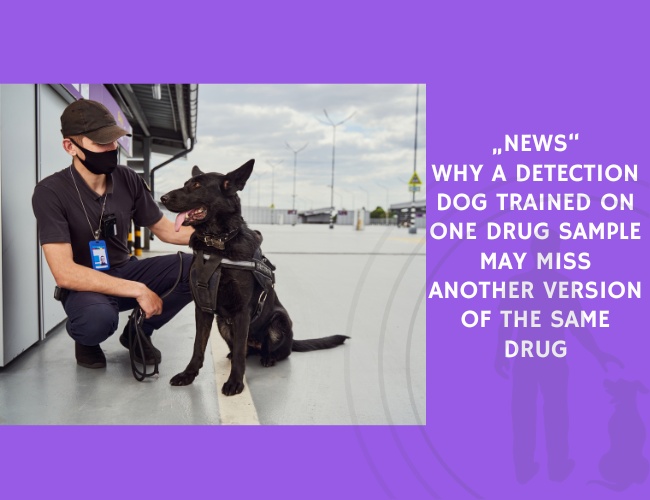
A detection dog trained to find drugs, explosives, or disease markers is not trained to find a molecule. It is trained to find a specific odour sample — and the odour released from different samples of the same target substance can vary significantly depending on how it was produced, how long it has been exposed to air, how far it has degraded, and what other smells surround it. Whether the dog alerts to a variant of the target it has never encountered before is a question of generalisation — and a new review identifies this as one of the most under-researched and most practically significant variables in detection dog training. 🐾
Researchers Lyn Caldicott, Thomas Pike, Anna Wilkinson, and their team reviewed current understanding of odour generalisation in detection dogs — the cognitive process by which a dog trained on a specific conditioned stimulus responds similarly to stimuli that are different from but related to that original training sample. The review maps where the science currently stands, where training practice lags behind it, and where the gaps in research leave real operational risk unaddressed.
Why Odour Generalisation Is Harder Than It Sounds
Generalisation is a fundamental feature of learning across species. When a dog is conditioned to respond to a specific stimulus, they will typically also respond to stimuli that are sufficiently similar to the conditioned one — a process that in most training contexts is considered straightforwardly beneficial. The problem in detection work is that odour is a uniquely complex modality, and predicting when and how generalisation will occur is significantly less reliable than it is with auditory or visual stimuli.
A visual stimulus like a red circle generalises predictably to other red circles of different sizes. An odour stimulus does not follow the same rules. The chemical composition of a real-world drug sample varies based on synthesis route, cutting agents, storage conditions, and degradation state. A cadaver odour changes as decomposition progresses through different stages. A disease biomarker odour differs between patients, between sample types, and between disease stages. The dog trained on one version of the target odour is being asked, in the field, to recognise a potentially quite different chemical profile as the same thing.
Whether the dog makes that connection depends on multiple factors the review identifies: how the training samples were selected and varied, how many different odour variants the dog was exposed to during training, how the training environment shaped what the dog learned to attend to, and the individual dog’s cognitive flexibility. Current training practices in the field vary considerably on all of these dimensions — and the review identifies specific practices that carry identifiable generalisation risks without being widely recognised as problematic.
Where Current Training Practice May Be Falling Short ⚠️
The review is precise about the risks it identifies without being specific enough about individual training programmes to constitute direct criticism of any particular approach. The general pattern it describes is one of training that produces reliable performance on the specific samples used in training while leaving uncertain how well that performance transfers to the real-world odour variation the dog will encounter in deployment.
A dog trained predominantly on a single source or form of a target odour may develop a narrowly calibrated alert response that works reliably in training but shows reduced sensitivity to variants it has not been exposed to. This is not a failure of the dog. It is a predictable consequence of how generalisation works — the dog has learned what it was trained to learn, which may not be the full range of what the target actually smells like in operational contexts.
The review also highlights that odour is not experienced by the dog as a single chemical signal but as a complex mixture — and the extraneous odours surrounding a target in the real world add a layer of discrimination demand that training under controlled conditions may not adequately prepare the dog for. Generalisation and discrimination are in tension: a dog that generalises too broadly will alert to non-targets, while a dog that has learned to discriminate too narrowly will miss variants of the actual target. Finding and training for the right balance requires a more systematic understanding of odour generalisation than current field practice typically applies.
What This Means Beyond Detection Work 🐕
For most Zoeta Dogsoul readers, the immediate relevance is not operational detection training. But the cognitive principles the review describes apply directly to everyday training with any dog. Generalisation — the transfer of a learned response from the training context to novel but related contexts — is one of the most consistently underestimated challenges in dog training at every level.
A dog who performs a reliable recall in the garden does not automatically have a reliable recall on a busy street. A dog who walks calmly on leash in familiar territory does not automatically generalise that behaviour to an unfamiliar environment. The training was real. The learning was real. The generalisation to a sufficiently different context was simply never trained. Owners who understand generalisation as an active training challenge rather than an automatic consequence of learning will train more effectively and understand their dog more accurately when familiar behaviours appear to break down in new situations.
At Zoeta Dogsoul, this is part of what NeuroBond asks of an owner: accurate understanding of what has actually been built through training versus what is assumed to have been built. A behaviour that works in one context is a behaviour that has been learned in that context. Whether it generalises is a separate question — one that requires deliberate, varied exposure rather than the assumption that the dog will figure it out. The Invisible Leash holds most reliably when it has been tested and built across a genuine range of conditions, not just the ones where training happened to take place. 🐾
Source: Caldicott, L., Pike, T. W., Wilkinson, A., et al. (2024). Odour generalisation and detection dog training. Animal Cognition. Published November 1, 2024.










