
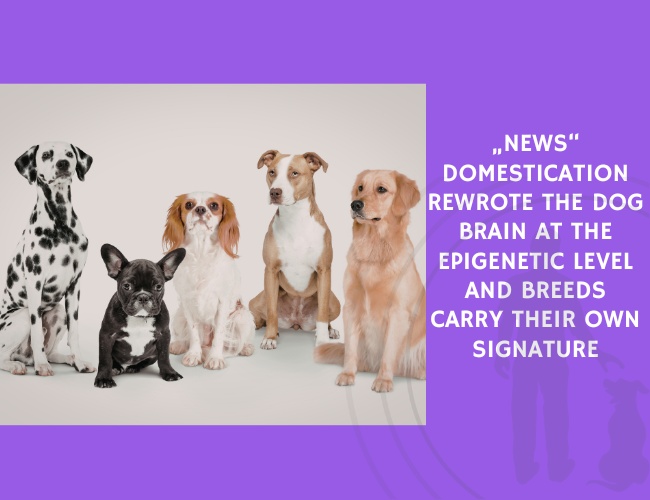
Sundman, Pértille et al. (2020) — PLoS ONE
DNA Methylation in Canine Brains Is Related to Domestication and Dog-Breed Formation
Published: July 19, 2026
We know that dogs behave differently from wolves. We know that breeds behave differently from each other. What science has not been able to show until recently is the molecular mechanism inside the brain that encodes those differences. A study examining DNA methylation in the frontal cortex of 38 dogs across 8 breeds and 3 wolves has now found exactly that — and what it reveals about the depth at which domestication has shaped the dog brain is striking. 🐾
Researchers Ann-Sofie Sundman, F. Pértille, Luiz Lehmann Coutinho, E. Jazin, C. Guerrero-Bosagna, and P. Jensen examined epigenetic differences in brain tissue between wolves and domestic dogs, and between different dog breeds. The tissue studied was the frontal cortex — the region most directly relevant to behaviour, decision-making, social processing, and impulse regulation. The method combined genotype-by-sequencing with methylated DNA immunoprecipitation to map methylation patterns across the genome. The findings add an entirely new layer to how we understand why dogs are the animals they are.
What Epigenetics Is and Why It Matters Here
DNA methylation is an epigenetic mechanism — a chemical modification to DNA that does not change the underlying genetic sequence but does affect whether and how genes are expressed. Methylation patterns can both shape phenotype and be inherited across generations, making them a mechanism through which environmental pressures can leave lasting biological marks that are transmitted to offspring without altering the DNA itself.
This is significant for understanding domestication because the speed at which dogs diverged from wolves — both behaviourally and morphologically — has always been difficult to fully explain through standard genetic mutation alone. Epigenetic mechanisms offer an additional pathway: changes in gene expression patterns, encoded through methylation, that can accumulate and be inherited across relatively short evolutionary timescales. If domestication produced rapid, heritable changes in brain function and behaviour, epigenetics is a plausible part of how that happened.
The frontal cortex was the specific tissue analysed — not muscle, not blood, not liver. Brain tissue. The region most directly implicated in the behavioural differences between wolves and dogs and between different breeds. This is not a peripheral finding about epigenetic variation in general. It is a finding about the molecular state of the tissue that controls how dogs think, respond, and relate.
What the Data Found Between Wolves Dogs and Breeds 🔬
The results were clear on two levels. There were substantial DNA methylation differences between wolves and domestic dogs — consistent with the hypothesis that epigenetic factors played a role in the speciation process from wolf to dog. And there were also meaningful methylation differences between different dog breeds — suggesting that breed formation, the divergence of Border Collies from Malinois from Labradors from Huskies, has left distinct epigenetic signatures in brain tissue that may underlie the behavioural differences observed between them.
The researchers specifically highlight methylation differences in genes related to behaviour and morphology. They hypothesise that these differences are involved in producing the phenotypic variation found across breeds — though they are precise in noting that future research will need to identify the specific mechanisms through which methylation differences in these genes translate into behavioural outcomes.
What the study establishes at this stage is the pattern: domestication and breed formation have left measurable molecular marks in the frontal cortex that differ between wolves and dogs and between breeds in ways that align with the behavioural differences we already observe. The molecular layer was always there. Now it is visible.
What This Means for How We Understand Every Dog We Work With 🐕
The cumulative picture that has been building across the genetics, neuroimaging, hormone, and now epigenetics research we have covered in this series is consistent and significant. The behavioural differences between breeds are not simply the product of training history or owner behaviour. They are written into the biology of the brain at multiple levels — genetic, structural, hormonal, and now epigenetic.
A Belgian Malinois and a Basset Hound do not simply have different personalities. They have different frontal cortex methylation profiles. Different gene expression patterns in the tissue that regulates their social processing, their arousal, their impulse control, and their decision-making. That difference was not produced by their owners. It was produced by thousands of years of selective pressure that left its mark at the molecular level.
This is the biological depth at which NeuroBond operates. Genuine attunement means reading a dog whose entire neurological architecture has been shaped by forces that predate the individual animal by millennia. The breed you are working with is not just a visual category or a behavioural tendency. It is a specific epigenetic configuration of a brain — and the relationship you build with that brain needs to be calibrated to what it actually is rather than what a generic training model assumes it to be.
The Invisible Leash is held at one end by a human nervous system and at the other end by a canine brain whose molecular state was shaped by domestication, by breed formation, and by developmental experience. Understanding that architecture — as precisely as current science allows — is what gives the connection between dog and owner its most accurate foundation. 🐾
Source: Sundman, A.-S., Pértille, F., Coutinho, L. L., Jazin, E., Guerrero-Bosagna, C., & Jensen, P. (2020). DNA methylation in canine brains is related to domestication and dog-breed formation. PLoS ONE. Published October 29, 2020.










