
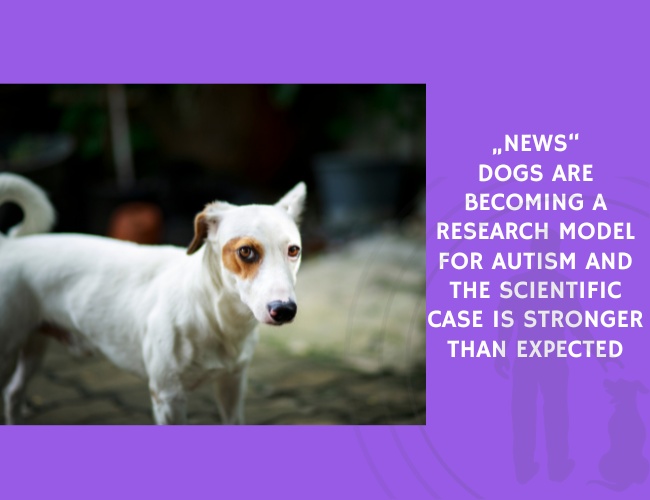
Topál, Román & Turcsán (2019) — Wiley Interdisciplinary Reviews: Cognitive Science
The Dog (Canis familiaris) as a Translational Model of Autism: It Is High Time We Move from Promise to Reality
Published: July 18, 2026
Autism spectrum disorder research has long relied on rodent models that share relatively little with the complexity of human social cognition. A growing body of researchers is now making the case for a different model entirely — one that lives in millions of homes worldwide, has co-evolved with humans for thousands of years, and shows a range of social cognitive variation that maps onto the human autism spectrum with striking precision. The domestic dog. 🐾
Researchers József Topál, V. Román, and B. Turcsán published an opinion paper in Wiley Interdisciplinary Reviews: Cognitive Science building the scientific case for why dogs represent a more valid translational model for autism spectrum disorder than the rodent models that have dominated the field. Their argument rests on four specific properties — and each one deserves careful attention.
Why Dogs Map Onto Autism Research Better Than Rodents
Translational validity in animal models is assessed across three dimensions: face validity (does the animal behaviour resemble the human symptom), construct validity (do the underlying biological and etiological mechanisms match), and predictive validity (does the animal model respond to treatments in ways that predict human responses). Rodent models of autism have struggled on all three — particularly face validity, because the social cognitive architecture of a mouse is so distant from human social cognition that the mapping requires significant inferential leaps.
Dogs do not have that problem. The researchers identify four properties that make the canine model substantially more compelling. First, there is large inter-individual variability in dogs’ social cognitive abilities — including both high and low phenotypic extremes that parallel the range seen across the autism spectrum in humans. Some dogs show unusually high human-oriented social cognition. Others show marked deficits in exactly the domains relevant to ASD: social gaze, joint attention, communication, and social motivation. That natural variability is precisely what a translational model needs.
Second, the phenotypic similarity between canine social cognitive profiles and human autism symptoms is substantially higher than between rodent profiles and human symptoms. Dogs and humans share a social environment, a co-evolutionary history, and a set of social cognitive demands that rodents simply do not. Third, the symptoms in dogs are functionally analogous to the human condition rather than artificially induced through genetic manipulation or chemical intervention. And fourth, the underlying etiology is more likely to be genuinely similar — dogs develop their social cognitive profiles through a combination of genetics and developmental experience in ways that parallel human neurodevelopmental trajectories more closely than any rodent model currently available.
What This Means Beyond the Research Lab 🔬
The implications of a valid canine model for autism research extend in two directions simultaneously. In one direction, dogs become a more legitimate subject for studying the neurocognitive mechanisms underlying social communication differences — with the potential to generate findings that translate more reliably into human clinical applications than rodent-derived data has historically done.
In the other direction, the research reframes how we understand the social cognitive variation we already observe in dogs in everyday life. A dog who struggles with social gaze, who does not orient toward human communicative signals in the way most dogs do, who shows reduced social motivation or atypical joint attention — that dog is not simply poorly socialised or behaviourally difficult. They may be expressing a phenotypic profile at the lower end of social cognitive capacity that has a genuine neurobiological basis comparable to what is seen in human autism spectrum presentations.
This has direct implications for how those dogs are trained, managed, and understood by their owners. Approaches calibrated for a neurotypical social cognitive profile will not work the same way for a dog at the low end of this spectrum. The expectations need to shift. The methods need to adapt. And the owner’s read of the dog needs to account for a fundamentally different social cognitive architecture rather than attributing behavioural differences to stubbornness, disinterest, or training failure.
Attunement Begins With Accurate Understanding 🐕
At Zoeta Dogsoul, this research sits directly within the territory of NeuroBond. Building genuine attunement with a dog requires starting from an accurate picture of who that dog is neurologically — not who average dogs are, not who the breed standard suggests they should be, but this specific animal with this specific social cognitive profile. A dog whose capacity for human-oriented social cognition sits at the lower end of the natural range is a dog whose relationship with their owner has to be built differently, with different signals, different expectations, and a different quality of patience.
The Invisible Leash is not the same for every dog. For a dog with a high social cognitive profile it develops quickly, runs through eye contact and shared attention, and responds readily to subtle communicative cues. For a dog at the lower end of that spectrum it takes longer to build, runs through different channels, and requires an owner who does not mistake the dog’s profile for a failure of the relationship. Both dogs can be reached. The path simply looks different. 🐾
Source: Topál, J., Román, V., & Turcsán, B. (2019). The dog (Canis familiaris) as a translational model of autism: It is high time we move from promise to reality. Wiley Interdisciplinary Reviews: Cognitive Science. Published July 1, 2019.










