
Wenden, Lester et al. (2020) — Pediatric Research
The Relationship Between Dog Ownership, Dog Play, Family Dog Walking, and Pre-Schooler Social-Emotional Development
Published: July 18, 2026
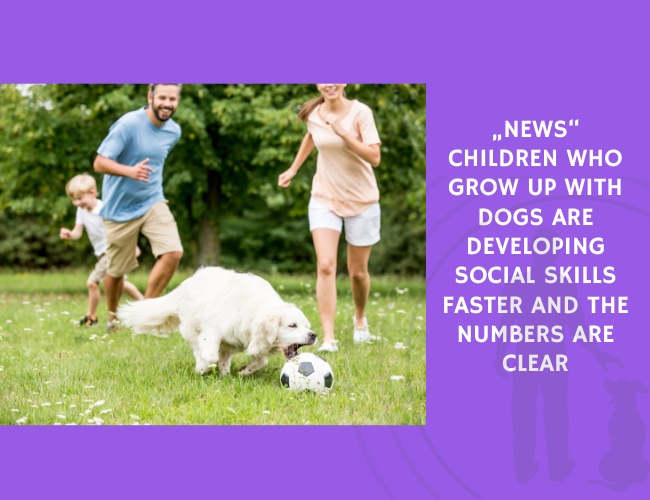
The idea that growing up with a dog is good for children has been repeated so often it has almost become background noise. A large observational study of 1,646 families has now put precise numbers behind it — and the specific mechanisms it identifies move the conversation well beyond general wellbeing claims into something measurable, reproducible, and practically useful for parents. 🐾
Researchers E. Wenden, L. Lester, S. Zubrick, M. Ng, and H. Christian surveyed parents of preschool-aged children, collecting data on dog ownership, frequency of dog walking, and frequency of active play with the family dog. Social-emotional development was measured using the Strengths and Difficulties Questionnaire, a validated parent-report tool widely used in developmental research. The scale captures conduct problems, peer problems, total difficulties, and prosocial behaviour — giving a multidimensional picture of where dogs make a difference and where they do not.
What the Data Found Across 1646 Families
Children from dog-owning households showed significantly better outcomes across multiple social-emotional dimensions compared to children without a dog. They were 30 percent less likely to have conduct problems, 40 percent less likely to have peer problems, and 23 percent less likely to score in the total difficulties range. They were 34 percent more likely to demonstrate prosocial behaviour.
These are not marginal effects. A 40 percent reduction in peer problems across a sample of over 1,600 families is a finding that warrants serious attention from parents, paediatricians, and child development researchers alike — particularly given that the children involved were preschool age, a developmental window in which the foundations of social competence are being actively laid.
Within dog-owning households, the frequency of interaction mattered significantly. Children who walked with the family dog at least once per week were 45 percent more likely to show prosocial behaviours and 36 percent less likely to score in the total difficulties range compared to dog-owning children who walked less frequently. Children who played actively with the dog three or more times per week were 74 percent more likely to demonstrate prosocial behaviours. The dog’s presence alone produced benefits. Regular active engagement with the dog amplified them substantially.
Why Dog Interaction Supports Social-Emotional Development ⚠️
The mechanisms the researchers propose are grounded in what dog interaction actually requires of a young child. Playing with a dog involves reading non-verbal signals, regulating arousal, responding to another being’s cues, adjusting behaviour based on the dog’s reaction, and navigating a relationship where communication is entirely non-verbal. These are precisely the social-emotional skills that predict peer competence, conflict management, and cooperative behaviour in human relationships.
Walking with the family dog adds a physical activity dimension that is consistently associated with better emotional regulation in young children, alongside the social facilitation effect that dogs reliably produce in public spaces. A child walking a dog is a child who encounters and interacts with strangers in a structured, low-stakes, dog-mediated social context that does not occur otherwise.
The study’s design does not establish causation — it cannot rule out that families with dogs differ from non-dog families in other ways that also contribute to child outcomes. The researchers are transparent on this point. But the within-group finding — that more frequent walking and play within dog-owning families produces better outcomes than less frequent engagement — provides a dose-response pattern that is more difficult to explain away as selection effect alone.
What This Means for Families Living With Dogs and Children 🐕
The practical message is both simple and specific. Dog ownership appears to confer social-emotional developmental benefits for preschool children — and those benefits increase with the frequency and quality of child-dog interaction. Passive coexistence with the family dog produces some benefit. Active, regular, engaged interaction produces substantially more.
At Zoeta Dogsoul, this research adds a developmental dimension to what we understand about NeuroBond. A child learning to read a dog’s signals, to approach calmly, to respond to what the dog needs rather than only what the child wants, is a child developing the attunement capacity that serves them in every relationship they will ever have. The dog is not just a pet in this picture. They are a developmental partner.
And the Invisible Leash that forms between a child and the family dog is building something that extends far beyond the relationship itself. The social intelligence, the non-verbal sensitivity, the capacity for prosocial behaviour that this data shows in dog-owning children — those qualities do not stay in the relationship with the dog. They travel into the playground, the classroom, and every human connection that follows. 🐾
Source: Wenden, E., Lester, L., Zubrick, S., Ng, M., & Christian, H. (2020). The relationship between dog ownership, dog play, family dog walking, and pre-schooler social-emotional development: findings from the PLAYCE observational study. Pediatric Research. Published July 6, 2020.










