Wynne (2021) — Frontiers in Psychology
The Indispensable Dog
Published: July 17, 2026
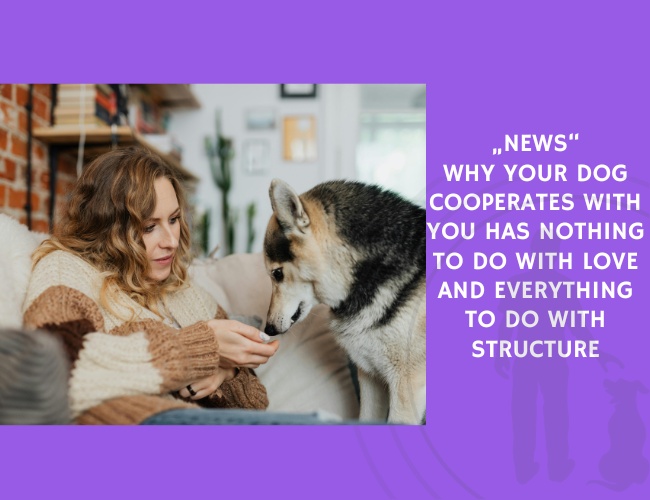
The story we tell about why dogs cooperate with humans usually involves love, loyalty, and a special emotional bond forged across thousands of years of shared history. Researcher Clive Wynne — one of the most prominent voices in canine cognition science — offers a more structurally precise account. And while it is less romantic, it is arguably more useful for anyone who actually wants to understand and work with dogs effectively. 🐾
In this review paper published in Frontiers in Psychology, Wynne examines the adaptations that account for the extraordinary success of dogs in a human-dominated world. The picture he builds is one of a species shaped by scavenging rather than hunting, more hierarchical with conspecifics than commonly assumed, and cooperating with humans not because they recognise us as a special species but because we occupy what he terms a position of super-dominance — complete control over every resource the dog needs to survive.
What Domestication Actually Changed
The standard narrative of dog domestication emphasises reduced aggression and increased sociability compared to wolves — dogs as the cooperative, friendly version of their ancestor. Wynne’s review challenges this directly. Several studies show that dogs’ social interactions with other dogs are actually more hierarchical and competitive than equivalent interactions between wolves. The reason, he argues, is ecological rather than temperamental.
Wolves are hunters. Hunting large prey requires coordination, cooperation, and the suppression of competitive impulses within the pack. Dogs are scavengers. Scavenging human food residues does not require cooperation with conspecifics — it requires proximity to humans and tolerance of competition at the food source. The social architecture that domestication selected for was not increased friendliness toward other dogs. It was increased tolerance of human proximity and responsiveness to human resource control.
The reproductive and foraging behavioural changes that accompanied domestication make sense within this framework. Dogs became adapted to living on the margins of human settlements, feeding on waste, reproducing in conditions shaped by human activity. The adaptations that succeeded were those that kept dogs close to humans without triggering human aggression — not those that made dogs particularly cooperative with each other.
Super-Dominance and Why It Explains Canine Cooperation 🔬
The conceptual core of Wynne’s paper is the proposal that humans occupy a position of super-dominance over dogs — not through aggression or pack leadership in the traditional sense, but through the structural reality that humans control every resource the dog requires. Food, shelter, water, social access, reproduction, safety — all of it flows through the human. The dog does not need to recognise the human as a member of their species, or to feel affection for them, or to form an attachment bond in the psychological sense, in order to cooperate with someone who has absolute resource control.
Wynne argues that the formal signals of dominance and submission overlap sufficiently between dog and human body language that the system functions cross-species without requiring the dog to make a species-identity judgement at all. A human who moves confidently, controls access to resources, and responds consistently to dog behaviour fits into the dog’s social cognitive framework in a way that produces cooperation regardless of whether the dog has any concept of humans as a distinct category.
This does not mean dogs feel nothing toward their owners or that the relationship lacks genuine emotional content. It means that the structural explanation for cooperation does not require emotional attachment as its foundation. The cooperation is more robustly explained by resource structure than by affection — which has practical implications for how that cooperation is built and maintained.
What This Changes About How We Build the Relationship 🐕
For owners, this framework is clarifying rather than deflating. If canine cooperation is grounded in structural resource control rather than spontaneous affection, then the most reliable way to build a cooperative relationship is to be genuinely and consistently the source of what the dog needs — not to pursue emotional connection as the primary mechanism, but to establish structural clarity that the dog’s social cognition can orient around.
This is entirely consistent with what NeuroBond is built on. Genuine attunement does not bypass structure — it operates through it. A dog who experiences their owner as a reliable, consistent, structurally clear source of everything they need is a dog whose cooperation is grounded in something more durable than mood or moment. The emotional connection that develops within that structural framework is real. But the structure comes first, and it is what makes everything else possible.
The Invisible Leash between dog and owner is not held in place by sentiment. It is held in place by the accumulated structural reality that the owner is the most reliable available source of what the dog needs. Understanding that is not a reduction of the relationship. It is an honest account of its foundation. 🐾
Source: Wynne, C. (2021). The Indispensable Dog. Frontiers in Psychology. Published July 26, 2021.