
Barcelos, Kargas et al. (2023) — Scientific Reports
Dog Owner Mental Health Is Associated with Dog Behavioural Problems, Dog Care and Dog-Facilitated Social Interaction: A Prospective Cohort Study
Published: July 6, 2026
The idea that dogs are good for human mental health is so widely held it has almost become background noise. But a rigorous prospective cohort study of 709 dog owners has produced a more complicated and more honest picture — one that every dog owner deserves to understand. Dogs can support mental health. Under specific conditions, they can also undermine it. And the difference lies almost entirely in the dog’s behaviour and the quality of care. 🐾
Researchers A.M. Barcelos, Niko Kargas, Phil Assheton, Jonathan Maltby, Sophie Hall, and Daniel Mills tracked 709 adult dog owners over four weeks, collecting weekly data on six wellbeing outcomes — depression, anxiety, loneliness, suicidal ideation, hedonic wellbeing, and eudaimonic wellbeing — alongside 17 dog-related factors ranging from exercise frequency to aggressive behaviour incidents. The statistical model used — a random intercept cross-lagged panel model — was specifically designed to detect directional relationships over time, making this one of the more methodologically rigorous studies of its kind in this area.
What Correlated with Worse Mental Health
Six dog-related factors emerged as correlated with poorer owner wellbeing: aggressive dog behaviour, fearful dog behaviour, poor dog health, failure to provide adequately for the dog, lack of control over the dog, and — most counterintuitively — dog presence itself.
That last finding deserves unpacking. Dog presence correlating with poorer wellbeing does not mean dogs make owners miserable. It likely reflects what happens when the relationship is already under strain: an owner struggling with anxiety or depression may spend more time with their dog precisely because they are struggling, or may experience a dog’s constant proximity as an additional source of pressure when they are already depleted. The correlation is real. The interpretation requires context.
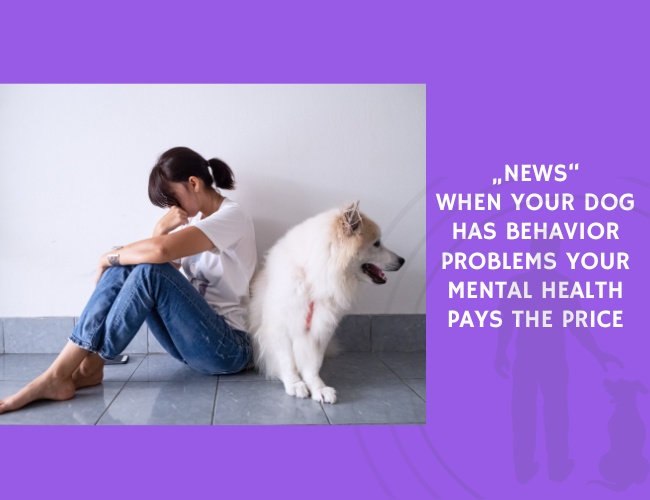
What is unambiguous is the picture painted by the other five factors. A dog who behaves aggressively, who is chronically fearful, who is in poor health, or who the owner cannot manage or adequately care for — that dog is a source of significant ongoing stress. The emotional and practical load of living with a behaviourally or physically compromised dog is measurable in its owner’s mental health outcomes. This is not a minor association. It was consistent across multiple wellbeing dimensions over a sustained observation period.
The One Factor That Helped — and What It Points To 🐕
Of all 17 factors examined, only one correlated with better wellbeing: friendly conversation with others facilitated by the dog. Not the dog itself. Not walking with the dog. Not time spent with the dog. The social connection that the dog made possible with other people.
That is a striking finding. It suggests that the mental health benefit most reliably associated with dog ownership in this data is not the direct human-dog relationship — it is the human-human relationship that the dog enables. Dogs as social catalysts. Dogs as the reason a conversation starts, a connection forms, a moment of human contact happens that might not have otherwise.
The practical implication is direct: dog ownership is most likely to support mental health when the dog is behaviourally stable, physically healthy, adequately cared for, and used as a bridge to social engagement. Dog ownership is most likely to damage mental health when the dog presents chronic behavioural or health challenges the owner cannot manage.
What This Means for the Relationship You Are Building 🐾
At Zoeta Dogsoul, this research lands at the centre of what we consistently work toward. A dog with unresolved behavioural problems is not just a training challenge. It is an ongoing source of load for the owner — and that load accumulates. Aggression incidents. Fear responses in public. The constant vigilance of a dog you cannot predict or control. These experiences do not sit neatly in the category of “dog problems.” They are owner wellbeing problems. The data now confirms that directly.
NeuroBond is built on the premise that the relationship between dog and owner functions best when both sides are operating from a place of stability. A behaviourally dysregulated dog cannot be a source of genuine support for an owner. And an owner whose mental health is being eroded by their dog’s behaviour cannot provide the quality of presence and structure the dog needs to improve. The two are not separate systems. They are one system, and they influence each other in both directions.
Addressing your dog’s behavioural problems is not just about the dog. It is about you. And the Invisible Leash between you functions most cleanly when both ends of it are stable. 🐾
Source: Barcelos, A. M., Kargas, N., Assheton, P., Maltby, J., Hall, S. S., & Mills, D. (2023). Dog owner mental health is associated with dog behavioural problems, dog care and dog-facilitated social interaction: a prospective cohort study. Scientific Reports. Published December 8, 2023.










