
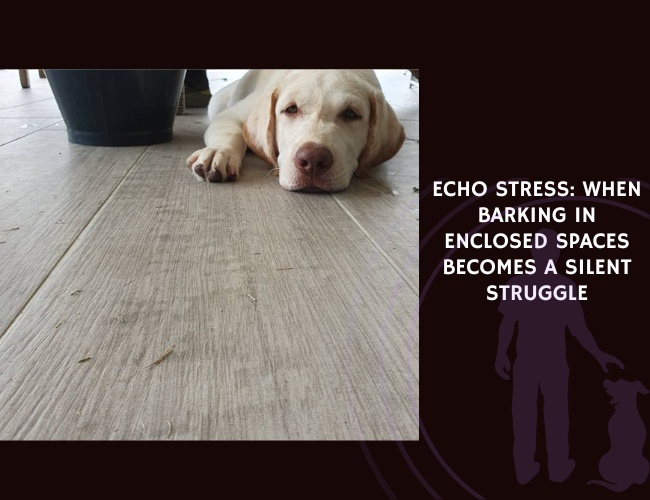
Have you ever noticed your dog’s barking intensify in a bathroom, hallway, or kennel? What seems like simple vocalization might actually be a complex stress response triggered by the space itself. Let us guide you through the fascinating—and often overlooked—phenomenon of Echo Stress, where the walls around your furry friend become amplifiers of anxiety.
Introduction: The Hidden Acoustic Trap
Your dog barks. The sound bounces off tile floors, hard walls, glass windows. It returns—louder, distorted, relentless. What you hear as simple reverberation, your dog experiences as sensory chaos. This is Echo Stress: a neurobiological stress response triggered when dogs vocalize in acoustically reflective environments.
In kennels, veterinary clinics, grooming salons, or even your own bathroom, enclosed spaces with hard surfaces create a perfect storm for canine anxiety. The very act of barking—often a dog’s way of communicating distress—becomes the trigger for escalating stress. Through the NeuroBond approach, we’re beginning to understand how deeply these acoustic environments impact our dogs’ emotional and physiological well-being. 🧡
Did you know? Research suggests that dogs can experience heightened arousal and stress responses in reverberant environments, where their own vocalizations create a feedback loop of anxiety. This isn’t just behavioral—it’s neurological.
Understanding the Acoustic Environment: When Spaces Become Amplifiers
How Sound Behaves in Enclosed Spaces
Reflective surfaces transform ordinary spaces into acoustic echo chambers. When your Corgi barks in an open field, sound waves dissipate naturally into the environment. But place that same bark in a tiled bathroom or concrete kennel? Everything changes.
Sound waves bounce off hard surfaces—walls, floors, ceilings—creating reverberation. The original bark persists as echoes, layering upon itself, amplifying in intensity. What started as a single vocalization becomes a sustained auditory experience that can last several seconds.
Key acoustic factors include:
- Reverberation time: How long sound persists in a space
- Surface materials: Tile, concrete, and glass reflect; carpet, curtains, and foam absorb
- Room geometry: Corners and parallel walls intensify echo effects
- Frequency response: Typical bark frequencies (2–5 kHz) may resonate particularly strongly
The Canine Auditory Experience
Dogs perceive sound differently than humans. Their hearing range extends from approximately 40 Hz to 60,000 Hz—compared to our modest 20 Hz to 20,000 Hz. This means dogs detect subtle acoustic nuances we completely miss.
In reverberant spaces, dogs struggle with sound localization—the ability to identify where sounds originate. When echoes surround them from multiple directions, their spatial awareness becomes compromised. Imagine trying to navigate while someone plays your voice back at you from every angle, slightly delayed and distorted. This sensory confusion creates genuine distress. 🧠
The frequencies typical of canine barking (2,000–5,000 Hz) happen to be particularly susceptible to amplification in many enclosed human-made spaces. It’s almost as if we’ve accidentally designed environments that maximize acoustic stress for our dogs.
The Neurobiology of Echo Stress: What Happens in Your Dog’s Brain
The Amygdala Response: When Fear Takes Control
At the heart of Echo Stress lies the amygdala—your dog’s emotional alarm system. This almond-shaped brain region processes threats and triggers fear responses. When persistent, amplified auditory feedback floods your dog’s sensory system, the amygdala interprets this as a threat signal.
Prolonged echo exposure doesn’t just create momentary stress—it can lead to amygdala hypersensitivity. The brain becomes increasingly reactive to auditory stimuli, lowering the threshold for anxiety responses. What began as environmental stress becomes a neurological pattern.
The brainstem auditory pathways, which process incoming sound before it reaches higher brain centers, remain in a state of heightened activation. This creates a physiological foundation for chronic arousal and hypervigilance.
The Feedback Loop: Self-Reinforcing Stress Cycles
Here’s where Echo Stress becomes particularly insidious. Your dog experiences anxiety and barks. The echo amplifies that bark. The amplified sound increases anxiety. Your dog barks more intensely. The cycle repeats—and escalates.
This represents a classic operant conditioning loop, but with an involuntary twist. The bark itself becomes both the behavior and the reinforcing stimulus. Unlike typical learned behaviors, your dog isn’t choosing to continue—the environment is essentially forcing the pattern.
Research on stress-related neural networks, while primarily conducted in humans, provides insights into how chronic stressors can create lasting changes in brain structure and function. The Invisible Leash reminds us that emotional regulation isn’t just about training—it’s about the neurobiological state we help our dogs maintain. 🐾
Polyvagal Theory and Acoustic Safety
The Polyvagal Theory offers another lens for understanding Echo Stress. This framework describes how the autonomic nervous system regulates our emotional states through three distinct pathways:
- Ventral vagal: Safe and social state (calm engagement)
- Sympathetic: Fight or flight (active defense)
- Dorsal vagal: Freeze or shutdown (passive defense)
In acoustically chaotic environments, dogs struggle to maintain that safe, socially engaged state. The constant auditory stimulation triggers sympathetic activation—elevated heart rate, rapid breathing, heightened arousal. In severe cases, dogs might shift into dorsal vagal shutdown, appearing withdrawn or unresponsive.
The absence of clear, predictable acoustic cues disrupts your dog’s ability to feel safe. Without that foundation of safety, true learning and emotional regulation become nearly impossible.
Behavioral Manifestations: Recognizing Echo Stress in Your Dog
Primary Vocal Changes
Dogs experiencing Echo Stress show distinctive changes in their vocalizations:
- Increased intensity: Barking becomes progressively louder
- Higher frequency: Pitch rises with escalating anxiety
- Rapid succession: Gaps between barks shorten
- Altered acoustic quality: Barks may sound more frantic or desperate
- Compulsive patterns: Vocalization continues even when trigger is removed
You might notice your typically calm companion transforms in certain spaces—becoming persistently vocal in the grooming salon despite being quiet at home.
Secondary Stress Indicators
Beyond vocalization, watch for these behavioral signals:
- Physical tension: Stiff posture, raised hackles, rigid tail
- Displacement behaviors: Excessive panting, lip-licking, yawning
- Avoidance: Reluctance to enter specific spaces
- Hypervigilance: Constant scanning, inability to settle
- Recovery difficulty: Extended time to calm after leaving the space
Some dogs show signs of generalized sensory sensitivity—becoming reactive to other sounds, textures, or environmental changes. This suggests Echo Stress may be part of broader anxiety patterns rather than an isolated response.
Individual Variation and Vulnerability
Not all dogs experience Echo Stress equally. Certain factors increase vulnerability:
- Previous acoustic trauma: Dogs with history of noise phobias
- Genetic predisposition: Herding breeds with heightened auditory sensitivity
- Early socialization: Limited exposure to varied acoustic environments
- Underlying anxiety: Dogs already prone to stress responses
- Age factors: Senior dogs with hearing changes may be more reactive
Shelter dogs face particular risk. The combination of confinement stress, separation anxiety, novel environments, and reverberant kennel designs creates a perfect storm for developing chronic Echo Stress behaviors.
The Physiological Impact: Measuring Stress Beyond Behavior
Cortisol and the Stress Hormone Cascade
When your dog experiences Echo Stress, the hypothalamic-pituitary-adrenal (HPA) axis activates, releasing a cascade of stress hormones. Cortisol, the primary stress hormone, rises significantly in dogs exposed to prolonged acoustic stressors.
Research has documented that confinement combined with sensory stressors leads to sustained cortisol elevation and potential immune suppression. This isn’t just emotional distress—it’s physiological strain with real health implications.
Chronic cortisol elevation can lead to:
- Immune system suppression
- Digestive disturbances
- Sleep disruption
- Impaired learning and memory
- Increased inflammation
Measuring cortisol through saliva, blood, or even fur samples provides objective evidence of stress levels, allowing us to quantify what your dog experiences beyond observable behavior.
Heart Rate Variability: The Window into Autonomic Balance
Heart Rate Variability (HRV)—the variation in time between heartbeats—serves as a powerful indicator of stress and autonomic nervous system function. Lower HRV correlates with higher stress and reduced physiological resilience.
Dogs in echoic environments show measurably different HRV patterns compared to acoustically neutral spaces. The constant auditory stimulation keeps the sympathetic nervous system activated, reducing the parasympathetic “rest and digest” influence that promotes calm.
Over time, chronic Echo Stress can lead to baseline shifts in autonomic function, where your dog’s nervous system remains in a perpetually heightened state—even outside the triggering environment.
Loud. Trapped. Overwhelmed.
Echo turns voice into threat. In hard-walled spaces, a bark doesn’t fade—it multiplies. What begins as a call for reassurance becomes a storm of returning sound the brain mistakes for danger.
The nervous system remembers noise. Each reflection feeds the amygdala’s fear loop, teaching the body to brace even before the first bark begins. Stress becomes pattern, and silence no longer means safety.



Softness restores calm. Absorbing surfaces, distance, and your steady presence break the cycle. When sound stops fighting back, the dog’s voice can rest—and peace returns to the space within.
Long-Term Sensitization: When Hearing Becomes Hyperacute
Perhaps most concerning is the potential for hyperacusis—abnormally increased sensitivity to normal environmental sounds. Chronic exposure to amplified, reverberant vocalizations may recalibrate your dog’s auditory system, lowering the threshold for sound-induced stress.
This noise sensitization means everyday sounds—a door closing, dishes clattering, children playing—become increasingly distressing. What started as stress in specific acoustic environments generalizes to broader sound phobias.
Some dogs develop compulsive barking or self-directed frustration behaviors as maladaptive coping mechanisms. These patterns indicate that Echo Stress has progressed beyond an environmental reaction to a chronic psychological condition requiring intervention. 😟
Environmental and Social Variables: Context Matters
The Role of Confinement
Confinement itself is a known stressor. When combined with echoic acoustic properties, the stress response amplifies significantly. Small spaces with hard surfaces—veterinary exam rooms, grooming cages, bathroom quarantine areas—create the highest-risk environments.
Recovery time matters too. A brief exposure might cause temporary stress, but repeated or prolonged confinement in reverberant spaces can lead to chronic stress patterns and learned helplessness.
The Human Buffer Effect
Here’s the encouraging part: your presence matters profoundly. Human emotional stability, calm energy, and reassuring tone can significantly buffer echo-induced agitation. This is where Soul Recall comes into play—those deep moments of connection where your dog draws on the trusting relationship you’ve built together.
Research consistently shows that dogs co-regulate with their humans. Your calm physiological state—steady breathing, relaxed posture, gentle voice—provides a model for your dog’s nervous system. In stressful acoustic environments, you become their anchor to safety.
Effective human buffering strategies include:
- Maintaining your own calm (dogs read your stress instantly)
- Using soft, low-pitched vocalizations
- Providing physical contact if your dog seeks it
- Creating positive associations through treats and play
- Remaining emotionally predictable and consistent
That balance between science and soul—that’s the essence of Zoeta Dogsoul.
High-Risk Environments
Certain settings present elevated risk for developing Echo Stress behaviors:
Veterinary Clinics: Combination of medical anxiety, confinement, and tile-floored exam rooms creates multiple stressors. Dogs may begin associating the acoustic environment with negative experiences, compounding stress responses.
Grooming Salons: Hard surfaces for easy cleaning, plus clippers and dryers, create complex auditory challenges. Repeated visits mean chronic exposure for many dogs.
Shelters and Kennels: Perhaps the highest-risk environment. Concrete runs with metal gates produce maximum reverberation. Multiple dogs barking simultaneously create acoustic chaos. Add separation stress and confinement, and you have conditions for severe Echo Stress development.
Home Bathrooms: Even familiar environments can become problematic. Many dogs are isolated in bathrooms during thunderstorms or fireworks—associating the space with fear, then experiencing Echo Stress amplification of their own anxiety vocalizations.
Mitigation Strategies: Creating Acoustic Sanctuary
Architectural and Environmental Modifications
The most effective intervention is often the simplest: change the acoustic environment. Sound-dampening modifications can dramatically reduce reverberation and stress.
Practical modifications include:
- Acoustic panels on walls (even decorative fabric panels help)
- Area rugs or rubber mats on hard floors
- Curtains or fabric wall hangings
- Soft furnishings (dog beds, cushions) to absorb sound
- Textured surfaces rather than smooth, reflective materials
In professional settings like shelters or grooming salons, these changes benefit all dogs while creating a calmer working environment for staff. The investment in acoustic treatment pays dividends in reduced stress behaviors and faster recovery times.
For home environments:
- Avoid isolating anxious dogs in bathrooms or laundry rooms
- Create “safe spaces” with soft materials and sound absorption
- Use white noise or calming music to mask echoes
- Consider temporary acoustic solutions (blankets over crates, portable panels)
Desensitization and Counterconditioning
Behavioral modification can help dogs build positive associations with previously stressful acoustic environments. However, classical counterconditioning alone may have limitations when dealing with involuntary neurological responses.
Effective desensitization protocol:
- Start below threshold: Introduce the space when your dog is calm, with minimal reverberation
- Pair with positive experiences: High-value treats, favorite toys, gentle play
- Gradual exposure: Slowly increase time spent in the space
- Monitor stress signals: Watch for early warning signs and adjust accordingly
- Build gradually: Multiple short, positive sessions outperform fewer long ones
The NeuroBond Methodology: Emotional Co-Regulation
Here’s where traditional training meets neurobiological understanding. The NeuroBond methodology emphasizes emotional co-regulation alongside behavioral modification—recognizing that your dog’s stress response is physiological, not just behavioral.
This approach integrates:
- Your calm presence as a biological regulator
- Emotional synchrony where you actively model the state you want your dog to achieve
- Trust-based foundation built through consistent, predictable interactions
- Patience with the process understanding that neurobiological change takes time
Through this framework, you’re not just training behaviors—you’re helping restore your dog’s sense of safety and predictability in sound environments. The Invisible Leash reminds us that true guidance comes through awareness and connection, not tension or force.
Controlled Acoustic Retraining
Advanced rehabilitation might include acoustic retraining protocols where dogs gradually learn to tolerate and eventually feel comfortable in reverberant spaces. This requires:
- Careful acoustic measurement and control
- Gradual exposure with precise monitoring
- Immediate escape routes if stress escalates
- Professional guidance from veterinary behaviorists
- Integration with anxiety medication when appropriate
The goal isn’t just tolerance—it’s restoring trust in sound environments and breaking defensive barking cycles that have become entrenched.
Special Considerations: When to Seek Professional Help
Red Flags Requiring Intervention
While mild Echo Stress might resolve with environmental modifications, certain signs indicate the need for professional support:
- Persistent compulsive barking that continues after leaving the space
- Generalized noise phobias developing or worsening
- Self-directed behaviors (excessive licking, chewing, pacing)
- Complete avoidance of entire categories of spaces
- Aggressive responses to acoustic triggers
- Inability to calm within 30-60 minutes of leaving the environment
A veterinary behaviorist can assess whether anxiety medication might support the behavioral modification process, addressing the neurobiological component while you work on environmental and training strategies.
The Role of Medication
For some dogs, the neurobiological changes from chronic Echo Stress require pharmaceutical support. Anti-anxiety medications can:
- Lower baseline arousal levels
- Reduce amygdala hypersensitivity
- Enable learning during desensitization
- Provide relief while environmental changes take effect
Medication isn’t admitting defeat—it’s recognizing that sometimes the brain needs help resetting its stress responses before behavioral work can succeed.
Looking Forward: Building Acoustic Awareness
For Dog Owners
Start paying attention to the acoustic properties of spaces where your dog spends time. Notice how your voice sounds, how footsteps echo, how barks reverberate. This awareness helps you anticipate and prevent Echo Stress before it develops.
When choosing boarding, grooming, or veterinary facilities, consider the acoustic environment. Facilities with soft surfaces, sound dampening, and thoughtful acoustic design demonstrate understanding of canine stress and welfare.
For Professionals
Those working with dogs in professional capacities have special responsibility. Veterinary clinics, groomers, trainers, and shelter staff can significantly reduce Echo Stress through:
- Acoustic treatment in confinement areas
- Minimizing time dogs spend in high-reverberation spaces
- Training staff to recognize early stress signals
- Implementing environmental enrichment that reduces barking triggers
- Creating protocols that prioritize acoustic comfort
The welfare implications extend beyond individual dogs to the broader question of how we design spaces for animals in our care.
Conclusion: The Silent Suffering We Can Address
Echo Stress represents a significant but often overlooked environmental stressor for dogs. What appears as simple barking may actually be a neurobiological stress response amplified by the very spaces we’ve created. From the physics of sound reflection to the neurochemistry of chronic stress, understanding this phenomenon opens pathways to meaningful intervention.
The encouraging news? Echo Stress is largely preventable and treatable. Through architectural modifications, behavioral support, and the emotionally attuned approach of NeuroBond methodology, we can create acoustic environments that support rather than stress our dogs.
Your next steps:
- Evaluate the acoustic properties of spaces where your dog spends time
- Watch for early signs of Echo Stress in your furry friend
- Implement simple sound-dampening modifications in your home
- Seek professional guidance if stress behaviors persist
- Advocate for acoustic awareness in professional dog care facilities
Remember: your dog’s distress in enclosed spaces isn’t just behavioral—it’s physiological, neurological, and entirely valid. By understanding and addressing Echo Stress, you’re not just improving behavior. You’re fundamentally supporting your dog’s wellbeing at the deepest level.
That trusting relationship you share, built on understanding and responsive care—that’s the foundation from which all healing flows. 🧡🐾










