
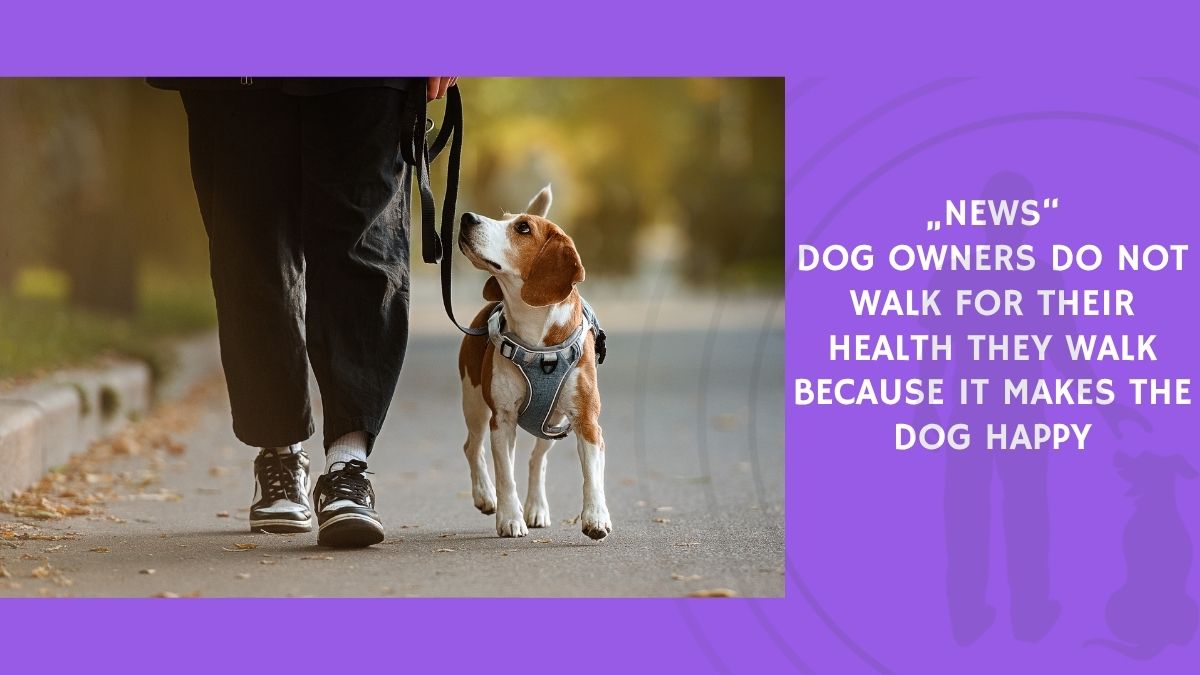
Westgarth, Christley et al. (2017) — International Journal of Environmental Research and Public Health
I Walk My Dog Because It Makes Me Happy: A Qualitative Study to Understand Why Dogs Motivate Walking and Improved Health
Published: July 25, 2026
Dog owners are more physically active than non-owners — that much is well established. What has been far less understood is why. A qualitative study combining 26 interviews with autoethnographic observation of actual dog walking experiences has produced an answer that challenges the way public health messaging around dog walking is typically framed. The motivation is not exercise. It is the relationship. 🐾
Researchers C. Westgarth, R. Christley, G. Marvin, and E. Perkins investigated the psychological and relational mechanisms behind why dog owners walk — and why some dog owners, despite having a dog, rarely do. What emerged from the interviews was a consistent construction of dog walking as something done for the dog, driven by the owner’s perception of the dog’s needs and personality, and conditional on the belief that the dog was genuinely enjoying the experience.
The Walk Is Constructed as Being for the Dog
The central finding is structural. Owners did not primarily describe walking as something they did for their own health, fitness, or stress management — even when those benefits were real and acknowledged. They described walking as something the dog needed. The owner’s motivation was built around their representation of the dog’s requirements, and those requirements were filtered through their perception of the dog’s individual personality and behaviour.
This framing — the walk as for the dog — aligned the owner’s motivation with the dog’s needs in a way that made the activity feel obligatory in a positive sense rather than discretionary. The dog created a social commitment that exercise alone does not produce. A gym session can be cancelled without consequence. A dog waiting by the door cannot.
The happiness dimension was the most consistent emotional driver reported. Owners described deriving positive outcomes from walking — most notably feelings of happiness — but crucially, these feelings were contingent on the perception that their dog was also enjoying the experience. An owner whose dog was anxious, reactive, or visibly uncomfortable on the walk did not derive the same emotional return. The walk was satisfying when it was mutually satisfying. When it was not, the motivational architecture collapsed.
Physical activity and social interaction with other people emerged as secondary outcomes — real bonuses that owners appreciated but rarely named as the reason they walked. This has direct implications for public health interventions that promote dog walking as an exercise strategy. Framing the walk as a health behaviour for the owner may simply not connect with the motivational reality the research documents. The more effective lever is the relationship.
Why the Dog’s Behaviour Determines Whether the Owner Walks ⚠️
The contingency finding — that owner happiness from walking depended on perceiving the dog as happy — has an important inverse implication that the researchers acknowledge. Owners whose dogs show problem behaviours on walks: reactivity, pulling, anxiety, aggression toward other dogs or people, are owners whose primary motivational reward for walking is being actively undermined by the walk itself.
A dog who lunges at cyclists, who is difficult to manage around other dogs, or who shows visible stress in the walking environment is not a dog the owner experiences as enjoying the walk. And an owner who does not perceive their dog as enjoying the walk loses the emotional payoff that drives the behaviour in the first place. The result is a dog who gets walked less — which in most cases compounds the behavioural problems that caused the reduction in the first place.
This creates a feedback loop with significant welfare implications. Dogs who most need regular walking for physical and mental health are often the dogs whose behaviour on walks is most aversive for their owners. The motivational system that drives dog walking is not robust to that aversion — it is directly dependent on the quality of the shared experience. Interventions that address the dog’s walking behaviour are therefore simultaneously interventions in the owner’s physical activity levels and mental wellbeing.
What This Means for the Walk as a Relational Practice 🐕
The research frames dog walking as a complex social interaction with a significant other — not as a solitary health behaviour that happens to involve an animal. The dog is not a piece of exercise equipment. They are a relational partner whose enjoyment, behaviour, and personality actively shape the owner’s motivation, emotional experience, and long-term walking behaviour.
At Zoeta Dogsoul, this is exactly the territory of NeuroBond. The daily walk is one of the most consistent points of contact between dog and owner — a shared practice that either deepens the relationship or erodes it depending on the quality of what happens within it. A dog who walks with ease, who checks in, who moves through the environment without generating management demands, is a dog who is giving their owner the emotional return that sustains the practice across years.
The Invisible Leash is most visible on the walk — in the check-ins, in the attentiveness, in the way the dog moves relative to the handler rather than simply pulling toward whatever is next. Building that quality of movement and connection transforms the walk from a management task into the kind of shared experience the research shows actually motivates people to keep doing it. 🐾
Source: Westgarth, C., Christley, R., Marvin, G., & Perkins, E. (2017). I Walk My Dog Because It Makes Me Happy: A Qualitative Study to Understand Why Dogs Motivate Walking and Improved Health. International Journal of Environmental Research and Public Health. Published August 1, 2017.










