Nagasawa, Mitsui et al. (2015) — Science
Oxytocin-Gaze Positive Loop and the Coevolution of Human-Dog Bonds
Published: July 23, 2026
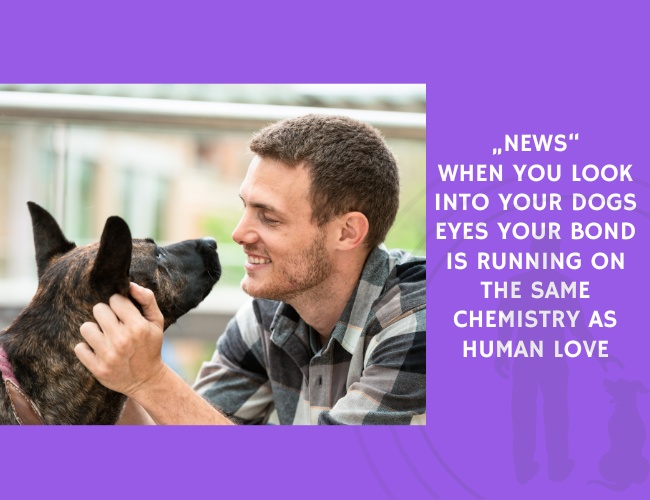
Humans bond emotionally through mutual gaze. It is one of the most fundamental mechanisms of human attachment — mediated by oxytocin, activated by eye contact, present from the first hours of life between mother and infant. A landmark study published in Science has shown that this same mechanism operates across species — between humans and their dogs — and that it is not present between humans and wolves. What that means for the biology of the human-dog bond is one of the most significant findings in the entire history of canine science. 🐾
Researchers M. Nagasawa, S. Mitsui, T. Kikusui, and their team measured urinary oxytocin concentrations in dogs and their owners before and after periods of mutual gazing and other types of interaction. They also tested whether administering oxytocin nasally to dogs would affect their gazing behaviour — and whether that behavioural change would in turn affect oxytocin levels in the owners. The full loop they documented is not simply a correlation. It is a bidirectional, self-reinforcing physiological mechanism that runs in real time between two different species during eye contact.
The Loop That Built the Bond
The findings unfolded in sequence. Mutual gazing between dogs and their owners increased urinary oxytocin concentrations in the owners. That oxytocin increase in turn facilitated owners’ affiliative behaviour and increased oxytocin concentrations in the dogs. When dogs were administered oxytocin nasally, their gazing behaviour toward their owners increased — and that increased gazing produced elevated oxytocin in the owners. The loop is complete and bidirectional: dog gaze raises owner oxytocin, owner oxytocin raises affiliative response, affiliative response raises dog oxytocin, dog oxytocin raises dog gaze.
This is not a metaphor for connection. It is a documented biochemical feedback system operating in real time through eye contact between two species. The same hormonal mechanism that mediates mother-infant bonding in humans — one of the most evolutionarily conserved attachment systems in mammalian biology — is operating across the species boundary between dog and human through the act of mutual gaze.
The wolf finding sharpens the significance enormously. Wolves, whose human handlers attempted to engage in the same protocol, did not show the same gaze-mediated oxytocin response. Wolves rarely engage in prolonged eye contact with human handlers and appear resistant to the loop. This is not a general mammalian effect. It is specific to dogs — and the researchers argue it emerged during domestication as dogs acquired human-like modes of social communication including mutual gaze as a bonding signal. The capacity to run this loop with humans may be one of the defining biological features that distinguishes dogs from every other species on earth.
What This Means for Every Moment of Eye Contact With Your Dog ⚠️
The practical implication is both simple and profound. When your dog looks at you — not the anxious scanning of an uncertain animal, but the relaxed, sustained, soft-eyed gaze of a dog who is settled and connected — they are initiating a biochemical process in both of you simultaneously. Your oxytocin rises. Theirs rises in response to your response. The loop runs.
This is not something you can manufacture through force or training in the conventional sense. A dog who gazes at you because they have been commanded to make eye contact is not running the same loop as a dog who gazes at you from genuine social orientation and security. The oxytocin system responds to the quality of the interaction, not just its surface form. Forced eye contact and voluntary mutual gaze are behaviourally similar and neurochemically different.
The wolf resistance to the loop also clarifies something important about what domestication actually selected for. It was not simply tameness or reduced aggression. It was the specific capacity to engage in human social bonding mechanisms — to participate in the oxytocin loop that humans use with each other. Dogs did not just become tolerant of humans. They became biologically integrated into human social bonding chemistry in a way that no other species has achieved.
The Biology Behind NeuroBond 🐕
This paper is the most direct scientific description of what NeuroBond is built on. The attunement between dog and owner is not a training outcome or a behavioural product. It is a neurochemical state — an oxytocin-mediated loop that deepens through quality of interaction, that runs through the eyes, and that was shaped by thousands of years of co-evolution into something that now functions as a genuine interspecies attachment system.
The Invisible Leash between dog and owner has a biochemical substrate. It runs through oxytocin. It is activated by gaze. It is reinforced every time the loop completes. And it is not available to wolves — meaning it is not simply a property of proximity or familiarity between animal and human. It is a specific biological capacity that dogs alone have developed, through co-evolution with the species they now share their lives with. 🐾
Source: Nagasawa, M., Mitsui, S., et al. (2015). Oxytocin-gaze positive loop and the coevolution of human-dog bonds. Science, 348(6232), 333-336. Published April 17, 2015.