Dobenecker (2004) — Journal of Nutrition
Nature, Nurture, and the Case for Nutrition: Apparent Calcium Absorption in Growing Dogs of Two Different Sizes
Published: August 07, 2026
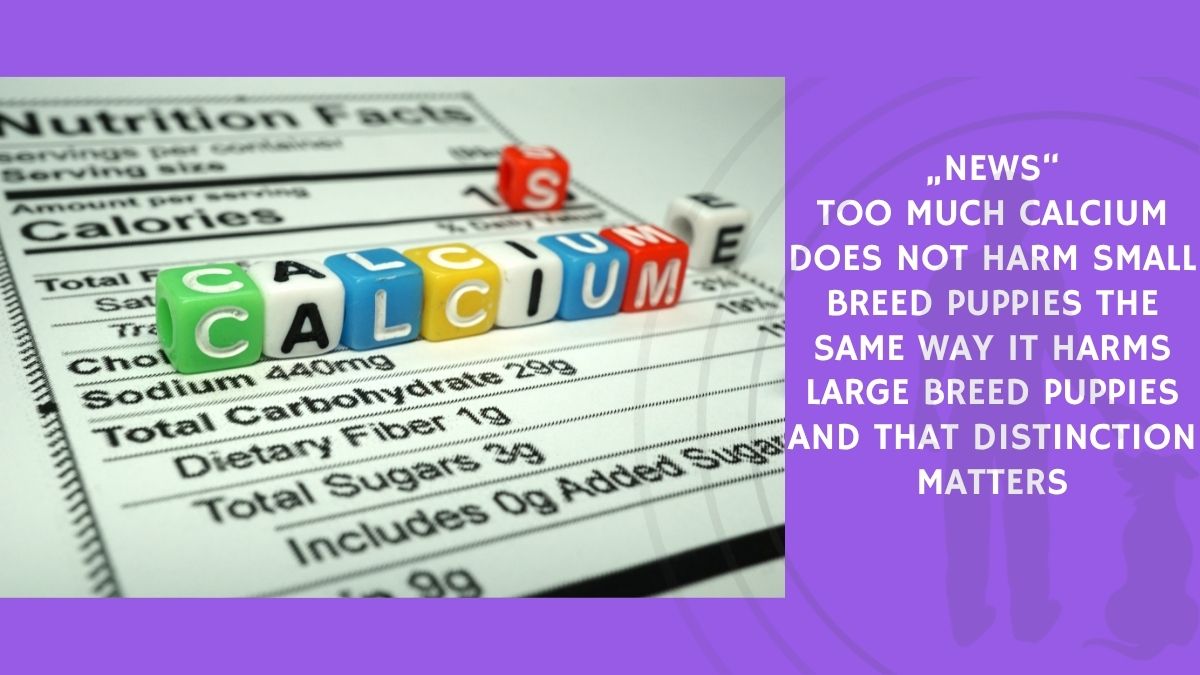
Calcium is essential for skeletal development. That much is universally known. What is far less widely understood is that the relationship between calcium intake and skeletal health in growing dogs is not the same across breed sizes — and that excess calcium, which produces no visible problems in small breed puppies, can drive clinical skeletal disease in large breed puppies eating the same diet. A study investigating calcium absorption and balance during growth in dogs of different sizes has confirmed this breed-size differential and identified a genetic component to how dogs regulate calcium uptake. 🐾
Researcher B. Dobenecker examined calcium balance during growth in dogs of different breed sizes — building on a body of experimental evidence primarily developed in Great Danes as the large-breed model and Miniature Poodles, Beagles, and mixed breeds as small-breed comparators. The consistent pattern across that literature, and confirmed in this investigation, is striking in its specificity: Great Dane puppies consuming excess calcium develop clinical signs of skeletal disturbance, while small-breed dogs on the same excess intake show no signs or only subclinical changes. The same dietary calcium level, the same excess, and fundamentally different outcomes depending on breed size.
Why Large Breed Puppies Cannot Regulate Calcium the Same Way
In healthy adults and small breed puppies, the gastrointestinal regulation of calcium absorption acts as a buffer. When calcium intake exceeds requirements, absorption efficiency decreases — the gut adjusts downward to prevent excessive uptake. This regulatory mechanism is mediated by active vitamin D-dependent transport that responds to the body’s calcium status, reducing active absorption when calcium is plentiful and increasing it when calcium is scarce.
In large breed puppies growing rapidly, this regulatory mechanism appears to function less effectively. The evidence from multiple experimental studies reviewed in this paper suggests that Great Dane puppies do not reduce calcium absorption efficiently in response to dietary excess — they continue absorbing calcium at high rates even when intake is already above requirement. The result is calcium accumulation in the developing skeletal system at levels that disrupt the precisely coordinated remodelling process through which healthy cancellous bone is formed.
This connects directly to the mechanism documented in the Dämmrich research covered in this series: subchondral bone weakness in large breed puppies develops when the bone formation and remodelling process is disrupted by overnutrition. Excess calcium is one specific pathway through which that disruption occurs — not only through accelerated growth from excess energy, but through the direct interference of calcium oversupply with the mineralisation and remodelling sequences that determine trabecular bone density and strength.
The genetic dimension the study investigates adds a further layer of complexity. Not every large-breed puppy consuming excess calcium develops skeletal abnormalities — individual variation within breeds exists, and breed-to-breed differences in response to calcium excess have been documented in both experimental studies and field observations. The calcium regulatory capacity appears to be influenced by genetic factors that vary within and across breeds, meaning that the same dietary calcium level carries different risk for different individuals even within the same size category.
What This Means for Reading Dog Food Labels ⚠️
The practical implication of this research is direct and often missed by owners of large breed puppies selecting commercial food. A puppy food that meets AAFCO or FEDIAF nutritional standards is formulated to be adequate for puppy growth in general — but the calcium levels that are safe and appropriate for a Miniature Poodle or a Beagle puppy may not be safe and appropriate for a Great Dane, Irish Wolfhound, or Bernese Mountain Dog puppy growing at a fundamentally different rate toward a fundamentally different adult body size.
Large breed puppy formulas exist specifically to address this — they are formulated with reduced calcium levels compared to standard puppy foods, and with calcium-to-phosphorus ratios calibrated for the specific mineralisation requirements of rapidly growing large breed skeletal systems. Using a standard puppy food for a Great Dane or Rottweiler puppy because it meets general puppy nutritional standards is not equivalent to feeding a large breed specific formula — the calcium level alone may be in a range that the standard formula considers adequate but the large breed puppy cannot adequately regulate.
Supplementing calcium on top of a complete puppy diet is one of the more common and more directly harmful owner interventions in large breed puppy nutrition. A puppy already consuming a nutritionally complete food is meeting their calcium requirements from that food. Adding supplemental calcium — cottage cheese, yoghurt, bone meal, calcium tablets — pushes intake into excess territory in a puppy whose regulatory capacity for excess calcium is already limited. The intention is supportive. The physiological consequence can be skeletal damage.
Nutrition for Large Breed Puppies Is Not Simply More of the Same 🐕
The consistent message across the large breed puppy nutrition research is one that the pet food marketing landscape does not always make clear: large breed puppies are not simply large versions of small breed puppies. Their skeletal development biology is different. Their calcium regulatory physiology is different. Their response to dietary excess is different. And the consequences of getting the nutrition wrong are not minor or reversible — they are structural changes to developing joints that shape the dog’s orthopaedic health for their entire life.
At Zoeta Dogsoul, physical foundation is always part of the full picture that NeuroBond asks owners to see clearly. A large breed puppy whose calcium intake is being managed appropriately — within the specific range their developing skeletal system can regulate — is a puppy whose joint health is being protected during the window when it can still be shaped. That protection does not show in the puppy’s behaviour or demeanour today. It shows in whether they are still moving freely and without pain at eight, ten, and twelve years old. 🐾
Source: Dobenecker, B. (2004). Nature, nurture, and the case for nutrition: apparent calcium absorption in growing dogs of two different sizes. Journal of Nutrition, 134(8 Suppl), 2079S-2082S. Published 2004.