
Savalois, Lescureux & Brunois (2013) — Society and Animals
Teaching the Dog and Learning from the Dog: Interactivity in Herding Dog Training and Use
Published: August 20, 2026
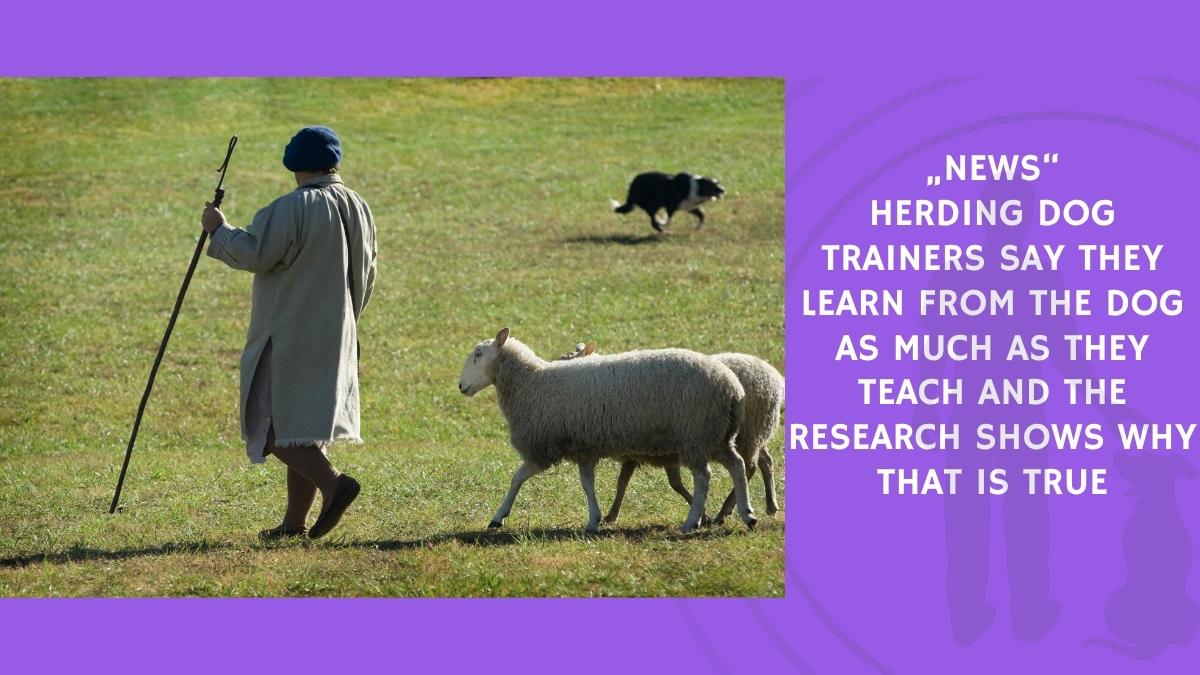
What actually happens in the relationship between a skilled herding dog trainer and their dog? An ethnographic study embedded with herding dog trainer-users in France has produced one of the most nuanced accounts of that relationship available in the research literature — and its findings challenge the common assumption that training is something humans do to dogs rather than something that emerges from genuine mutual interaction. 🐾
Researchers Nathalie Savalois, Nicolas Lescureux, and F. Brunois conducted an ethnographic study examining the discourses and practices of herding dog trainer-users — observing and documenting how experienced handlers conceptualise their dogs, how they train them, and how they describe what they learn from the animals they work with. The qualitative depth of ethnographic methodology captures dimensions of the human-dog working relationship that quantitative behavioural studies cannot easily access: the implicit knowledge, the relational understanding, and the practical wisdom that experienced trainers carry about their specific dogs and the working partnership they have built.
Two Training Modes and How They Work Together
The study identified two distinct training modes that trainer-users employed simultaneously rather than sequentially. Contextual training taught the dog the human-dog-livestock relationship itself — the spatial logic of herding, how livestock move, what pressure is and what releasing it means, the interactional dynamics of the three-way relationship between handler, dog, and flock. Conditioned training taught the commands — the specific signals that call specific behaviours in specific moments.
The sequencing of these modes matters. Contextual training gives the dog the understanding within which commands become meaningful. A command without contextual understanding is a trigger without interpretive framework. A dog who understands the herding relationship contextually can apply that understanding to novel situations — can problem-solve when the livestock do something unexpected, can maintain working effectiveness when the handler’s commands are delayed or ambiguous. A dog trained only through conditioned commands without contextual understanding is a dog who performs in scripted scenarios and struggles when the script breaks down.
This dual-mode framework maps directly onto what the GWAS research covered in this series identified at the neurological level: herding behaviour involves the same neural circuits as predation, modified by the removal of killing instinct. The contextual training mode is shaping those predatory circuits into the specific channel that productive herding requires — teaching the dog what to do with an instinct that already exists, not creating an instinct from scratch. The conditioned mode then places human direction on top of that contextually shaped instinct.
The Dog as Work Assistant Not Work Tool ⚠️
The most significant conceptual finding from the ethnographic data is the consistent way trainer-users distinguished between the dog as a work tool and the dog as a work assistant. Tools are operated. Assistants are worked with. Every trainer-user in the study recognised the individual personalities of their dogs and was sensitive to the quality of their relationship with them — and all of them expected the dogs to be more competent than humans in understanding livestock behaviour.
This expectation of superior competence in the dog is not false modesty. An experienced herding dog reads livestock behaviour — the subtleties of flight zones, the body language that precedes movement, the social dynamics within the flock that determine where pressure will produce movement and where it will produce dispersal — with a precision that even experienced handlers cannot match through observation alone. The handler sees the outcome of what the dog is reading. The dog reads it first.
The trainer-users described the dog as helping them establish an optimal interrelational distance between species — managing space, time, and what they called affectivity in the triangular human-dog-livestock relationship. This framing positions the dog not as an instrument executing human commands but as an active participant in a complex three-way interspecific relationship whose management requires more competence than any single species in the relationship possesses alone.
The researchers describe the relationship as a misunderstanding maintained by the livestock breeders in order to reach the leader position — the handler presenting as pack leader to the dog while the dog presents as predator to the livestock, with the livestock experiencing the handler as part of the predator system even when the handler’s actual role is to direct rather than threaten. This framing reflects the layered nature of the interspecific relationship: multiple simultaneous social fictions, all functional, all maintained because they produce the working outcome that none of the participants could achieve alone.
What Experienced Trainers Know That Research Often Misses 🐕
The ethnographic methodology of this study captures something that behavioural experiments and questionnaire surveys systematically miss: the tacit, experiential knowledge that accumulates in skilled practitioners over years of working with specific animals in specific contexts. The trainer-users who describe learning from their dogs — adjusting their understanding of how to work based on what a specific dog does in a specific situation — are describing a form of knowledge production that is bidirectional, iterative, and relational in ways that formal training models rarely acknowledge.
This is the territory of NeuroBond. The attunement between dog and handler is not built through commands alone. It is built through the accumulated experience of working together — reading each other, adjusting to each other, developing a shared working language that is specific to this pair in this context. The trainer-users who describe this process are not being sentimental. They are describing a real and documentable form of knowledge exchange that runs in both directions across the relationship.
The Invisible Leash between herding dog and handler is built precisely through this mutual learning — the handler teaching the dog the commands, the dog teaching the handler how to read livestock, both adjusting continuously until the working partnership becomes something neither could have built alone. That is not training in the conventional sense. That is a relationship. 🐾
Source: Savalois, N., Lescureux, N., & Brunois, F. (2013). Teaching the Dog and Learning from the Dog: Interactivity in Herding Dog Training and Use. Society and Animals, 21(2), 172-189. Published March 1, 2013.










