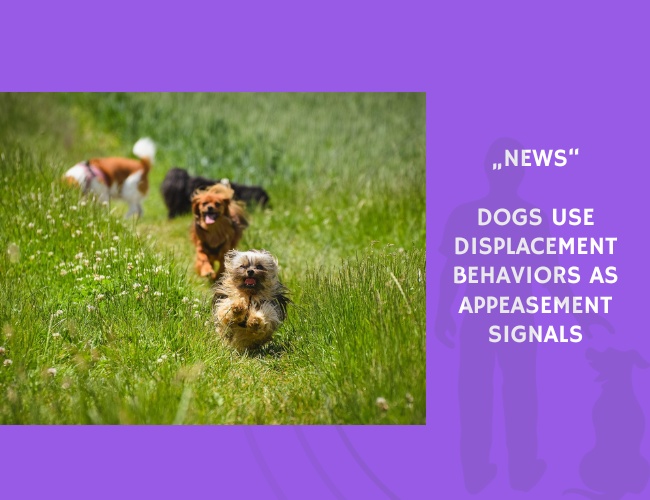
Dogs often use subtle signals to communicate their intentions and avoid conflict. Pedretti et al. (2023) investigated whether specific displacement behaviors—actions seemingly unrelated to the immediate situation—function as appeasement signals toward humans. These included blinking, nose licking, lip wiping, and head turning.
In the study, 53 dogs were approached by unfamiliar humans who acted in either a mildly threatening or neutral manner. Dogs were classified as “reactive” (barking or lunging) or “non-reactive” (remaining passive). The researchers then measured the frequency and duration of displacement behaviors across conditions.
The findings revealed that blinking, nose licking, and lip wiping were strongly associated with a non-reactive, non-aggressive attitude, regardless of whether the person approached in a threatening or neutral way. Additionally, head turning was more common among non-reactive dogs in the threatening scenario. These behaviors appear to signal peaceful intent rather than being strictly tied to conflict resolution.
The results suggest that such displacement behaviors serve as part of dogs’ appeasement repertoire, helping them avoid escalation and maintain social harmony. However, since the signals were not always linked to conflict situations, further research is needed to better understand their role in canine communication.
Source: Pedretti, G., Canori, C., Biffi, E., Marshall-Pescini, S., & Valsecchi, P. (2023). Appeasement function of displacement behaviours? Dogs’ behavioural displays exhibited towards threatening and neutral humans. Animal Cognition, 26, 943–952. Published January 20, 2023.