
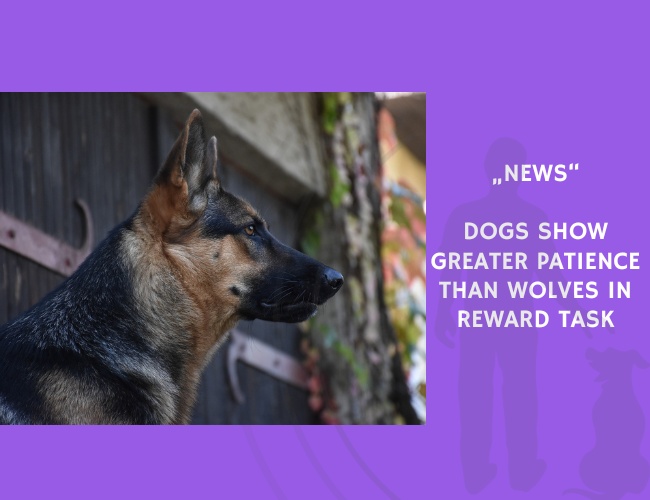
Self-control, the ability to resist immediate impulses for greater long-term rewards, is central to problem-solving and cooperation across species. Friederike Range, Désirée Brucks, and Zsófia Virányi (2020) tested whether domestication enhanced this trait in dogs compared to their wolf relatives.
The researchers designed a delay of gratification task, where both dogs and wolves were offered a choice: take a low-quality reward immediately or wait for a set delay to receive a high-quality reward. On average, dogs waited 66 seconds, while wolves managed only 24 seconds. Food quality did not affect how long the animals were willing to wait, but motivation trials revealed that dogs performed more consistently than wolves, though their performance decreased with longer delays.
The findings suggest that domestication and adaptation to human environments may have selected for traits linked to patience and self-control. Dogs may have evolved greater tolerance for waiting due to cooperative roles with humans, such as hunting and herding, which required persistence and coordination.
However, the authors caution that other factors may also explain the results, including the influence of human presence, differences in task understanding, or wolves’ lower motivation to participate. Despite these complexities, the study supports the view that human selection pressures have shaped key aspects of canine cognition.
Source: Range, F., Brucks, D., & Virányi, Z. (2020). Dogs wait longer for better rewards than wolves in a delay of gratification task: but why? Animal Cognition, 23, 443–453. Published February 14, 2020.










