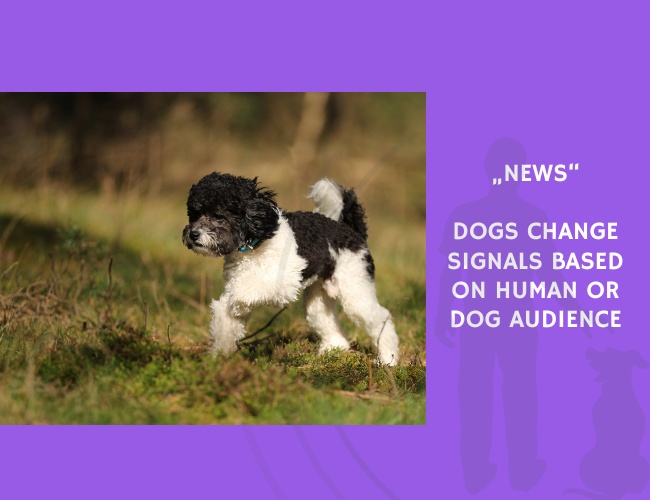
Dogs are skilled communicators, but their signals vary depending on who is watching. Pedretti et al. (2024) examined how audience type—human, conspecific (another dog), or no audience—shaped canine behavior and facial expressions when a food reward was withheld.
Forty-six dogs were tested across three conditions. Compared to the non-social setup, the presence of a dog audience triggered more facial expressions identified via DogFACS, such as ears downward, along with displacement behaviors like nose licking and lip wiping. Dogs also displayed more tail wagging, whining, and panting in this setting. Interestingly, when faced with another dog, they adopted a more avoidant stance, maintaining distance and avoiding direct gaze at the stimuli.
With a human audience, dogs still exhibited displacement behaviors and ear movements but to a lesser extent than with conspecifics. The data suggest that dogs show heightened communicative signals with other dogs, perhaps due to greater uncertainty in those interactions.
Importantly, salivary cortisol analysis showed no differences in stress levels across conditions, indicating that the variations in behavior were not stress-driven but audience-dependent. These results highlight dogs’ flexible communication strategies and the role of audience effects in shaping canine social behavior.
Source: Pedretti, G., Canori, C., Costantini, E., Palme, R., Valsecchi, P., & Marshall-Pescini, S. (2024). Intra and interspecific audience effect on domestic dogs’ behavioural displays and facial expressions. Scientific Reports, 14. Published April 25, 2024.