
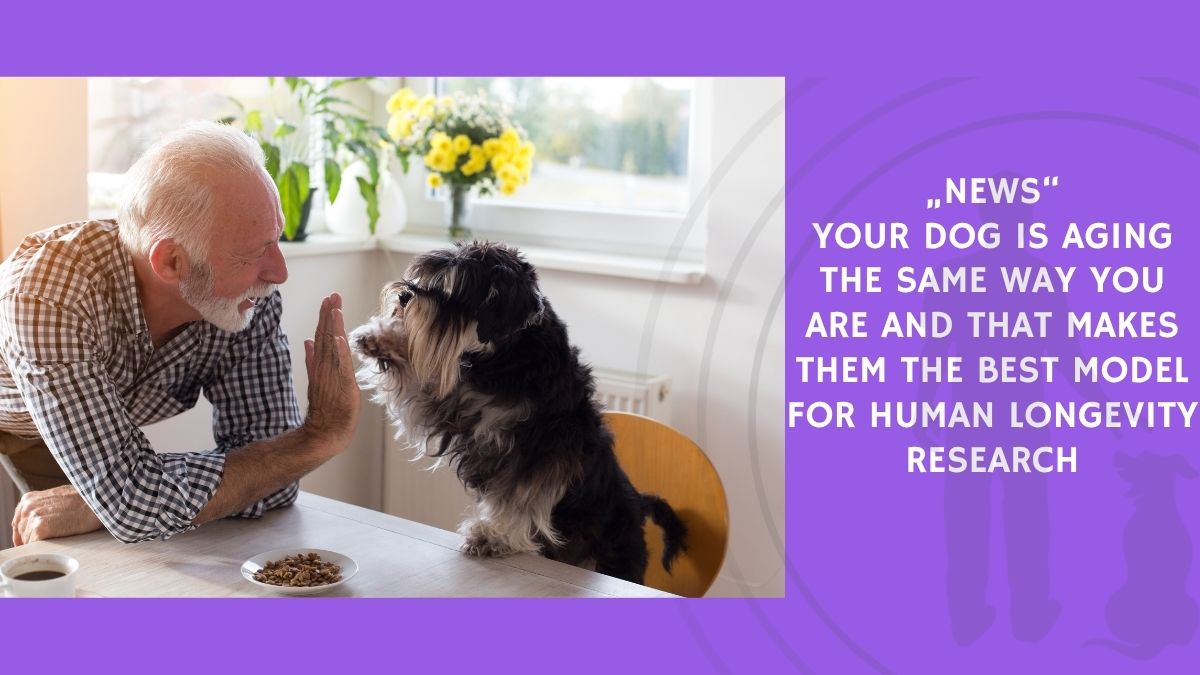
Hoffman, Creevy et al. (2018) — Aging Cell
The Companion Dog as a Model for Human Aging and Mortality
Published: August 12, 2026
Human populations are living longer than at any point in recorded history. But those additional years are increasingly being spent managing multiple chronic conditions simultaneously — the biological reality behind the phrase “living longer but not necessarily better.” Understanding what drives age-related morbidity and comorbidity is one of the most urgent questions in ageing science. And the first large-scale comparison of human and canine patterns of age-specific morbidity and mortality has established that the companion dog may be the closest available model for studying those patterns. 🐾
Researchers Jessica Hoffman, Kate Creevy, Alexander Franks, D. O’Neill, and D. Promislow conducted the first systematic large-scale comparison of age-related disease dynamics between humans and companion dogs — examining morbidity patterns, comorbidity associations, and mortality trajectories across both species. Their findings support a conclusion that individual papers in this series have been building toward from multiple angles: the companion dog is not simply a convenient laboratory subject. It is a genuinely close biological parallel to the human ageing experience.
Why Mice Are Not Enough for Ageing Research
Laboratory mice and rats dominate ageing biology research because they are cheap, genetically tractable, breed rapidly, and have short lifespans that allow ageing studies to be completed within reasonable timeframes. What they do not share with humans is the environmental context of ageing — they do not live in human homes, eat human-adjacent diets, breathe human-environment air, share human microbiomes, or develop disease through the complex gene-environment interactions that shape human ageing trajectories.
They also do not naturally develop many of the specific pathologies that define human ageing — the cancers, the metabolic syndromes, the neurodegenerative conditions, the cardiovascular deterioration — in ways that accurately mirror the human disease phenotype. Laboratory mouse models of these conditions are often artificially induced through genetic manipulation or chemical exposure rather than arising spontaneously through the same biological processes that produce them in humans.
Dogs circumvent these limitations. They share the human domestic environment. They eat commercially formulated food with nutritional profiles not entirely unlike processed human diets. They are diagnosed with naturally occurring conditions using the same diagnostic frameworks applied in human medicine. They are treated with many of the same drugs and interventions. And they develop age-related disease through biological processes that are, as this study now confirms at population scale, similar in their age-specific dynamics to the human pattern.
What the Morbidity and Comorbidity Comparison Found ⚠️
The study examined four chronic conditions that are among the most prevalent and most consequential in both human and canine ageing populations: obesity, arthritis, hypothyroidism, and diabetes. Across all four conditions, the researchers found that the comorbidity patterns — the degree to which these conditions cluster together and amplify each other’s effects — were similarly high in companion dogs as in human populations.
This is a meaningful finding beyond the individual conditions themselves. Comorbidity — the simultaneous presence of multiple chronic conditions — is the dominant feature of human ageing in developed countries. It is not obesity alone that drives late-life morbidity and healthcare burden. It is obesity alongside arthritis alongside metabolic dysfunction alongside cardiovascular disease alongside cognitive decline — each condition exacerbating the others through overlapping biological mechanisms. If companion dogs show similarly high levels of comorbidity clustering around the same chronic conditions, they are modelling the most challenging and most practically important feature of human ageing rather than a simplified single-disease version of it.
The mortality trajectory analysis added further precision. Neoplastic causes of death — cancer — showed similar age-related risk trajectories between the two species. Congenital causes showed similar patterns. Metabolic causes of death showed similar age dynamics. The biological relationship between age and disease risk is not simply shared between dogs and humans in a general sense. It is shared at the level of specific disease category trajectories that rise, peak, and decline at comparable life-stage proportions in both species.
What This Means for Everyday Dog Owners and the Relationship 🐕
For owners, the practical implication of this research is a reframing of what watching a dog age actually means. A dog who develops arthritis in middle age, whose weight management becomes more difficult as they get older, whose thyroid function shifts, whose cancer risk rises — that dog is traversing an ageing trajectory that mirrors the human ageing trajectory more closely than any laboratory model does. The conditions they develop are not simply veterinary problems. They are biological processes that human medicine is actively trying to understand and intervene in.
This shared ageing trajectory also means that the lifestyle factors influencing canine ageing outcomes — diet quality, body weight, exercise levels, inflammatory load, gut microbiome health, stress exposure — are the same factors influencing human ageing outcomes through similar or identical biological pathways. An owner who manages their dog’s weight carefully, maintains their activity, monitors for early signs of chronic conditions, and provides evidence-based nutritional support is doing more than responsible pet ownership. They are navigating the same ageing biology that will eventually govern their own trajectory, in a species whose lifespan compression allows those dynamics to become visible and addressable within years rather than decades.
At Zoeta Dogsoul, NeuroBond is built over time — through accumulated presence, through daily attentiveness, through the quality of care that keeps a dog physically capable of engagement across as many years as their biology allows. Research that confirms how closely canine ageing parallels human ageing is not an abstract scientific contribution. It is a direct argument for the depth of investment that the relationship deserves — because the animal you are investing in is ageing through the same biological landscape you will eventually navigate yourself, just on a compressed timescale that makes the choices and their consequences visible within the span of the relationship you share. 🐾
Source: Hoffman, J. M., Creevy, K. E., Franks, A. M., O’Neill, D., & Promislow, D. (2018). The companion dog as a model for human aging and mortality. Aging Cell. Published February 19, 2018.










