
Fedoseeva, Gindullina et al. (2025) — Glavnyj Zootehnik (Head of Animal Breeding)
Features of Expert Evaluation of Dogs of Cavalier King Charles Spaniel Breed with Using Selection and Genetic Parameters
Published: August 09, 2026
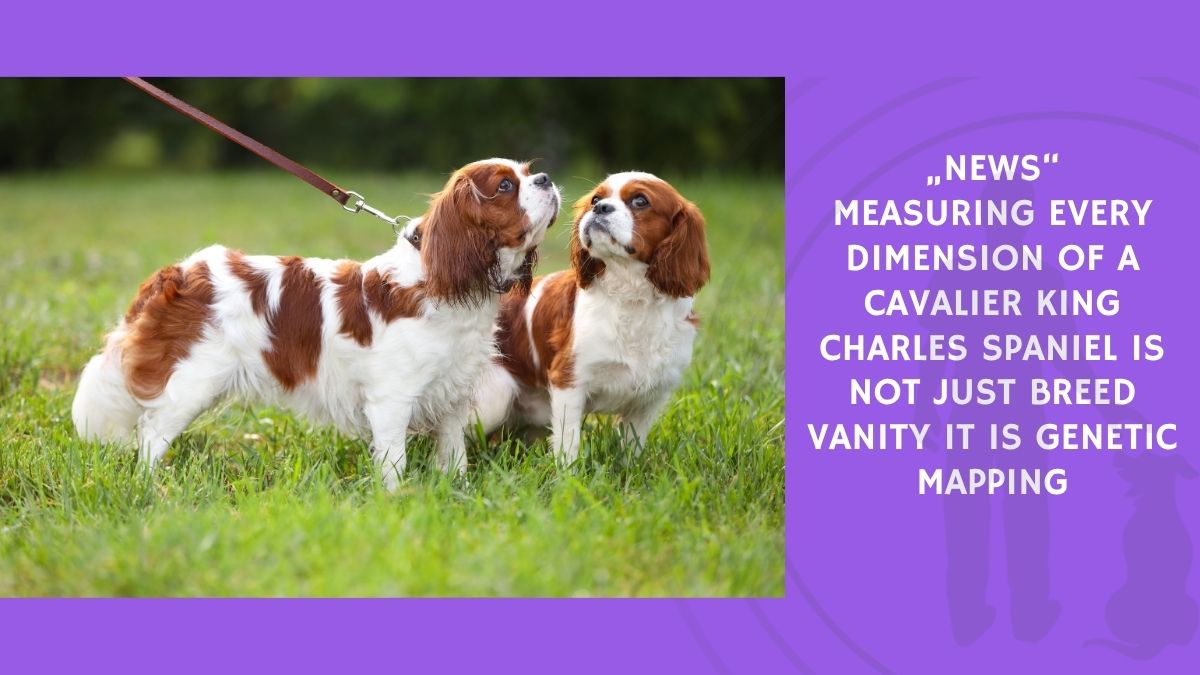
Breed conformation evaluation — the systematic measurement of a dog’s physical characteristics against breed standard criteria — is often dismissed outside specialist breeding circles as a purely aesthetic exercise. A study applying selection and genetic parameters to the conformation of Cavalier King Charles Spaniels from a Belarusian breeding population reveals that what is being measured is more than aesthetics. It is the heritable biological architecture of the breed — and understanding that architecture with precision is the foundation on which any meaningful selective breeding programme is built. 🐾
Researchers N. Fedoseeva, E.R. Gindullina, O. Yudina, and A.M. Mukhtarov conducted the first systematic conformation evaluation using selection and genetic indicators in the Cavalier King Charles Spaniel — a first for the breed according to the researchers — assessing height at the withers, height at the sacrum, head length, muzzle length, skull girth, cheekbone width, and chest width alongside colour inheritance patterns across a population of Belarusian-bred animals.
What the Conformation Data Actually Shows
The measurable conformation differences between males and females in this population were consistent with expected sexual dimorphism. Males showed reliable superiority in height at the withers, height at the sacrum, and skull girth — 30.56 cm in males against 27.96 cm in females, a statistically significant difference. Head length and muzzle length showed near-equal values between sexes — males at 2.94 cm muzzle length, females at 2.87 cm — while skull dimensions diverged more substantially.
The variability analysis — expressed as coefficients of variation — revealed where within-sex variation is highest in this population. Among males, chest width showed the greatest variability at 15.10 percent, indicating meaningful individual variation in this measurement even within a breed population maintained to standard. Head and muzzle length showed moderate variation coefficients. In females, head length and muzzle length coefficients were 6.96 and 10.79 percent respectively — indicating more consistent expression of these traits in females than in males of this population.
Variation coefficients matter for breeding selection because they indicate where within a population the traits are most and least consistent. High variability in chest width in males means that this measurement cannot be reliably predicted from parentage alone and requires direct assessment. Lower variability in female head measurements means these traits are more predictably heritable and more efficiently selected for in females.
The Colour Inheritance Data and What It Reveals ⚠️
The colour inheritance analysis covered 13 Blenheim males, 3 Tricolour males, and Black and Tan males across their recorded offspring. Blenheim sires produced predominantly Blenheim offspring — 73 of 79 — with 6 Tricolour. Tricolour sires produced a more mixed outcome of 10 Blenheim and 6 Tricolour from 16 offspring. Black and Tan sires produced 3 Ruby and 8 Black and Tan offspring from 11 recorded.
These patterns are consistent with what is known about Cavalier colour genetics — Blenheim and Tricolour involve different combinations of the B and E loci, and the proportions observed in this dataset reflect the expected genetic transmission ratios for these colour combinations without unexpected deviations. The value of documenting these patterns in a specific national breeding population is that it confirms the population’s genetic behaviour aligns with established colour genetics models — useful for breeding programme planning and for identifying any unexpected colour outcomes that might indicate unrecorded genetic variation.
The repeatability coefficients calculated for head measurements in Black and Tan male offspring — head length rw = 0.96, muzzle length rw = 0.98, skull girth and cheekbone width both near 0.96 to 0.97 — are among the highest documented for these traits in this breed. Repeatability coefficients approaching 1.0 indicate high consistency of trait expression across the offspring of the same sire, confirming strong heritable transmission of these specific measurements in this colour group.
What Systematic Conformation Genetics Means for Breed Health 🐕
Cavalier King Charles Spaniels carry known breed-associated health vulnerabilities — mitral valve disease, syringomyelia, and hip dysplasia among the most documented. The longevity genetics research covered in the previous article in this series identified nine candidate genes associated with living past 13 in this breed. These two papers, read together, represent different approaches to the same underlying challenge: understanding the heritable architecture of the breed well enough to make selective breeding decisions that improve health and longevity outcomes rather than purely optimising aesthetic conformance.
Systematic measurement with genetic parameters is the precondition for any quantitative genetic selection programme. Without knowing the heritability of specific traits, their coefficients of variation within the population, and their repeatability across sire lines, breeding decisions are made on impression rather than on data. The Cavalier population studied here now has a baseline — measurements and genetic parameters that future evaluation can be compared against, and that provide the foundation for identifying which traits are responding to selection and which require different approaches.
For owners who are selecting a Cavalier puppy from a breeder, the existence of systematic conformation and selection-genetic evaluation in a breeding programme is a meaningful quality indicator. A breeder who is measuring and recording these parameters across their breeding stock is a breeder who is working with data rather than only with visual impression — and in a breed with the health challenges Cavaliers carry, data-driven breeding is not a luxury. It is the mechanism through which the health of future generations is shaped.
At Zoeta Dogsoul, understanding the dog you have begins with understanding where that dog came from — the breeding decisions, the selection pressures, the genetic transmission patterns that produced the specific individual in front of you. NeuroBond is built on accurate attunement to the real animal — and the real animal is, in part, a product of the breeding programme that created them. Understanding that programme with the rigour this research represents is part of what responsible breeding and informed ownership both look like. 🐾
Source: Fedoseeva, N., Gindullina, E. R., Yudina, O., & Mukhtarov, A. M. (2025). Features of expert evaluation of dogs of Cavalier King Charles Spaniel breed with using selection and genetic parameters. Glavnyj Zootehnik (Head of Animal Breeding). Published January 2, 2025.










