
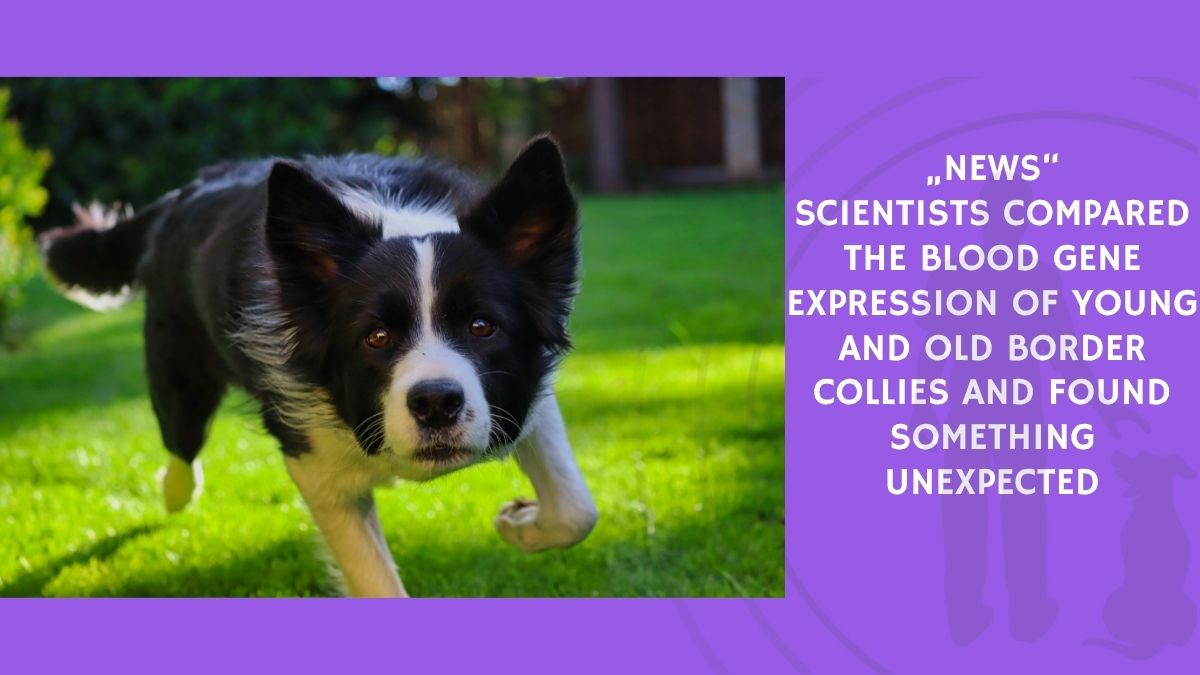
Jónás, Tátrai et al. (2025) — Veterinary Sciences
Differential Gene Expression Analysis of Whole Blood Transcriptome Between Young and Old Border Collie Dogs
Published: August 17, 2026
Ageing changes how genes are expressed — in some species dramatically, across thousands of genes, in others more subtly. A transcriptomic study comparing whole blood gene expression between young adult and elderly healthy Border Collie dogs set out to identify biomarkers of healthy ageing in dogs. What it found — or more precisely, what it largely did not find — adds an important and unexpected dimension to the growing science of canine ageing. 🐾
Researchers Dávid Jónás, K. Tátrai, Zsófia Rékasi, Balázs Egyed, and E. Kubinyi analysed whole blood transcriptomes — the complete set of RNA transcripts reflecting which genes are being actively expressed — in healthy Border Collies divided into young adult and elderly groups. Whole blood was chosen as the sample source because it is minimally invasive, practical for longitudinal collection, and reflects systemic physiological changes across the body rather than being limited to a single tissue type. The study was designed to identify genes whose expression changes significantly with healthy ageing — potential biomarkers that could flag age-related biological transitions without waiting for clinical disease to appear.
What the Gene Expression Analysis Found
The study found only a limited number of genes with significant age-related expression differences between young and elderly Border Collies. This is the central and most scientifically interesting result — not what was found, but the relative scarcity of what was found. The transcriptomic landscape of healthy ageing in this breed, as captured in whole blood, showed fewer significant changes than studies in other species typically report.
The researchers note that this finding aligns with what other dog transcriptomic ageing studies have found — limited blood transcriptomic change with age in healthy dogs — but contrasts with broader transcriptomic shifts reported in other species. This cross-species contrast raises genuinely interesting questions about whether dogs age differently at a gene expression level than other mammals, whether whole blood is capturing the most relevant tissue for canine ageing biology, or whether the specific comparison of healthy individuals is selecting a subset of ageing dogs whose transcriptome has successfully maintained regulatory stability.
The distinction between healthy ageing and pathological ageing matters significantly here. A study comparing healthy elderly dogs to healthy young dogs is asking what changes with age in the absence of disease — the biology of successful ageing rather than the biology of age-related breakdown. It is possible that the limited gene expression differences in healthy elderly Border Collies reflect precisely this: dogs who have aged successfully have maintained relatively stable gene expression regulation, and the dramatic transcriptomic changes reported in other species or other study designs may reflect the accumulation of pathological ageing rather than healthy ageing per se.
Why Border Collies and Why This Approach Matters ⚠️
Border Collies were a deliberate breed choice for this research. They are a cognitively demanding, high-activity breed with a relatively consistent genetic background — and the Senior Family Dog Project, with which several of the researchers are associated, has established Border Collies as a primary breed for canine ageing research precisely because of their consistency and the longitudinal data that has been collected on this breed population over time.
The whole blood transcriptome approach is methodologically significant for a different reason. Most transcriptomic ageing studies use tissue biopsies — brain, liver, muscle — that capture gene expression in specific organs but require invasive collection that limits longitudinal and large-scale study. Whole blood can be collected repeatedly from the same individual over years, making it theoretically ideal for tracking gene expression changes across the ageing timeline rather than capturing a single cross-sectional snapshot. The limitation the study identifies — that whole blood may not capture the most relevant ageing signals in dogs — is itself a valuable finding that guides how future transcriptomic ageing studies in dogs should be designed.
The dog-as-ageing-model argument made earlier in this series gains another supporting data point here. The fact that canine blood transcriptomic ageing produces a different pattern from what is seen in commonly studied model organisms is exactly the kind of species-specific finding that justifies studying dogs in their own right rather than assuming findings from mice or other species will translate directly.
What This Means for Canine Ageing Research and for Owners 🐕
The practical significance of biomarker research for ageing is the possibility of early detection — identifying biological signals of ageing before clinical disease appears, creating a window for preventive intervention. If blood transcriptomics in healthy dogs shows limited age-related change, the search for reliable blood-based ageing biomarkers in dogs may need to focus on other molecular layers — methylation patterns, protein expression, or metabolomic profiles — rather than gene expression in whole blood.
The researchers are explicit about this: further research is needed to clarify the blood transcriptomic basis of healthy ageing in dogs and humans. This is an honest scientific conclusion from a study that has contributed by establishing what whole blood transcriptomics in healthy ageing Border Collies does and does not show — narrowing the search space even when the result is partly a null finding.
For owners of Border Collies and other long-lived working breeds, the broader message from the growing canine ageing research is consistent: healthy ageing in dogs is biologically distinct from disease-driven ageing, the biological markers that distinguish the two are still being identified, and supporting the conditions for healthy ageing — through nutrition, maintained activity, cognitive engagement, and attentive health monitoring — remains the most evidence-grounded approach available while the biomarker science develops.
At Zoeta Dogsoul, the time we have with our dogs is the foundation on which NeuroBond is built — and that time is finite, variable, and increasingly understood at a molecular level. Research that advances our understanding of what distinguishes healthy ageing from pathological ageing in dogs is research that directly serves the quality and duration of what dog and owner can build together. Even a limited finding from a carefully designed study adds a brick to that edifice. 🐾
Source: Jónás, D., Tátrai, K., Rékasi, Z., Egyed, B., & Kubinyi, E. (2025). Differential Gene Expression Analysis of Whole Blood Transcriptome Between Young and Old Border Collie Dogs. Veterinary Sciences. Published January 23, 2025.










