
Morrill, Hekman et al. (2022) — Science
Ancestry-Inclusive Dog Genomics Challenges Popular Breed Stereotypes
Published: July 29, 2026
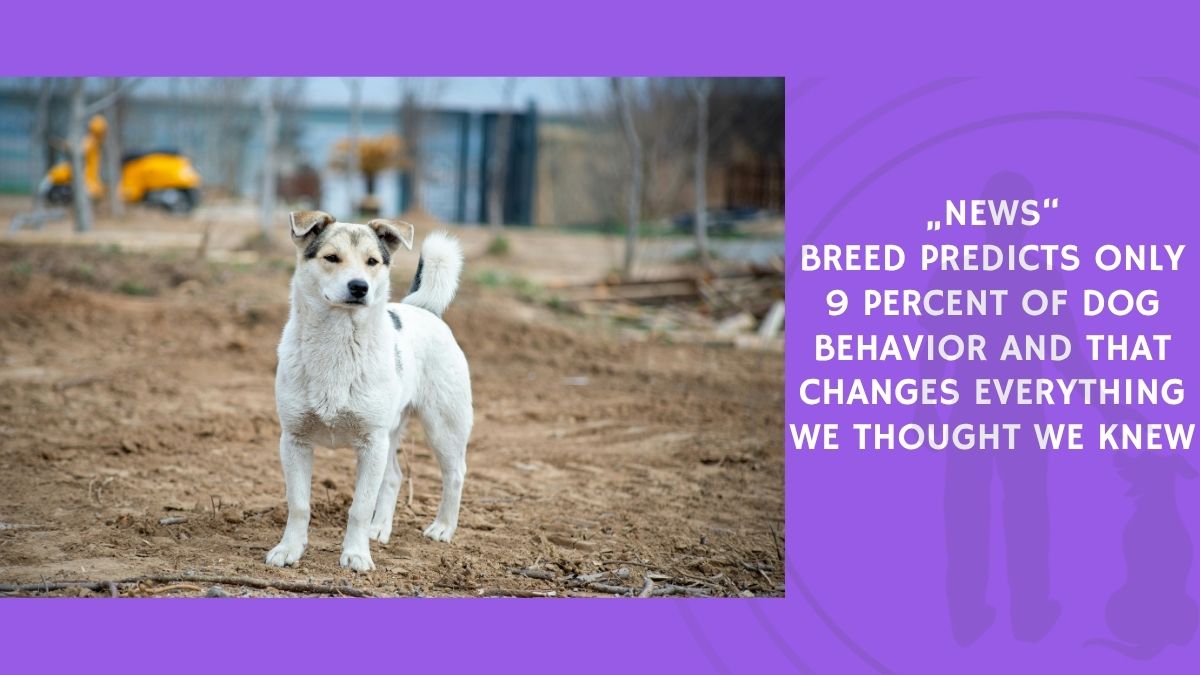
The assumption that breed determines behaviour is so deeply embedded in dog culture that it shapes adoption decisions, insurance policies, legislation, and training expectations worldwide. A landmark study published in Science — one of the most rigorous and most comprehensive genetic analyses of dog behaviour ever conducted — has now directly tested that assumption. The result is a finding that the entire dog world needs to sit with: breed explains just 9 percent of behavioural variation between individual dogs. 🐾
Researchers Kathleen Morrill, Jesseca Hekman, Elinor Karlsson, and their team surveyed the owners of 18,385 purebred and mixed-breed dogs and genotyped 2,155 of them through the Darwin’s Ark community science project. The inclusive approach — capturing purebred dogs, mixed-breed dogs, and dogs of full genetic diversity rather than restricting to pure breeds — was deliberate and methodologically significant. It allowed the researchers to separate what breed ancestry actually predicts genetically from what owner and cultural perception assumes it predicts.
What the Data Actually Shows About Breed and Behaviour
Most behavioural traits in the dataset were heritable — heritability estimates above 25 percent across the majority of traits tested. Behaviour has a genuine genetic dimension. That finding is not in dispute. What is in dispute is whether breed is the meaningful unit through which that genetic variation is organised and expressed at the individual level.
The answer the data provides is direct: it is not. Breed explains 9 percent of behavioural variation between individual dogs. The remaining 91 percent is explained by individual genetic variation, developmental history, environment, and experience — factors that breed ancestry does not capture. For some traits this predictive gap is smaller. Biddability — responsiveness to human direction and commands — is the most heritable and most breed-differentiated behavioural trait in the dataset, and knowing breed ancestry does make predictions somewhat more accurate for this specific trait. Border collie ancestry showed a confirmed small genetic effect on biddability in mixed-breed dogs that aligned with owner survey data for purebred Border Collies.
For other traits the predictive gap is larger. Agonistic threshold — how easily a dog is provoked by frightening or uncomfortable stimuli — showed almost no breed-level predictive value. And for human sociability, Labrador Retriever ancestry showed no significant genetic effect in mixed-breed dogs, directly contradicting the widespread assumption that Labradors are genetically predisposed to high human sociability relative to other dogs.
The genome-wide association analysis produced a further finding that reframes the entire history of dog behaviour genetics. The 11 genomic regions significantly associated with behaviour are not unusually differentiated between breeds. The genomic regions associated with aesthetic traits — coat colour, body size, ear shape — are highly differentiated between breeds, consistent with a history of direct selection. Behavioural regions are not. This means that the selective breeding that created modern dog breeds was selecting primarily for how dogs look, not for the behavioural characteristics those breeds are stereotypically assumed to carry.
Where Breed Behaviour Actually Comes From ⚠️
The conclusion the researchers draw from this pattern is one of the most significant reframings in canine science. The behaviours perceived as characteristic of modern breeds do not primarily derive from breed formation — the last 160 years of pedigree breeding. They derive from thousands of years of polygenic adaptation that predates modern breed creation entirely. The ancestral functional roles that shaped dogs before formal breeds existed — hunting, herding, guarding, scavenging — left polygenic behavioural tendencies distributed across the entire dog population at varying prevalence. Modern breed formation then selected aesthetic traits on top of that pre-existing behavioural variation without substantially reorganising it.
This means that a Border Collie’s herding tendency is not primarily the product of Border Collie breed selection. It is the product of thousands of years of selection for herding function across a much broader ancestral population — and that tendency, while statistically more prevalent in Border Collies, exists at varying levels across dogs of all breeds and mixed ancestry. The breed label is a weak and noisy proxy for the underlying polygenic reality.
The practical implications extend to breed-specific legislation, insurance exclusions, and adoption policies built on the premise that breed reliably predicts individual behavioural risk. If breed explains 9 percent of individual behavioural variation — and if the traits most associated with public safety concerns like agonistic threshold show almost no breed-level predictive value — then policies built on breed as a risk proxy are built on a foundation the data does not support.
What This Means for How You See the Dog in Front of You 🐕
For individual owners, this research is both liberating and demanding. Liberating because it removes the deterministic weight of breed labels from the individual animal — a mixed-breed dog of unknown ancestry is not behaviourally unpredictable in any way that distinguishes them from a purebred dog of known ancestry, because that ancestry predicts very little of what matters behaviourally at the individual level. Demanding because it means that the 91 percent of behavioural variation not explained by breed has to be understood through the individual animal — their specific developmental history, their particular genetic makeup as an individual rather than as a breed representative, and the specific relationship built between them and their owner.
This is exactly the territory of NeuroBond. Genuine attunement cannot be achieved by reading a breed profile and assuming it applies to the individual dog in front of you. The dog is not their breed. They are the specific animal shaped by a specific combination of polygenic tendencies, developmental experience, and relational history that no breed label adequately describes. Reading that animal accurately — not the stereotype, not the assumption, but the actual individual — is where real understanding begins.
The Invisible Leash connects you to this specific dog. Not to the breed average. Not to what Border Collies or Labradors or Pit Bulls are supposed to be like. To the individual animal whose 91 percent of behavioural variation is waiting to be read by an owner willing to look past the label. 🐾
Source: Morrill, K., Hekman, J., et al. (2022). Ancestry-inclusive dog genomics challenges popular breed stereotypes. Science, 376(6592). Published April 29, 2022.










