
Bray, Otto et al. (2021) — Frontiers in Veterinary Science
Enhancing the Selection and Performance of Working Dogs
Published: July 22, 2026
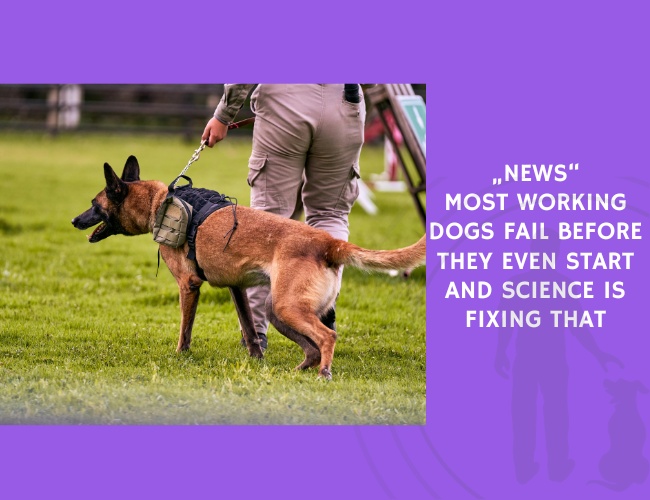
Working dogs are among the most trained, most evaluated, and most carefully selected animals in the world. And yet failure rates in working dog programmes remain high enough that the field has identified improving selection as one of its most urgent research priorities. A comprehensive review by six of the most prominent researchers in canine cognition science maps exactly where the current approach falls short and what the evidence supports as the path forward. 🐾
Researchers Emily Bray, C. Otto, M. Udell, Nathaniel Hall, Angie Johnston, and Evan MacLean reviewed the empirical literature on working dog selection, rearing, training, and breeding across the full range of working roles — assistance and service dogs, guide dogs, therapy dogs, detection dogs including search and rescue and explosives, and military and law enforcement dogs. Their conclusions carry implications that extend well beyond working dog programmes into how we think about dog selection, early development, and training effectiveness at every level.
Why Selection Matters More Than Training
The core problem the review addresses is that training a dog for a working role is an extremely resource-intensive process — taking months or years, requiring significant handler time, specialist expertise, and financial investment. When a dog fails to meet the behavioural criteria required for certification at the end of that process, the loss is substantial. And failure is not rare. Across working dog programmes, a significant proportion of candidate dogs do not complete training successfully.
The two approaches the review identifies as the most promising paths to improvement are selection and performance enhancement — and critically, they are not independent. Selection that identifies dogs most likely to succeed reduces the downstream training burden. Rearing and early development practices that improve performance expand the pool of candidates who can be successfully trained. Breeding approaches that increase the frequency of desirable traits in the candidate population shift the baseline from which selection operates. Each dimension compounds the others.
On selection specifically, the review summarises the evidence around early cognitive and behavioural testing as a predictive tool. Findings from multiple programmes suggest that specific cognitive capacities — inhibitory control, human-directed attention, problem-solving persistence, and social cognition — measured at relatively young ages show meaningful predictive validity for later working success. The challenge is that these relationships are task-specific, breed-specific, and role-specific. A test battery that predicts guide dog success does not automatically predict detection dog success, because the cognitive demands of the roles differ substantially.
What Rearing and Early Development Actually Change ⚠️
The rearing section of the review is where the implications for non-working dog owners become most direct. The empirical literature on early development in working dog candidates has produced some of the clearest evidence available on how the period between birth and approximately six months shapes the adult dog’s capacity for training, social engagement, and stress regulation.
Early enrichment, varied sensory exposure, structured handling, and consistent socialisation during the critical developmental window all show measurable effects on adult performance in working roles. These are not theoretical recommendations based on general learning principles. They are findings from controlled studies with outcome data tracking dogs from puppyhood through working certification or failure.
The review also addresses the breeding dimension — the possibility of selectively breeding for the cognitive and temperamental traits that predict working success. This is a longer-term intervention than selection or rearing, but the evidence suggests that the traits most predictive of working dog success are sufficiently heritable to respond to selective breeding pressure across generations. The combination of improved genetics, optimised rearing, and evidence-based selection represents the most comprehensive approach to the failure rate problem — and each element reinforces the others.
What the Working Dog Literature Reveals About Every Dog 🐕
The working dog research base is one of the richest sources of longitudinal, outcome-tracked evidence in all of canine science — precisely because working dog programmes have clear success criteria, large sample sizes, and the resources to track dogs from birth through years of performance. What it reveals about cognitive development, early experience, and training effectiveness applies far beyond the specialised roles these dogs fill.
A dog who grows up in an enriched, varied, consistently handled early environment arrives at training with a different nervous system architecture than a dog who did not. That difference is not a matter of natural talent. It is the measurable consequence of specific developmental inputs during a specific window. Owners who understand this are not just better positioned to raise their own puppies well. They are better equipped to understand the adult dog in front of them — including the ways in which early developmental gaps continue to shape behaviour and trainability years later.
At Zoeta Dogsoul, this is the developmental foundation on which NeuroBond is built. Attunement begins with understanding what shaped the dog before you met them — the rearing they received, the socialisation they did or did not have, the cognitive capacities that were developed or left underdeveloped during the window when they were most plastic. That understanding does not excuse current behaviour or make change impossible. It makes the path toward change more accurately mapped.
The Invisible Leash between dog and owner holds most reliably when it is built with knowledge of what the dog is actually bringing to the relationship from their earliest developmental history. Working dog science is producing that knowledge at a level of rigour that is now available to every owner willing to use it. 🐾










