
Koskela, Törnqvist et al. (2024) — Scientific Reports
Behavioral and Emotional Co-Modulation During Dog-Owner Interaction Measured by Heart Rate Variability and Activity
Published: July 21, 2026
The idea that dog and owner are emotionally in sync is something many owners feel intuitively. A study measuring heart rate variability in 29 dog-owner pairs during real interaction tasks has now produced physiological evidence for exactly that — and the pattern it reveals is strikingly comparable to what is found in human attachment relationships. 🐾
Researchers Aija Koskela, Heini Törnqvist, Miiamaaria Kujala, and their team measured heart rate variability and physical activity in dogs belonging to cooperative breeds and their owners across resting baselines and four positive interaction tasks: stroking, training, sniffing, and playing. They also collected survey data on owner temperament and the quality of the dog-owner relationship. The combined dataset allowed the researchers to examine not just whether synchrony existed, but under which specific conditions it appeared and what variables predicted it.
What Co-Modulation Actually Means and Why It Matters
Heart rate variability is not simply a measure of how fast the heart beats. It measures the variation between individual heartbeats — and that variation is a direct window into the state of the autonomic nervous system. Higher HRV generally reflects a nervous system that is flexible, regulated, and capable of responding adaptively to changing demands. Lower HRV reflects a system under stress or in a fixed activation state. In attachment research, the finding that two individuals’ HRV patterns synchronise during interaction is taken as evidence of genuine physiological emotional connection — the kind of co-regulation that characterises secure attachment in humans.
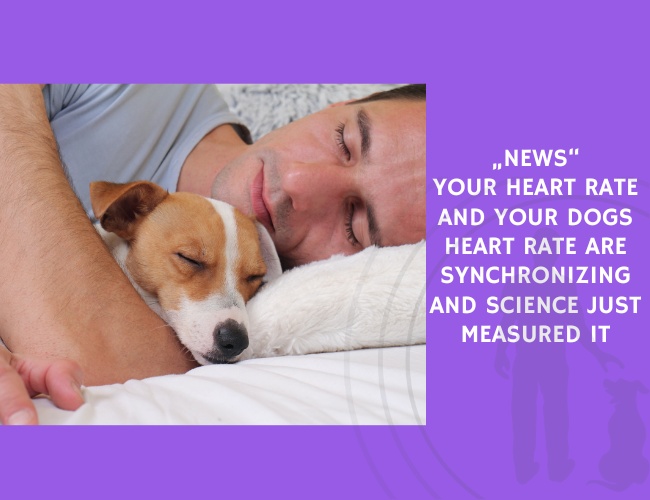
That is precisely what this study found in dogs and their owners. Overall HRV correlated between dogs and owners across tasks. Overall activity also correlated. The relationship was not incidental background noise. It was a consistent pattern of physiological co-modulation that the researchers explicitly describe as comparable to what is found in human attachment relationships.
The task-specific analyses added important nuance. HRV of dogs and owners correlated specifically during free behaving periods — the pre-baseline and post-baseline phases where no structured task was being performed. During predefined interaction tasks, it was activity rather than HRV that synchronised between dog and owner. This distinction suggests that the deeper autonomic synchrony happens during unstructured shared presence rather than during task performance — during simply being together rather than doing something together.
What Predicts the Synchrony and What Does Not ⚠️
The regression findings are where the study becomes most practically significant. Dog overall HRV was the only variable that predicted owner overall HRV — the dog’s physiological regulation directly predicted the owner’s. Not the other way around as one might assume. The dog’s nervous system state was the leading variable in the dyadic physiological relationship across this sample.
Dog HRV was predicted by four factors: dog height, ownership duration, owner negative affectivity, and the dog-owner interaction scale score. The ownership duration finding confirms that co-modulation deepens over time — the longer the relationship, the stronger the physiological synchrony. Owner negative affectivity — a trait reflecting the tendency toward negative emotional states — was associated with lower dog HRV, consistent with research showing that owner emotional regulation directly affects the dog’s physiological state. And the relationship quality measure predicted dog HRV independently of all other variables.
Dog height as a predictor is a more unexpected finding and likely reflects the body size and breed-related physiological differences that make HRV measurements more or less sensitive across dogs of different sizes — a methodological consideration rather than a relational one.
The Bond Is Not a Metaphor It Is a Measurable Physiological State 🐕
This research is the most direct physiological evidence yet for what NeuroBond describes. The attunement between dog and owner is not simply a behavioural pattern or an emotional impression. It is a measurable, real-time physiological state in which the autonomic nervous systems of two different species are modulating each other during shared presence. The bond has a heartbeat — literally two heartbeats, patterning toward each other across time.
The finding that the dog’s HRV predicts the owner’s — and not simply the reverse — is particularly significant. It places the dog’s nervous system state at the centre of the dyadic physiological relationship. An owner whose dog is in a chronic state of low HRV, elevated stress, or autonomic dysregulation is an owner whose own physiological regulation is being pulled in that direction. The dog is not a passive recipient of the owner’s emotional state. They are an active physiological partner in a co-regulatory system that runs in both directions.
This is the Invisible Leash at its most literal. It runs through the autonomic nervous system, through HRV patterns that synchronise during unstructured shared presence, through the accumulated physiological history of a relationship that has been building since the day dog and owner first met. It does not require a command, a training session, or even a look. It operates continuously, below conscious awareness, as a shared biological state. 🐾
Source: Koskela, A., Törnqvist, H., et al. (2024). Behavioral and emotional co-modulation during dog-owner interaction measured by heart rate variability and activity. Scientific Reports. Published October 24, 2024.










