
Bunford, Reicher et al. (2018) — Scientific Reports
Differences in Pre-Sleep Activity and Sleep Location Are Associated with Variability in Daytime/Nighttime Sleep Electrophysiology in the Domestic Dog
Published: July 19, 2026
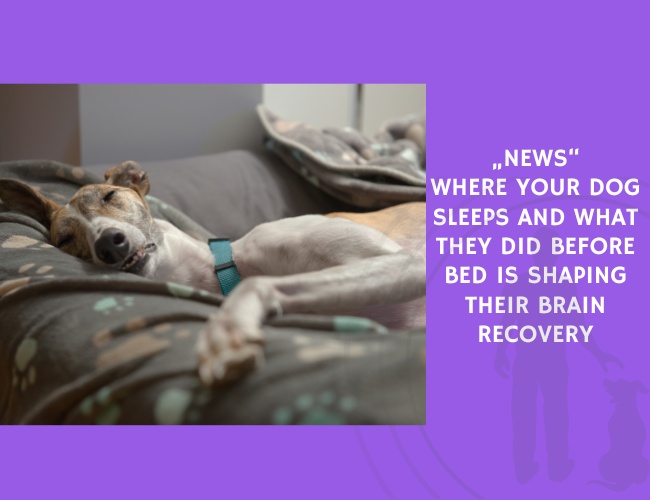
Most dog owners know their dog sleeps a lot. Far fewer think carefully about the quality of that sleep — and almost none consider how what happened earlier in the day, what time it is, and where the dog is sleeping are all actively shaping the neurological recovery happening during those hours. A study using sleep electrophysiology in 16 family dogs has now mapped exactly how these variables interact. 🐾
Researchers N. Bunford, V. Reicher, M. Gácsi, and their team used EEG-based sleep recording to assess how pre-sleep activity, time of day, and sleep location affected sleep macrostructure in dogs — measuring drowsiness onset, non-REM sleep, REM sleep, and wakefulness after first drowsiness across different conditions. Sixteen family dogs across ten breeds participated, ranging from 1.5 to 7 years old. The findings were consistent across all three variables — each one had measurable, independent, and sometimes interactive effects on how dogs slept.
What Physical Activity Before Sleep Actually Does
Following an active day, dogs slept more overall, entered drowsiness and NREM sleep earlier, and spent less time in drowsiness while spending more time in both NREM and REM sleep. This is a pattern directly parallel to what is seen in human sleep research: physical activity promotes deeper, more consolidated sleep with a shorter latency to restorative stages.
The effect was not uniform across conditions — activity interacted with both location and time of day, producing different patterns depending on where the dog slept and whether it was daytime or nighttime. This complexity matters for owners who may notice their dog sleeping differently in different circumstances and assume the variation is random. It is not. It is a measurable response to the specific combination of variables the dog is experiencing.
REM sleep is where the most neurologically significant recovery and consolidation happens — in dogs as in humans. Memory consolidation, emotional processing, neural maintenance: these are REM-dependent processes. A dog whose activity level, sleep timing, and sleep location are not supporting adequate REM is a dog whose neurological recovery is being compressed in ways that compound across days and weeks.
The Sleep Location Finding That Owners Need to Know ⚠️
Location had a direct main effect on REM sleep specifically. When dogs slept away from home, REM sleep following a first NREM episode was significantly less likely. Dogs in unfamiliar sleep environments did not transition as readily from NREM into REM — the deeper, more restorative sleep stage that requires a nervous system settled enough to move through the full sleep cycle.
This finding has immediate practical implications. A dog who travels regularly, who stays in kennels, who sleeps in unfamiliar locations for any reason, is a dog whose REM sleep is likely being reduced in those conditions. A single disrupted night is a minor issue. A consistent pattern of REM-reduced sleep across weeks of travel, boarding, or displacement accumulates into a meaningful physiological deficit — one that shows in behaviour, in arousal thresholds, in learning capacity, and in emotional regulation long before it is obvious to an owner as a sleep problem.
Nighttime sleep also produced better overall architecture than daytime sleep across the sample — dogs sleeping at night spent more time in NREM and REM and less time in drowsiness and post-sleep wakefulness. This is consistent with circadian biology and has implications for how owners structure their dog’s rest across the day rather than allowing entirely unstructured sleeping patterns.
Sleep as Foundation Not Background 🐕
At Zoeta Dogsoul, physical foundation is always part of the full picture of the dog we are in relationship with. Sleep is not downtime sitting passively alongside the relationship. It is the biological process through which the nervous system recovers from the day, consolidates what was learned, regulates emotional tone, and prepares the capacity for engagement and attunement that makes the following day’s interactions possible.
A dog who is not sleeping well — whether because of inadequate physical activity, disrupted location, poor sleep timing, or accumulated stress — is a dog arriving at each new day with a nervous system that has not fully recovered from the last one. That deficit is invisible in the sleep itself but shows in the quality of everything that follows: reactivity, learning speed, emotional regulation, and the kind of calm presence that NeuroBond depends on from both sides of the relationship.
Knowing that your dog’s sleep location matters neurologically, that an active day produces measurably better sleep architecture, and that nighttime sleep outperforms daytime sleep on every restorative measure — these are not minor lifestyle details. They are the physical substrate on which every interaction you have with your dog is built. The Invisible Leash runs through a nervous system. How well that nervous system is recovering overnight is part of what determines how much of the dog is available to you when morning arrives. 🐾
Source: Bunford, N., Reicher, V., et al. (2018). Differences in pre-sleep activity and sleep location are associated with variability in daytime/nighttime sleep electrophysiology in the domestic dog. Scientific Reports. Published May 8, 2018.










