
Murata, Liu & Watanabe (2025) — Behavioural Processes
Reading Emotions in Dog Eyes and Faces by Japanese Observers: A Replication and Extension Study
Published: July 15, 2026
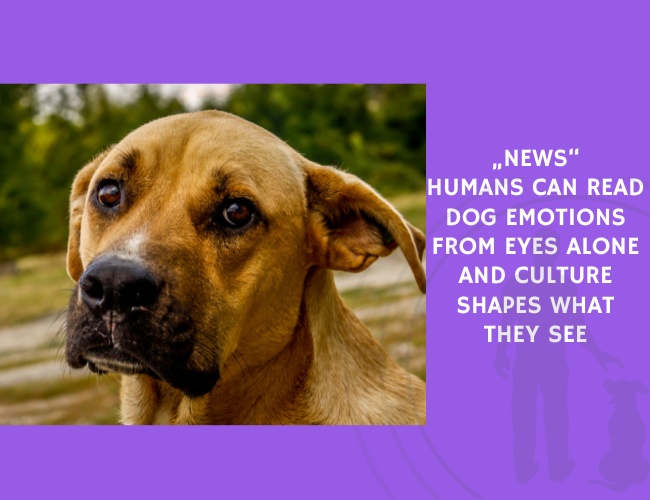
Can you read your dog’s emotional state from their eyes alone? A study of 342 Japanese participants has confirmed that humans can — at levels significantly above chance — and has uncovered something equally interesting: the specific emotions people identify most accurately are shaped by the culture they come from. Reading dog emotions may be a universal human capacity. But it is not a culturally neutral one. 🐾
Researchers Aiko Murata, Yu-Lin Liu, and Katsumi Watanabe replicated and extended previous work conducted in the United States and Brazil, testing whether the ability to read canine emotions from photographs generalises across cultures. Participants were shown photographs of three dog breeds in both full-face and eye-only conditions, then asked to identify the dog’s presumed emotional state. The Japanese context was deliberately chosen to test whether findings from Western populations held in a culturally distinct setting.
What Japanese Observers Could and Could Not Read
The core finding replicates the Western research: Japanese participants identified dog emotions at levels significantly above chance from both full-face images and eye-only images. The capacity to extract emotional information from canine facial cues appears to exist across cultural contexts, not only in populations with Western dog ownership norms and cultural frameworks around animals.
Full-face images produced notably higher accuracy than eye-only images, which is consistent with findings from prior studies and aligns with what we know about the role of broader facial context in emotion recognition generally. The eyes carry genuine signal. The full face carries more of it. Both are readable to human observers at above-chance levels.
Two findings challenged assumptions that many dog owners and researchers hold. Dog ownership had no effect on accuracy. Participants who owned dogs did not outperform non-owners in identifying canine emotional states from photographs. And the ability to accurately recognise human emotions did not predict performance with dogs, suggesting that reading canine facial emotions relies on distinct cognitive mechanisms rather than simply being an extension of general human emotion recognition skill.
Where Culture Made a Difference ⚠️
While the overall pattern replicated across cultures, cross-cultural differences emerged in which specific emotions were most accurately identified. Japanese participants did not show the same pattern of accuracy across emotion categories as participants from Western populations in earlier studies. Some emotions that were reliably identified in American and Brazilian samples were less accurately identified by Japanese participants, and vice versa.
The researchers frame this as evidence of cultural factors and perceptual biases shaping cross-species emotion interpretation. This is a significant qualification of the universality claim. The capacity to read dog emotions from facial cues may be broadly human. But which signals map to which emotional categories, and how confidently those mappings are made, appears to be at least partially shaped by cultural context — by what people have been taught to notice, what they have been exposed to, and what frameworks they carry for interpreting animal expression.
This also connects directly to the recent research on contextual and mood-based distortion in emotion reading covered here previously. The picture building across this body of work is consistent: human perception of dog emotional states is a real capacity, but it operates through multiple layers of bias, cultural framing, contextual influence, and cognitive mechanism that owners rarely account for when they believe they are simply reading their dog.
What Accurate Reading of Dog Emotions Actually Requires 🐕
The finding that dog ownership does not improve accuracy in this task is one of the most practically important results in the study. Living with a dog does not automatically develop the ability to read their facial emotional cues from photographs more accurately than someone who has never owned one. Exposure alone is not attunement. It is the quality and intentionality of that exposure that determines whether the signal is actually being read.
This is exactly where NeuroBond distinguishes itself from simply spending time with a dog. Attunement is a developed capacity, not an automatic product of cohabitation. The owner who actively learns to read their specific dog — their particular patterns, their individual expression of emotional states, the subtle differences between how this dog looks when genuinely relaxed versus merely still — is building something that generic exposure does not produce.
And the cultural dimension adds another layer worth sitting with. The frameworks we bring to reading our dogs are shaped by more than individual experience. They are shaped by what our culture has taught us to see in animal faces, what emotional categories feel natural to apply, and what signals feel salient versus invisible. The Invisible Leash runs more clearly when those frameworks are examined rather than assumed. 🐾
Source: Murata, A., Liu, Y.-L., & Watanabe, K. (2025). Reading emotions in dog eyes and faces by Japanese observers: A replication and extension study of Burza et al (2022). Behavioural Processes. Published August 1, 2025.










