
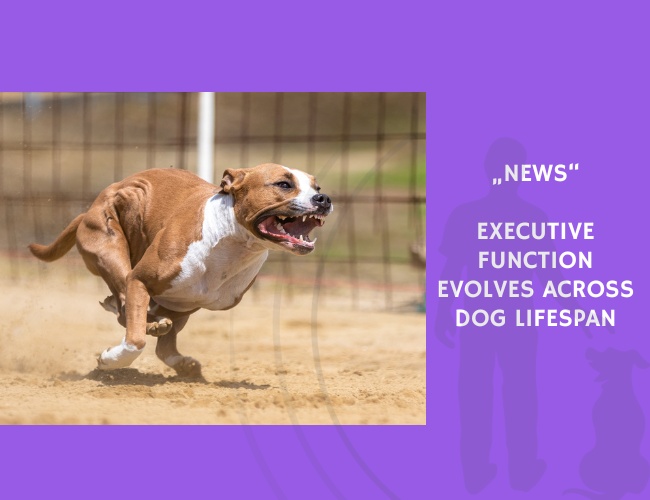
Just as in humans, a dog’s ability to self-regulate behavior depends on a suite of mental skills known as Executive Functions (EFs). These include inhibition (resisting impulses), working memory (holding and using information), and attention (sustaining focus). In a study published in Animals, Maike Foraita, Tammie Howell, and Pauleen C. Bennett examined how these abilities develop and decline throughout a dog’s life using the Dog Executive Function Scale (DEFS).
The researchers tested whether the DEFS, originally designed for adult dogs, could be applied to juvenile (<1 year) and senior (>8 years) dogs. Confirmatory factor analyses revealed that the same underlying EF structure applied across all age groups, showing that the same cognitive framework governs dogs’ self-control throughout life.
However, the study found that lifespan changes in executive function were complex. Working memory and attention toward the owner improved through early life but declined in old age, forming a U-shaped developmental curve. Meanwhile, different types of inhibition followed distinct trajectories—delay inhibition (the ability to wait) decreased with age, while motor regulation (control over physical responses) improved.
Beyond age, training experience and working status significantly influenced EF performance. Dogs that received more training, as well as working dogs, consistently scored higher on executive function measures. Interestingly, training history was more impactful in non-working dogs, likely because working dogs already undergo extensive cognitive conditioning as part of their duties.
The findings suggest that while aging influences cognitive flexibility and control, regular mental engagement through training can help maintain or even enhance executive function. Pet owners can therefore support their dogs’ cognitive health through ongoing enrichment and varied training activities, regardless of age.
Source: Foraita, M., Howell, T., & Bennett, P. C. (2023). Executive Functions as Measured by the Dog Executive Function Scale (DEFS) over the Lifespan of Dogs. Animals, 13. Published February 1, 2023.










